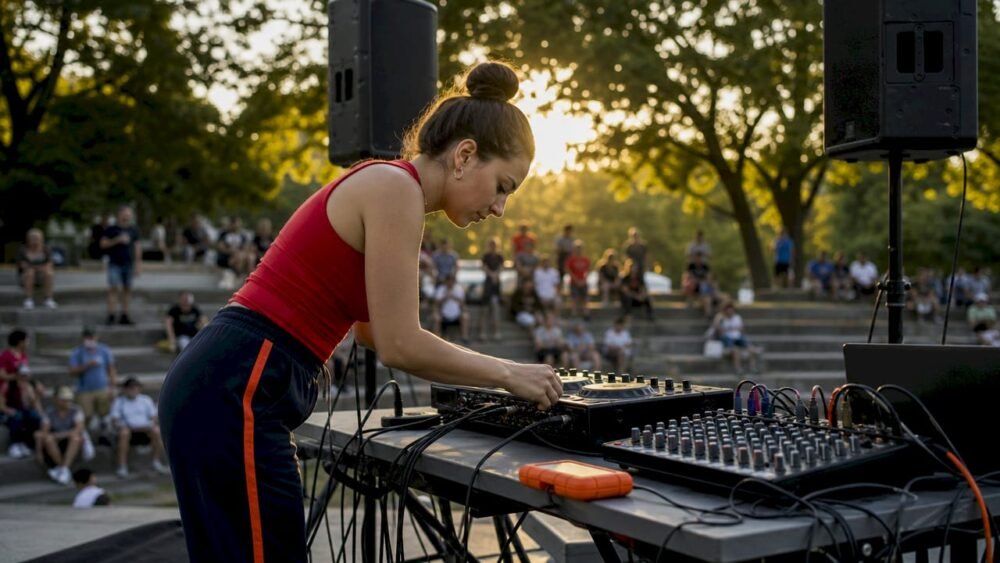
Sports event DJ equipment is defined as the specialised collection of audio control and sound reinforcement gear used to deliver music, announcements, and atmosphere with precision in sporting venues. Getting this right separates a forgettable afternoon from an event that genuinely energises athletes and spectators alike. The DJ setup for sports events differs fundamentally from a club or wedding rig because it must serve two masters simultaneously: high-energy music that builds crowd intensity, and crystal-clear speech for announcements and protocols. Dj-phoenix has worked with clients including FW Sports and Mercedes-Benz, and that calibre of experience confirms one truth. The right sports event DJ equipment, selected and operated with production awareness, is the foundation of every successful sporting event.
What are the essential components of sports event DJ equipment?
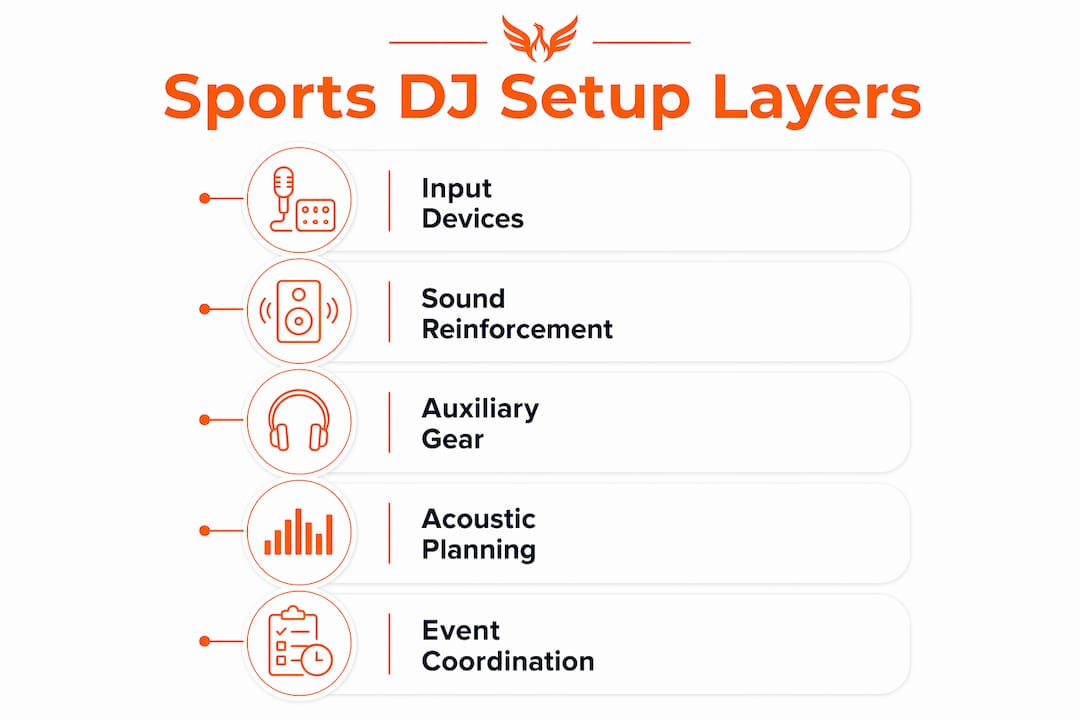
A professional sports DJ setup consists of three distinct layers: input devices, sound reinforcement hardware, and auxiliary support gear. Each layer carries specific responsibilities, and a gap in any one of them compromises the entire audio experience.
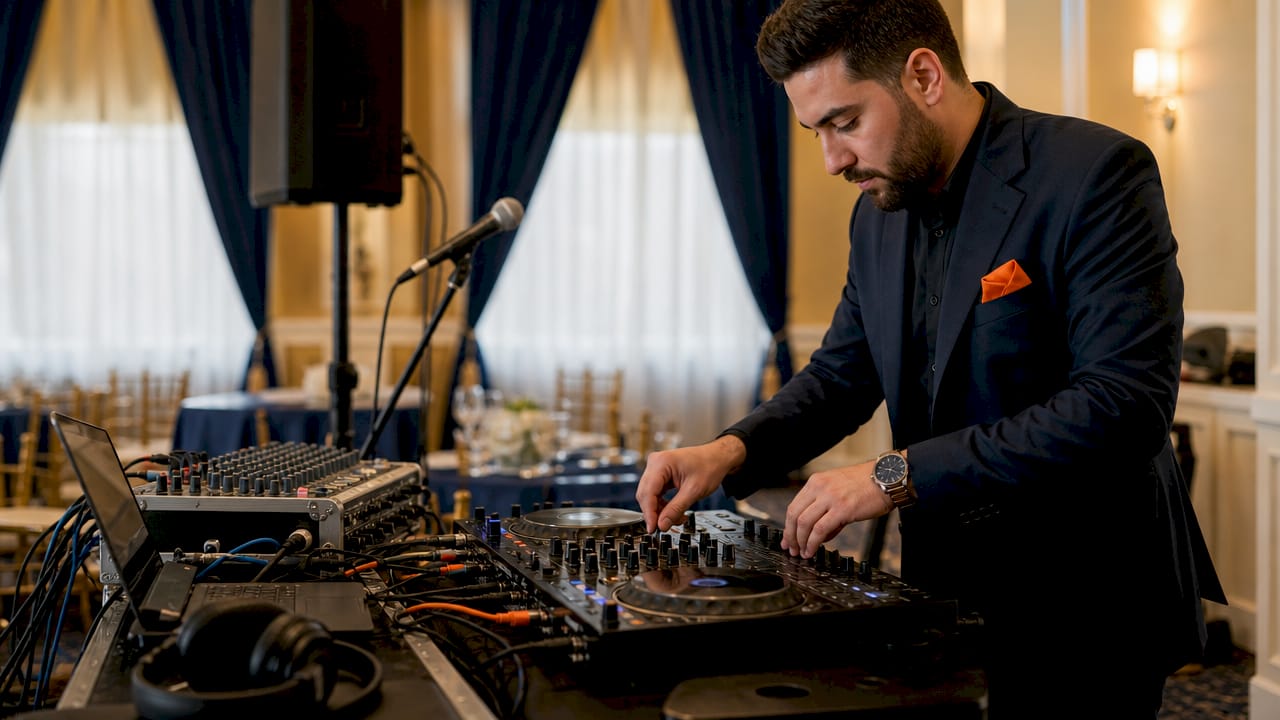
Input devices form the control centre of the rig. A DJ controller or standalone mixer processes all audio signals before they reach the speakers. A dedicated laptop running DJ software such as Serato or rekordbox stores and triggers the playlist. Many elite sports DJs carry a second laptop as a mirror backup, because a single point of failure at a live event is unacceptable.
Sound reinforcement is the most venue-dependent layer. The core components include:
- PA speakers: Full-range loudspeakers positioned to cover the audience area evenly. Line arrays work well in large arenas; point-source speakers suit smaller community venues.
- Subwoofers: These handle low-frequency energy for impact during high-energy moments. Controlled sub-bass use is critical. Overuse of sub-bass muddies acoustics and reduces speech intelligibility, which is the priority in any sports setting.
- Amplifiers: Passive speaker systems require dedicated amplifiers. Active (powered) speakers have amplifiers built in and reduce cabling complexity for smaller venues.
- Signal processors: Equalizers and digital signal processors (DSPs) shape the sound to suit the room’s acoustic properties.
Auxiliary gear completes the picture. Professional-grade closed-back headphones let the DJ monitor mixes without bleed into the venue feed. Wired and wireless microphones handle announcements and interviews. High-quality XLR cables, DI boxes, and a reliable audio interface connect every component cleanly.
Venue size dictates the scale of every choice. A community sports field with 500 spectators needs a very different audio equipment configuration than a 15,000-seat arena. Typical sports DJ setups are tailored to venue capacity, ceiling height, and surface materials.
Pro Tip: Always request a venue technical rider from the facility manager before finalising your gear list. Knowing the room’s dimensions and existing infrastructure saves significant setup time and prevents costly mismatches on event day.
How does the DJ setup adapt to the timeline and flow of a sports event?
Sports events follow a structured programme, and the DJ setup must mirror that structure precisely. Professional sports DJs begin building playlists approximately 6 months in advance, dedicating 10–12 hours daily near event time. That level of preparation reflects how tightly the audio programme is woven into the event’s fabric.
The operational timeline at a typical sports event runs as follows:
- Three hours before the event: Background music at moderate volume fills the venue as staff set up and early arrivals filter in. The DJ uses this window to test levels, confirm cue points, and verify communication channels with the production team.
- Two hours before: Energy builds progressively. The DJ shifts to a mid-tempo playlist that signals the event is approaching. Announcements about parking, seating, and concessions begin.
- The power hour: Music builds to a high-energy peak as the venue fills. This is the window for crowd-building tracks, team anthems, and sponsor acknowledgements. Volume increases deliberately, not abruptly.
- Thirty minutes before: Athlete introductions, national anthems, and official protocols require precise audio cues. The DJ coordinates directly with the emcee and production director.
- Ten minutes before kickoff: Music fades as the pre-match protocol begins. The structured timeline ends here, handing audio control to the event’s official programme.
DJ software and hardware controllers make these transitions fluid. Cue points, hot cues, and pre-loaded loops allow the DJ to respond instantly to a script change or an unexpected delay without audible disruption. Coordination with event production teams through earpiece communication or hand signals keeps every transition on time.
What technical challenges come with sound system setup in sports venues?
Sports venues present acoustic conditions that are genuinely hostile to clear audio. Large, hard surfaces such as concrete stands, metal roofing, and synthetic turf reflect sound in every direction. Stadium sound systems must contend with RT60 reverberation times of up to 5 seconds. That means a single spoken syllable continues to echo for five full seconds after it is produced, layering over the next syllable and destroying intelligibility.
The table below outlines the primary acoustic challenges and the equipment-based solutions that address each one.
| Challenge | Impact on audio | Equipment solution |
|---|---|---|
| High RT60 reverberation | Speech becomes unintelligible | Line array speakers with tight vertical dispersion |
| Uneven coverage | Dead spots and hot spots | Distributed speaker clusters or delay towers |
| Sub-bass buildup | Muddy low end, reduced clarity | DSP-controlled subwoofer crossover points |
| Background crowd noise | Masks announcements | Cardioid microphones with directional rejection |
| Outdoor wind interference | Signal dropout and noise | Windshield microphone covers, balanced XLR cabling |
Balancing energetic music with intelligible announcements requires active management. The DJ or sound engineer uses a DSP to apply high-pass filters during speech segments, reducing low-frequency energy that contributes to muddiness. During music segments, the full frequency range opens up for impact. Controlling low-frequency energy preserves the announcement clarity that sports events depend on for safety and coordination.
Sound systems for major sports venues require balancing speech intelligibility and energetic music delivery simultaneously. This is not a compromise. It is a design discipline that separates professional sports audio from amateur setups.
Pro Tip: Request a pre-event sound check at least 90 minutes before doors open. Walk the full spectator area with a radio and listen for dead zones. Adjust speaker angles or add delay speakers before the crowd arrives, not after.
What budget considerations and equipment redundancy matter for sports events?
Budget planning for sports event audio follows a clear spectrum based on event scale. Community sports event sound reinforcement packages typically range from $300 to $1,200 for a weekend booking. That figure covers a basic PA system, a DJ controller, and a single operator. Elite professional events command significantly higher investment, reflecting the complexity of the gear and the calibre of the operator.
Cost-effective equipment selection for coordinators working within tighter budgets involves several practical strategies:
- Prioritise the PA system. Speaker quality affects every attendee’s experience directly. Allocating the largest portion of the budget to sound reinforcement delivers the highest return.
- Rent rather than purchase for one-off events. Rental houses provide professional-grade gear at a fraction of ownership cost, and many include basic technical support.
- Carry essential backups. Backup playback devices including a second laptop, a USB audio interface, and spare XLR cables are non-negotiable. Equipment failure at a live event is not a question of if but when.
- Train a volunteer sound technician. A briefed volunteer who understands basic gain structure and cable connections can resolve minor issues without halting the event programme.
- Standardise on XLR connections. Consumer-grade RCA or 3.5mm connections introduce noise and fail under physical stress. Professional XLR cabling is the standard for a reason.
Budget allocation also affects redundancy planning. A coordinator who spends the entire budget on a single high-end speaker system with no backup has created a single point of failure. The professional approach splits the budget between primary gear and a reliable backup chain.
How can sports managers collaborate with DJs for smooth event execution?
Effective collaboration between sports managers and DJs begins well before event day. Veteran sports DJs emphasise production awareness as the defining skill that separates elite operators from competent ones. Production awareness means the DJ functions as a member of the broader event team, not as an independent performer.
Practical collaboration strategies for sports managers include:
- Share the full event script at least one week before the event. The DJ needs to know every cue, every announcement, and every timing marker to prepare the audio programme accordingly.
- Establish a communication protocol. Earpiece radios, hand signals, or a shared messaging channel between the DJ, emcee, and production director prevent missed cues during the live event.
- Approve the playlist in advance. Review the proposed track list for appropriateness, sponsor alignment, and audience demographics. A playlist built for a multicultural audience requires different curation than one for a single-demographic crowd.
- Schedule a technical walkthrough. Walk the venue together to identify speaker placement, cable runs, power supply locations, and potential interference sources.
- Assign a dedicated point of contact. The DJ should have one person to communicate with during the event. Multiple voices giving conflicting instructions create errors.
Dj-phoenix brings this level of production-integrated coordination to every sporting engagement, treating the audio programme as a component of the event’s overall production architecture. That philosophy, refined through work with clients of the calibre of FW Sports, reflects the pedigree that elite sports events demand. For coordinators building event venue partnerships, understanding the DJ’s role within the production team is as important as understanding the gear itself. You can also explore DJ playlist curation practices that professional DJs use to build sports event programmes with precision.
Key takeaways
A successful sports event audio programme requires specialised DJ equipment, acoustic planning, production awareness, and redundancy at every level of the signal chain.
| Point | Details |
|---|---|
| Equipment layers matter | Input devices, sound reinforcement, and auxiliary gear each serve a distinct function in the sports DJ rig. |
| Reverberation is the primary acoustic enemy | RT60 times up to 5 seconds in large venues demand line arrays and DSP-controlled signal processing. |
| Timeline integration is non-negotiable | The DJ programme runs from 3 hours pre-game to 10 minutes before kickoff, following a structured script. |
| Budget redundancy protects the event | Community packages range from $300 to $1,200; backup laptops and cables prevent single points of failure. |
| Production awareness defines elite DJs | The best sports DJs function as production team members, not independent performers. |
What I have learned about sports event audio after years on the floor
After working events at the calibre of FW Sports and Mercedes-Benz, the lesson that stands above all others is this: the equipment is only as good as the operator’s understanding of the room and the programme.
Coordinators often focus entirely on the gear list and overlook the acoustic reality of the venue. I have seen technically superior rigs underperform because nobody walked the room before doors opened. Conversely, I have delivered exceptional results with modest equipment because the setup was tuned to the specific reflections and dead zones of that particular space.
The second lesson is that production awareness is a discipline, not a personality trait. It requires reading the script, knowing every cue, and subordinating your musical instincts to the event’s timeline. The crowd does not know what you planned. They only experience what you deliver. When the national anthem cue arrives 45 seconds early because the athlete introduction ran short, the DJ who has internalised the script adapts without hesitation. The DJ who was focused only on the music stumbles.
My honest recommendation to every sports manager reading this: brief your DJ as thoroughly as you brief your emcee. The audio programme is not background support. It is a primary driver of crowd energy, and it deserves the same preparation time and operational respect as every other element of your event.
— Reza
Dj-phoenix: sports event audio expertise at your service
Dj-phoenix brings a refined approach to sports event audio that goes well beyond playing tracks. With a proven performance portfolio spanning elite corporate clients and high-profile sporting engagements, Dj-phoenix delivers a fully integrated audio programme, from pre-game atmosphere to post-match celebrations.
Every engagement includes professional-grade sound reinforcement, production-aware coordination with your event team, and a curated playlist built around your audience’s demographics and your event’s specific timeline. Dj-phoenix also offers tailored event packages designed to match the scale and budget of your sporting event. Connect with Dj-phoenix to discuss your next event and experience the difference that genuine sports audio expertise delivers.
FAQ
What is sports event DJ equipment?
Sports event DJ equipment is the collection of controllers, mixers, PA speakers, subwoofers, microphones, and cables configured to deliver music and announcements in sporting venues. The setup is tailored to venue size, acoustic conditions, and the event’s production timeline.
How early should a DJ begin preparing for a sports event?
Professional sports DJs begin playlist preparation approximately 6 months before the event, with daily preparation intensifying to 10–12 hours as the date approaches.
Why is sub-bass control important in sports venues?
Excessive sub-bass in reverberant venues muddies the acoustic environment and reduces speech intelligibility. Controlled low-frequency energy preserves the clarity of announcements, which is the audio priority at any sports event.
What budget should a coordinator plan for sports event DJ sound?
Community sports event sound packages typically range from $300 to $1,200 for a weekend booking. Larger professional events require significantly higher investment based on venue scale and equipment complexity.
How does a DJ coordinate with the event production team?
Production awareness is the core skill. The DJ follows the event script, responds to cues from the production director, and communicates via earpiece radio or hand signals to keep every audio transition aligned with the live programme.