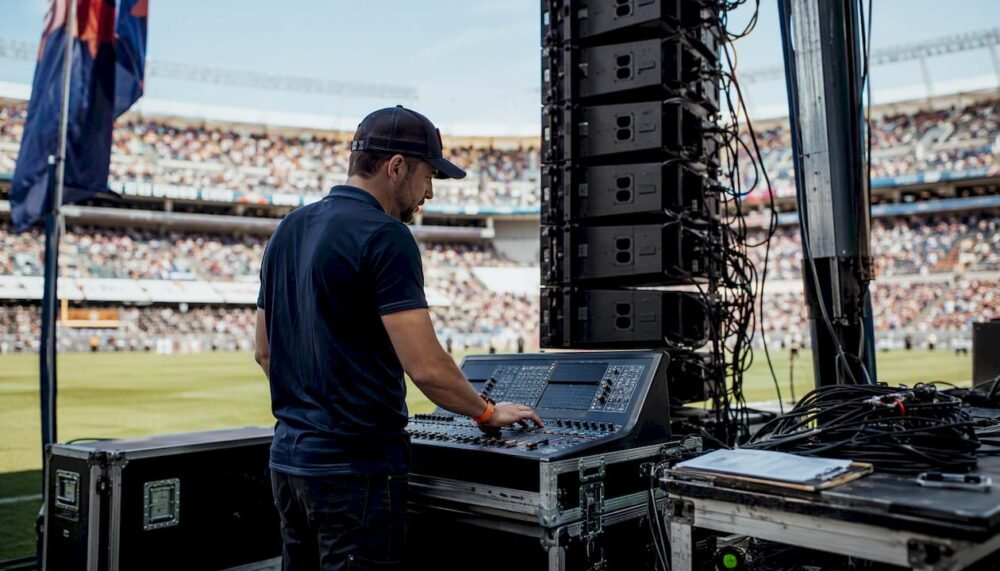
For outdoor stadiums, the best PA systems combine precision flown line arrays, matched subwoofers, networked DSP processing, and weatherproof delay fills across all zones. Book a site survey with a stadium-experienced provider and request Soundvision or equivalent coverage prediction files before committing to any equipment package.
Every credible outdoor stadium PA includes these core components:
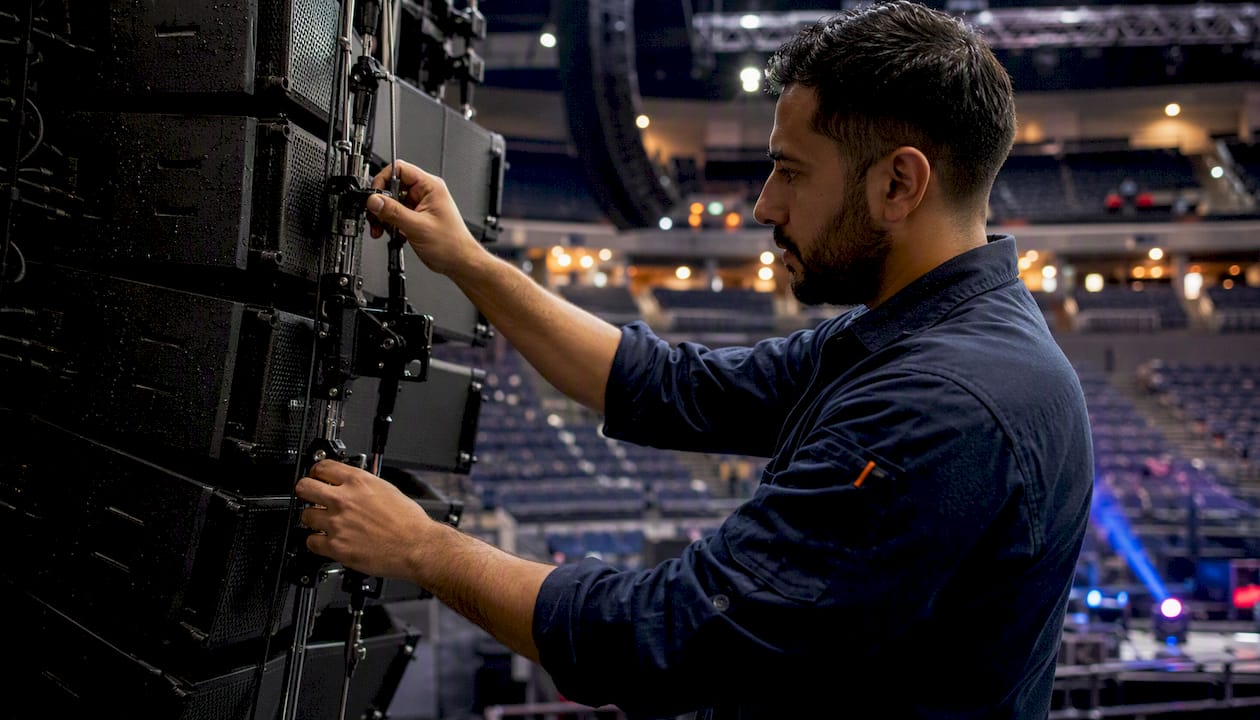
- Flown line arrays: main throw and controlled vertical coverage
- Subwoofers: low-frequency reinforcement for music and crowd energy
- Delay towers/arrays: extend coverage to far seating and preserve timing alignment
- Under-balcony and under-seat fills: coverage for sheltered zones
- Concourse, parking, and concession speakers: ancillary zone audio
- Front-of-house (FOH) console and I/O: signal routing and mix control
- Networked DSP and amplifiers: zone processing, EQ, and remote monitoring
- Monitoring, racks, and cabling: signal distribution and redundancy
Pro Tip: Require a measured Speech Transmission Index for Public Address (STIPA) target of ≥0.6 as a contractual deliverable. Ask vendors for prior test reports from comparable stadium installs before signing.
Table of Contents
- What does a stadium PA system actually include?
- Why coverage precision beats raw power in stadium sound
- Your checklist for evaluating PA rental and integration bids
- How to size a stadium PA and when modelling is mandatory
- How does a stadium PA integrate with touring and broadcast systems?
- What does stadium PA rental cost in Canada?
- Why hire a provider with stadium experience?
- Maintaining and troubleshooting outdoor stadium PA systems
- Which brands and models excel in outdoor stadium environments?
- How do you balance voice clarity and music playback in a stadium?
- Key takeaways
- What stadium sound has taught me about getting it right
- Dj-phoenix: stadium-capable sound for Canadian events
- Useful sources and further reading
What does a stadium PA system actually include?
A stadium PA is not a single product. It is an ecosystem of interdependent components, each assigned a specific acoustic role. Electro-Voice recommends using acoustically matched speaker models across seating, concourses, and ancillary areas, with IP-networked electronics for centralised control. That consistency is what separates a professional install from a patchwork of mismatched boxes.
Permanent installs typically include the flown arrays, rigging hardware, amplifier racks, and network infrastructure. Temporary or event-hire additions layer on top: touring consoles, stage monitors, broadcast splits, and supplemental delay towers. Understanding which elements are permanent and which are hired helps you ask the right questions when reviewing vendor quotes.
For outdoor use specifically, every enclosure must carry a weather-resistance rating. IP55 is a practical minimum for most Canadian climates; IP66 is preferable for exposed positions. Mounting hardware must be rated for wind loads and, in winter deployments, for ice accumulation.
Why coverage precision beats raw power in stadium sound
The single most consequential decision in stadium sound reinforcement is prioritising intelligibility over sheer SPL. Large outdoor bowls accumulate reverberation from hard surfaces, and neighbouring communities impose noise constraints. Adding more power without controlling where it lands makes both problems worse.
The L-Acoustics Allianz Arena install demonstrated this principle at scale, emphasising weight efficiency, precision of coverage, and intelligibility using Kara line-source elements and SB18 subwoofers. The design philosophy was coverage control first, SPL second.
STIPA of 0.8: The Boise State Albertsons Stadium K2 installation achieved a STIPA score of 0.8 across the bowl using compact K2 and Kara II arrays, improving intelligibility while reducing disruptive volume to neighbouring properties.
Directivity is the mechanism. A well-designed line array controls its vertical dispersion tightly, delivering consistent SPL from the front row to the upper deck without over-powering near seats or spilling energy onto reflective surfaces. Delay arrays preserve timing by aligning the acoustic arrival of the main system with the delayed signal, preventing the comb-filtering that destroys clarity.
Pro Tip: Request pre- and post-install STIPA measurement data from any vendor you are evaluating. A provider who cannot supply measurement files from a prior stadium project is not yet operating at the calibre this work demands.
Your checklist for evaluating PA rental and integration bids
Before signing any contract, require these deliverables in writing.
Pre-contract deliverables:
- Site survey report with venue dimensions, rigging point locations, and sightline analysis
- Coverage prediction files (Soundvision, EASE, or equivalent) with SPL contour plots and STIPA maps
- Rigging plan with load calculations signed by a qualified rigger
- Weatherproofing specification for all outdoor enclosures
- Power and distribution plan, including generator sizing if grid power is unavailable
- Audio network diagram showing DSP routing, IP addresses, and redundancy paths
Operational and event-day requirements:
- Load-in and line-check schedule with milestone times
- On-site technician headcount and role assignments
- Redundancy plan for amplifiers and critical network links
- Post-tuning STIPA measurement report delivered before doors open
- Handover documentation for venue staff
Compliance and safety:
- Municipal noise permits and any curfew restrictions
- Crane or hoist authority documentation for flown systems
- Wind-load and seismic restraint calculations where applicable
- Emergency paging integration confirmation with venue safety officer
The sports event DJ checklist published by Dj-phoenix covers the operational layer in detail and is worth reviewing alongside this technical list.
How to size a stadium PA and when modelling is mandatory
Use power and box-count rules of thumb only for early budget scoping. For any venue with complex geometry, long throws exceeding 60 metres, retractable or partial roofing, or televised broadcast requirements, detailed acoustic modelling is not optional.
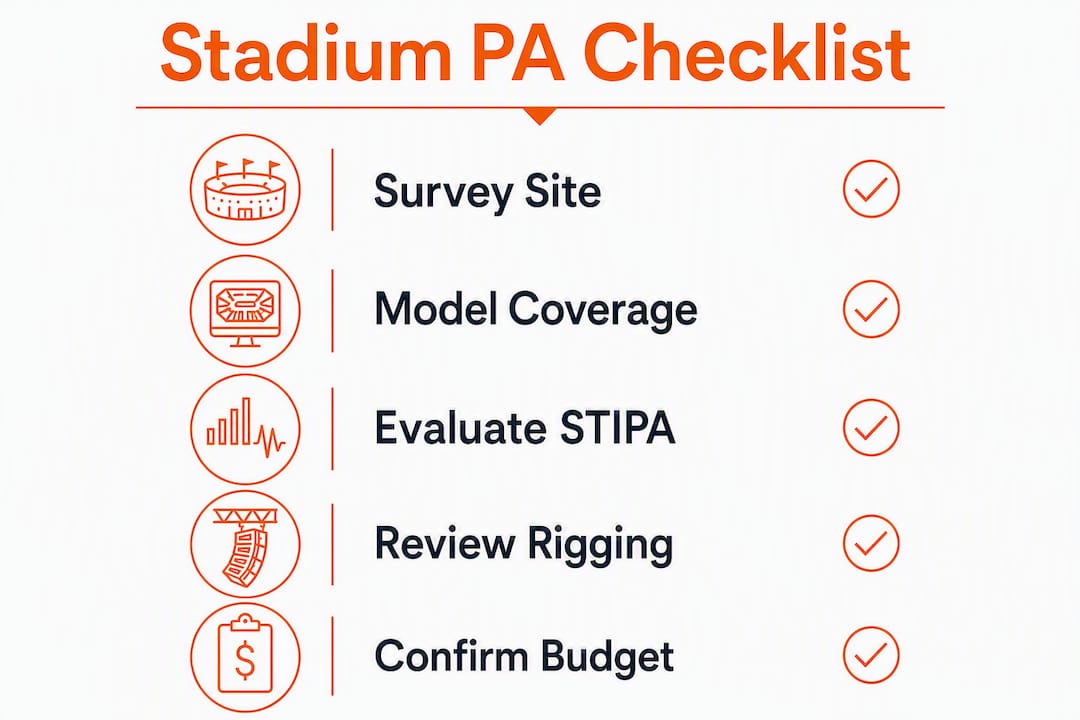
3D modelling software such as Soundvision validates coverage, intelligibility, and rigging constraints before any hardware is ordered. Rigging constraints are often the binding factor: some modern upgrades improve performance while reducing rig weight by up to 40%, which matters enormously in retrofit projects where structural load limits are fixed.
For smaller community or school stadiums, pre-configured packages can serve as a practical starting point. Larger or architecturally complex venues always require engineered solutions.
Pro Tip: Ask your vendor for expected STIPA maps and SPL contour plots as part of the design deliverable, not as an afterthought. If they cannot produce them, commission a different provider.
How does a stadium PA integrate with touring and broadcast systems?
A permanent stadium PA must function as a flexible hub, capable of acting as a delay extension for a touring rig or routing discrete feeds to broadcast trucks and temporary consoles. The Levi’s Stadium audio upgrade coordinated permanent infrastructure with temporary touring deployment for televised events, which is the standard expectation for any major Canadian stadium production.
Key integration points to confirm with your provider:
- FOH console split feeds: separate mixes for PA, broadcast, and stage monitors
- Digital audio networking protocol: confirm AVB, Dante, or Q-SYS compatibility across all components
- Clocking and sample-rate sync: mismatched clocking causes audible artefacts; confirm a single master clock source
- Latency targets: align delay compensation across all zones before the first line check
- Spare I/O channels: guest engineers for headline acts will need dedicated inputs and monitor sends
- Stage snake options: analogue or digital, with documented patch plans
Centralised networked control via platforms such as Q-SYS routes audio and monitors processing across all zones from a single interface, reducing configuration time and enabling remote diagnostics during an event.
What does stadium PA rental cost in Canada?
Costs vary considerably by venue size, rigging complexity, and event type. These are representative ballpark ranges for planning purposes only; actual quotes will differ.
- Equipment rental: $8,000–$40,000+ CAD per event, depending on system scale and zone count
- Rigging, crane, and labour: $5,000–$20,000 CAD, higher for complex flown systems
- Transport and logistics: $2,000–$8,000 CAD for out-of-city deployments
- Engineering, tuning, and measurement: $2,500–$8,000 CAD
- Permits and insurance: variable by municipality; budget $1,000–$3,000 CAD
- Contingency: 10–15% of total
A realistic planning timeline: site survey and quote in 2–4 weeks, detailed design and permitting in 4–8 weeks for complex installs, load-in and testing over 2–4 days, and final tuning the day before the event.
Factors that push costs higher include televised events requiring broadcast splits, long-throw requirements beyond 80 metres, winter deployments with ice-load rigging, and equipment sourced from out-of-province hires.
Why hire a provider with stadium experience?
Stadium-experienced providers bring design tools, rigging credentials, and measurement workflows that prevent the most costly mistakes. Accurate coverage predictions prevent under-powered zones. Correct load calculations prevent rigging failures. Tested redundancy prevents a single amplifier fault from silencing a section of the bowl.
“The most important thing we do before any stadium event is model the room. Every decision after that, from array length to delay timing, flows from what the model tells us. Guessing at coverage in a large bowl is how you end up with dead zones and noise complaints.” — acoustic design principle cited across major stadium installs by firms including Muller-BBM and WJHW.
Dj-phoenix brings this measurement-driven approach to Canadian events, with sports event equipment expertise documented for event coordinators. Ask any prospective provider for references from prior stadium or large outdoor venue work, and request the STIPA reports from those projects.
Maintaining and troubleshooting outdoor stadium PA systems
Outdoor systems degrade faster than indoor installs. Moisture ingress, UV exposure, and temperature cycling attack enclosure seals, driver surrounds, and connector contacts. A maintenance schedule should include quarterly inspection of all weatherproof seals, annual driver and transducer checks, and connector cleaning before every event season.
Common troubleshooting scenarios and their causes:
- Intermittent signal loss: most often a corroded XLR or Ethernet connector; inspect and clean all field connections
- High-frequency roll-off: damaged compression driver diaphragm or degraded HF horn seal
- Ground hum: earth loop between generator and venue power; use isolation transformers at the console
- Uneven zone levels: DSP routing error or failed amplifier channel; check network monitoring dashboard first
- Feedback during speech: microphone placed too close to a fill speaker; adjust delay timing or reposition the fill
For networked systems, IP-based remote monitoring allows technicians to identify a failed amplifier channel or a dropped network node before it becomes audible to the audience.
Which brands and models excel in outdoor stadium environments?
Several manufacturers have established a strong pedigree in outdoor stadium audio. L-Acoustics K2 and Kara II line arrays are among the most widely specified for large outdoor bowls, with documented STIPA performance and extensive rigging accessory ecosystems. The Bose ArenaMatch series, including the AMU208 with its IP55 rating and 126 dB peak SPL, suits mid-tier stadium fills and zone coverage. Electro-Voice and Dynacord components, combined in systems such as the Nevco Stadium Pro 3000, deliver concert-quality output from scoreboard-mounted configurations for venues of 10,000 seats or more. Pure Resonance Audio’s IP66-rated S10 loudspeakers offer a cost-effective option for community and school stadiums operating on 70V distributed systems.
For networked DSP, Q-SYS is the platform of choice for large multi-zone installs. Soundcraft Ui-series digital mixers provide Wi-Fi remote control for smaller event deployments. Shure QLXD wireless systems are the standard for reliable handheld and headworn microphone performance in outdoor environments.
How do you balance voice clarity and music playback in a stadium?
Voice intelligibility and music reproduction pull the PA system in opposite directions. Speech demands a flat, controlled midrange response and tight directivity to prevent reflections from masking consonants. Music demands extended low-frequency output, dynamic headroom, and a wider, more enveloping sound field.
The professional solution is DSP-driven preset switching. A well-configured networked processor stores separate EQ curves, compression settings, and level offsets for speech and music modes. Operators switch between them at the console or via the network interface. For announcements, a high-pass filter at 120–150 Hz and a presence boost at 2–4 kHz sharpens intelligibility. For music playback, subwoofer levels increase and the high-pass filter is removed.
The balance point also depends on the event type. A corporate awards ceremony weights heavily toward speech clarity. A concert or sports halftime show weights toward music impact. Designing the system with both modes in mind, and testing both before doors open, is the mark of a provider operating at an elite level.
Key takeaways
Outdoor stadium sound demands precision coverage, networked DSP control, and a measurement-verified STIPA target before any event goes live.
| Point | Details |
|---|---|
| Prioritise intelligibility | Require a STIPA target of ≥0.6 as a contractual deliverable, not a post-event aspiration. |
| Commission predictive modelling | Request Soundvision or EASE coverage files and SPL contour plots before approving any design. |
| Confirm integration points | Verify AVB/Dante/Q-SYS compatibility, clocking sync, and spare I/O for guest engineers before load-in. |
| Budget realistically | Equipment rental, rigging, engineering, and permits typically range from $18,500 to $79,000+ CAD for stadium-scale events. |
| Hire Dj-phoenix | Dj-phoenix delivers measurement-driven stadium sound rental and engineering for Canadian events, with sports-event credentials and documented equipment expertise. |
What stadium sound has taught me about getting it right
My work with stadium and sports events, including productions for clients of the calibre of Mercedes-Benz and FW Sports, has reinforced one conviction: the difference between a memorable event and a frustrating one is almost always decided in the design phase, not on event day. A system that has been modelled, measured, and tuned before the first guest arrives performs with a consistency that no amount of last-minute adjustment can replicate.
At Dj-phoenix, our approach is measurement-driven from the first site visit. We coordinate predictive modelling, specify matched equipment across all zones, and deliver on-site tuning with documented STIPA results. If you are evaluating providers for an upcoming stadium or large outdoor event, ask us for references and prior project documentation.
Dj-phoenix: stadium-capable sound for Canadian events
Dj-phoenix offers a calibre of sound system rental and event-day engineering that Canadian event organisers can rely on for stadium-scale productions. From site surveys and predictive modelling coordination to full PA rental with rigging and broadcast integration, the service is built around the precision and accountability that large outdoor venues demand.
Past productions for prestigious clients, including Mercedes-Benz and FW Sports, reflect the pedigree of execution Dj-phoenix brings to every engagement. Whether you are planning a corporate activation, a sports event halftime show, or a large private celebration in an outdoor venue, the corporate event services and event venue expertise on offer are designed for organisers who will not accept a compromised sound experience. Request a site survey or quote directly through dj-phoenix.com and receive a response within one business day.
Useful sources and further reading
The following sources informed the technical claims in this article and are recommended for organisers who want to verify specifications or brief their own acoustic consultants.
- L-Acoustics Allianz Arena customer story — best for understanding coverage-precision design philosophy and line-array selection rationale
- L-Acoustics Boise State Albertsons Stadium press release — best for STIPA benchmarks, Soundvision modelling workflow, and compact array rigging examples
- Electro-Voice stadium systems overview — best for matched-model zone design and IP-networked control product guidance
- FOH: Levi’s Stadium audio upgrade — best for permanent-plus-temporary system integration and televised-event complexity
- LSi Online: LD Systems NRG Stadium upgrade — best for retrofit weight-reduction benchmarks and Fulcrum-based system performance
- FOH: LD Systems Houston stadium upgrade — best for centralised Q-SYS networked processing and multi-zone delay array design
- Pro Acoustics stadium speaker systems — best for community and school-scale pre-configured package scoping
- Dj-phoenix sports event equipment guide — best for understanding DJ-side I/O requirements and equipment checklists for sports events
When briefing vendors, request the STIPA targets and prediction files cited in the L-Acoustics sources above as the benchmark standard your project should meet.