Make your do-not-play list, send it to every vendor in writing, and require written acknowledgement before the wedding day. That single action prevents more awkward moments than any other music decision you will make.
The most important step most couples skip: A do-not-play list with unlimited entries, delivered to your DJ, band, and venue manager at least one week before the event, with written confirmation that each vendor has read and accepted it, protects your celebration far more reliably than a carefully curated must-play list alone.
Three things to do right now:
- Draft your do-not-play list (no cap on entries) and share it with your DJ, band, and venue manager.
- Ask each vendor to confirm receipt in writing and to state who holds responsibility for SOCAN and Re:Sound licensing coverage.
- Book a pre-wedding consultation with your DJ, such as Dj-phoenix, to walk through timings, must-plays, and banned tracks together.
Key takeaways
A do-not-play list delivered in writing to every vendor, with written acknowledgement and a licensing clause in the contract, is the single most effective safeguard for your wedding music.
| Point | Details |
|---|---|
| Send the list early | Deliver your do-not-play list at least one week before the event so your DJ can load edits and prepare transitions. |
| Require written confirmation | Ask every vendor (DJ, band, venue AV) to confirm receipt and acceptance of the list in writing. |
| Include a licensing clause | Confirm SOCAN and Re:Sound coverage in your venue and DJ contracts before the wedding week. |
| Keep entries unlimited | There is no cap on do-not-play entries; categorising by theme preserves DJ flexibility while setting clear boundaries. |
| Dj-phoenix enforces the list | Dj-phoenix manages DNP enforcement, licensing checks, and on-night guest requests for weddings across Toronto, Montreal, and Ottawa. |
Table of Contents
- Why certain songs end up on every do-not-play list
- Songs that commonly appear on wedding banned lists
- How to build and deliver your do-not-play list to vendors
- Which songs to avoid at each wedding moment
- What Canadian couples need to know about music licensing
- Replacement songs that keep the moment alive
- Copy-and-paste templates for couples and vendors
- What actually enforces a do-not-play list on the night
- Dj-phoenix handles your do-not-play list so you don’t have to
- Sources
Why certain songs end up on every do-not-play list
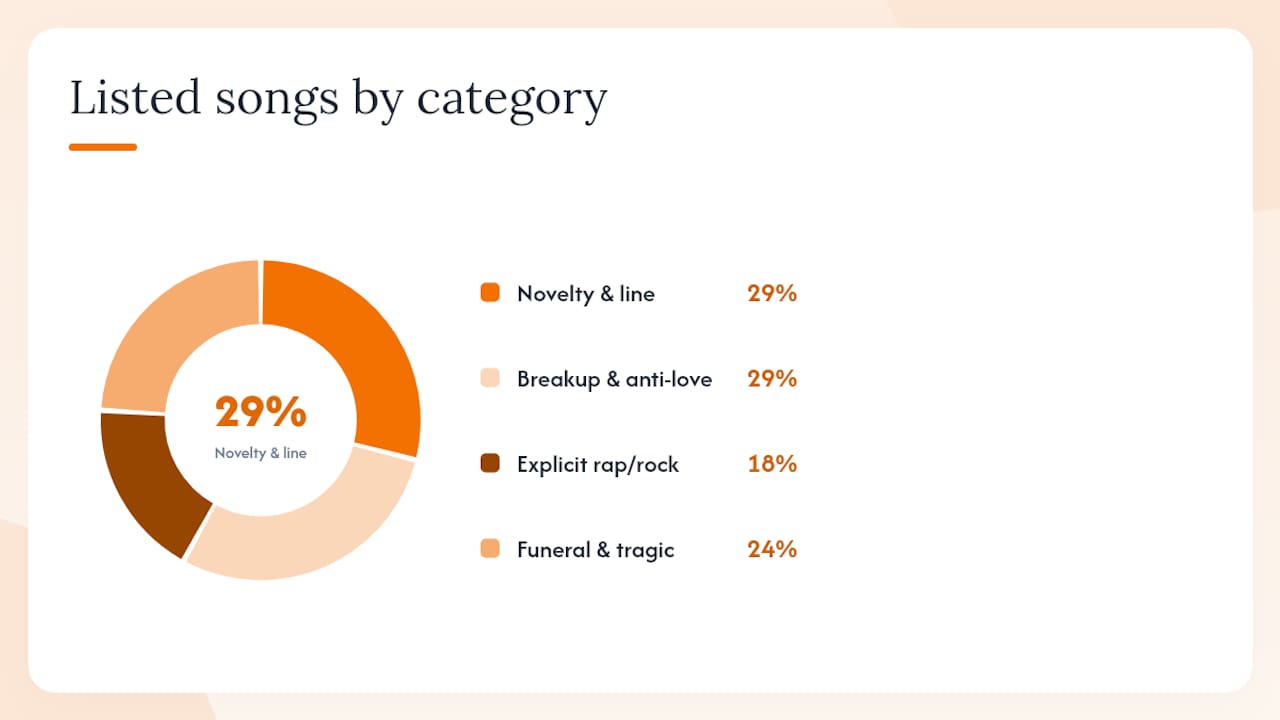
Understanding the categories helps you audit your own tastes quickly rather than combing through thousands of tracks one by one. The Knot’s guide to wedding songs to skip identifies several recurring problem types, and professional DJs across Canada echo the same groupings.
- Novelty and line-dance tracks. Songs like “The Chicken Dance,” “Macarena,” and “Y.M.C.A.” pull guests into choreographed routines that can feel forced and cheesy. They also signal a tonal shift that is hard to recover from. Swap suggestion: an upbeat singalong like “September” by Earth, Wind and Fire keeps energy high without the gimmick.
- Breakup, cheating, and infidelity anthems. “Before He Cheats,” “Gold Digger,” and “Irreplaceable” carry lyrical weight that clashes with a celebration of commitment. The subtext lands even when guests are not consciously listening. Swap suggestion: “Crazy in Love” or “All of Me” keeps the romantic intensity without the narrative baggage.
- Explicit sexual or violent lyrics. Tracks with graphic content are particularly problematic during dinner or when children are present. Swap suggestion: choose the radio edit or a clean version, and note that preference explicitly in your list.
- Songs tied to funerals or tragedy. “My Heart Will Go On,” “Angels,” and “Tears in Heaven” carry strong grief associations for many guests. Swap suggestion: “A Thousand Years” or “Can’t Help Falling in Love” delivers the same emotional weight without the mourning connotation.
- Ex-related or personally loaded songs. Only you know which tracks carry that history. Add them without explanation.
- Tempo and mood mismatches. Heavy EDM during dinner or a slow ballad mid-dance-floor peak disrupts the arc of the evening. Swap suggestion: work with your DJ on tempo ramps rather than sudden shifts.
- Long intros or outros. Some tracks have 90-second builds before the first lyric, which stalls momentum on a dance floor. Swap suggestion: request DJ-ready edits with clean entry points.
- Divisive cultural or political tracks. Songs that carry strong partisan or cultural associations can alienate segments of a diverse guest list. Swap suggestion: choose tracks with universal emotional resonance.
Songs that commonly appear on wedding banned lists
Brides’ catalogue of 32 songs couples routinely avoid organises tracks by theme, and the groupings below reflect what professional DJs across Canada see most often. Copy and paste this into your own document, then add personal entries.
Novelty and line dances
- “The Chicken Dance” (Werner Thomas)
- “Macarena” (Los Del Rio)
- “Y.M.C.A.” (Village People)
- “Who Let the Dogs Out” (Baha Men)
- “Cotton Eye Joe” (Rednex)
Breakup, cheating, and anti-love
- “Before He Cheats” (Carrie Underwood)
- “Gold Digger” (Kanye West)
- “Irreplaceable” (Beyoncé)
- “Since U Been Gone” (Kelly Clarkson)
- “You Oughta Know” (Alanis Morissette)
Explicit rap and rock singles (clean edits may be acceptable — note your preference)
- “WAP” (Cardi B)
- “Blurred Lines” (Robin Thicke)
- “Closer” (Nine Inch Nails)
Funeral and tragic associations
- “My Heart Will Go On” (Céline Dion)
- “Angels” (Robbie Williams)
- “Tears in Heaven” (Eric Clapton)
- “The Sound of Silence” (Simon and Garfunkel)
Personal additions (add songs tied to exes, family tragedies, or inside jokes only you would understand)
Pro Tip: There is no limit to how many songs you can add to your do-not-play list. A longer list does not handcuff your DJ; it actually gives them clearer boundaries to work within. Categorising entries by theme — “no line dances,” “no modern country” — preserves their flexibility to read the room while signalling your priorities clearly.
How to build and deliver your do-not-play list to vendors
A well-crafted list that never reaches your vendors is worthless. Follow this workflow to close that gap.
Building the list
- Brainstorm freely with your partner, then sort entries into the categories above.
- Add personal songs without explanation — your DJ does not need context.
- Note whether a clean edit is acceptable for any explicit track.
- Include Spotify or Apple Music links, or timestamps, for any track with a common cover version so there is no ambiguity.
- Cap your must-play list at 10–15 tracks to preserve DJ flexibility; keep the do-not-play list unlimited.
Delivering to vendors
- Send to: your DJ, live band (if applicable), venue AV manager, and videographer (they may use music in highlight reels).
- Format: a shared Google Doc or PDF with song title, artist, and optional link.
- Deadline: at least one week before the event, so your DJ can load edits and prepare transitions.
- Request written acknowledgement via email or a signed addendum to the contract.
Guest request policy
A three-tier approach works well on the night:
- Must-plays: locked in, non-negotiable.
- Approved requests: songs not on the DNP list that the DJ can use if the moment fits.
- Not tonight: anything on the DNP list, declined graciously.
A short script for your DJ: “That’s a great song — I’ll keep it in mind for later in the evening.” This acknowledges the request without committing, and without embarrassing the guest.
Pro Tip: If a family member pushes back on a DNP entry, the couple’s decision is final. Ask your DJ to hold the line politely and, if needed, refer the guest to you. A professional DJ treats the DNP list as absolute, not as a starting point for negotiation.
Which songs to avoid at each wedding moment
The do-not-play logic shifts depending on where you are in the evening. Applying it moment by moment keeps the soundtrack cohesive.
Ceremony
- Avoid: novelty tracks, anything with explicit lyrics, songs with strong pop-culture associations that pull attention from the moment (“Here Comes the Bride” in its original form can feel dated; “Crazy in Love” can feel too casual for a processional).
- Avoid: songs that are personally loaded for either family.
- Replacement direction: classical arrangements, acoustic covers, or orchestral versions of meaningful songs.
Cocktail hour
- Avoid: heavy bass or EDM, which competes with conversation.
- Avoid: slow ballads that deflate energy before dinner.
- Replacement direction: jazz standards, bossa nova, or light acoustic pop at moderate volume.
Dinner
- Avoid: tracks with explicit lyrics (children and older relatives are at the table).
- Avoid: sudden tempo spikes that interrupt conversation.
- Replacement direction: Motown, soul, or soft pop at a volume that allows easy conversation.
Dance floor
- Avoid: novelty line dances unless you have specifically requested them.
- Avoid: more than two slow songs in a row, which empties the floor.
- Avoid: viral meme songs that draw attention away from the couple and toward a group performance.
- Replacement direction: tempo ramps from 100 BPM upward, mixing decades to keep multiple generations engaged.
Last dance
- Avoid: breakup anthems or bittersweet tracks with ambiguous endings.
- Avoid: songs that fade out rather than ending cleanly.
- Replacement direction: a song with a definitive, celebratory close — “Don’t Stop Believin’,” “I Gotta Feeling,” or a personally meaningful ballad with a strong final note.
What Canadian couples need to know about music licensing
Music licensing in Canada involves two separate rights, and both matter at a wedding. Canada Wedding Guide’s breakdown of wedding music licensing advises resolving this during venue contract review, not in the week before the wedding.
The two key collectives
- SOCAN licences the composition (the song as written). SOCAN’s guidance on who pays for music confirms that venue operators must obtain performing rights licences for public gatherings, and that fees are an operational cost which may be passed to event renters.
- Re:Sound licences the recording (the specific recorded version). Re:Sound’s tariff pages outline per-event rates for receptions and similar events, organised by user group and event type.
- Entandem offers a combined SOCAN/Re:Sound licence, simplifying the process for venues and event organisers.
One important nuance: Queen’s University Library’s guidance on SOCAN and Re:Sound fees notes that internet radio is not covered by the radio exemption, and that specific tariffs — such as Tariff 8 for receptions — may apply depending on venue use and whether dancing is involved. Streaming a playlist from Spotify through a venue’s speakers is not automatically covered.
Action checklist for your venue and DJ contracts
- Ask the venue whether SOCAN and Re:Sound coverage is included in your rental fee, and who pays if it is not.
- Request itemised licence fee quotes for your event type and capacity.
- Require your DJ to warrant in writing that their music files and edits are from authorised sources.
- When multiple vendors are involved (DJ, live band, venue AV, videographer), list every location where music will play and mark each use as live, recorded, or both to avoid coverage gaps.
Sample contract clause:
Pro Tip: Ask your venue coordinator to confirm in writing which tariff number applies to your event. Tariff 8 is the most common for receptions with dancing, but the applicable tariff can shift based on capacity and event type.
Replacement songs that keep the moment alive
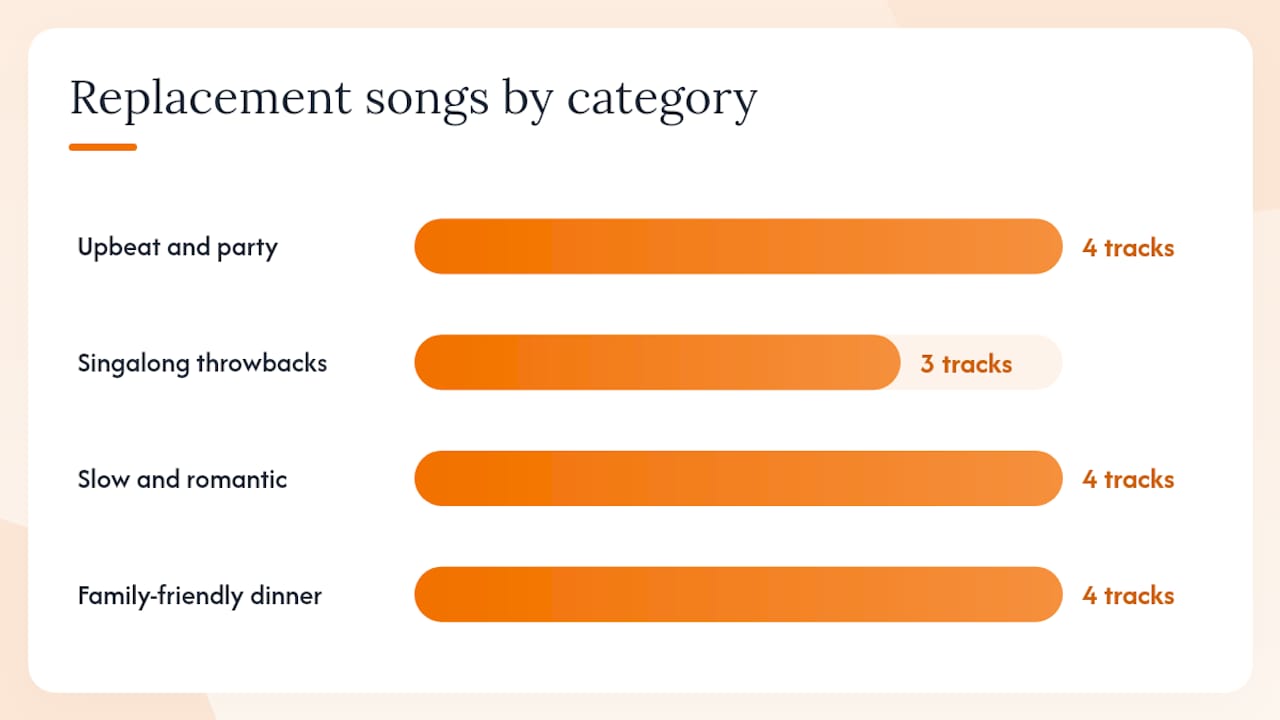
Removing a track from the playlist should never leave a gap in the emotional arc. These alternatives are DJ-ready, broadly crowd-pleasing, and appropriate for mixed-age Canadian wedding guests.
Upbeat and party
- “September” (Earth, Wind and Fire)
- “Uptown Funk” (Bruno Mars)
- “Can’t Stop the Feeling!” (Justin Timberlake)
- “Dancing Queen” (ABBA)
Singalong throwbacks
- “Don’t Stop Believin’” (Journey)
- “Sweet Caroline” (Neil Diamond)
- “I Want It That Way” (Backstreet Boys)
Slow and romantic
- “All of Me” (John Legend)
- “A Thousand Years” (Christina Perri)
- “Can’t Help Falling in Love” (Elvis Presley)
- “Make You Feel My Love” (Adele)
Family-friendly dinner
- “The Way You Look Tonight” (Frank Sinatra)
- “Fly Me to the Moon” (Frank Sinatra)
- “Thinking Out Loud” (Ed Sheeran)
For international or cultural songs, provide your DJ with a Spotify or Apple Music link and note the language and mood so they can place it at the right moment without disrupting the flow for guests unfamiliar with the track. Pair it with a brief emcee introduction if the song carries special significance. For a deeper look at multicultural wedding music, Dj-phoenix has a dedicated guide worth reading before your consultation.
Copy-and-paste templates for couples and vendors
Do-not-play list template
WEDDING DO-NOT-PLAY LIST
Couple: [Names] | Date: [Date] | Venue: [Venue]
CEREMONY — Do not play:
- [Song Title] by [Artist] | [Spotify link or timestamp]
COCKTAIL HOUR — Do not play:
- [Song Title] by [Artist]
DINNER — Do not play:
- [Song Title] by [Artist]
DANCE FLOOR — Do not play:
- [Song Title] by [Artist]
ALWAYS BANNED (any moment):
- [Song Title] by [Artist] | Reason: [optional]
CLEAN EDITS ACCEPTABLE FOR:
- [Song Title] by [Artist] — clean version only
Guest request policy (for DJ use on the night)
- Must-plays: confirmed in advance — play as scheduled.
- Approved requests: songs not on the DNP list — play if the moment fits.
- Not tonight: any DNP entry — decline with: “Great choice — I’ll keep that in mind for later.”
One-week-before music brief checklist
- Final must-play list (max 15 tracks) with Spotify links
- Final do-not-play list with any updates since the initial submission
- Event timeline (ceremony start, cocktail, dinner, first dance, last dance times)
- Emcee cues and announcements
- DJ and venue contact information confirmed
Vendor licensing clause (add to DJ or venue contract)
What actually enforces a do-not-play list on the night
The list itself is only as strong as the professional holding it. A skilled wedding DJ treats the do-not-play list as a firm boundary, not a suggestion, while still reading the room and keeping the energy where it needs to be. The artistry lies in honouring those boundaries without guests ever noticing the constraint.
There was an evening at a multicultural wedding where a well-meaning uncle requested a track that had been explicitly listed as off-limits — a song tied to a painful family history the couple had shared in confidence during the pre-wedding consultation. Because the list was in hand and the policy was clear, the request was declined graciously and a culturally resonant alternative was played instead. The uncle danced. The couple exhaled. That is what a properly enforced list looks like in practice.
The couples who get the best results are those who treat the DNP list as a collaborative document, built with their DJ during the pre-wedding consultation rather than emailed as an afterthought. The consultation is where context gets shared, edge cases get resolved, and the DJ earns the couple’s trust to make real-time decisions on the night.
Dj-phoenix handles your do-not-play list so you don’t have to
Planning a wedding in Toronto, Montreal, or Ottawa means coordinating multiple vendors, navigating SOCAN and Re:Sound requirements, and trusting someone to hold the line on your music preferences when a guest makes a request at 10 PM. Dj-phoenix brings the pedigree and the process: a structured pre-wedding consultation, a formal DNP enforcement protocol, and the experience to read a multicultural crowd while keeping every banned track off the floor.
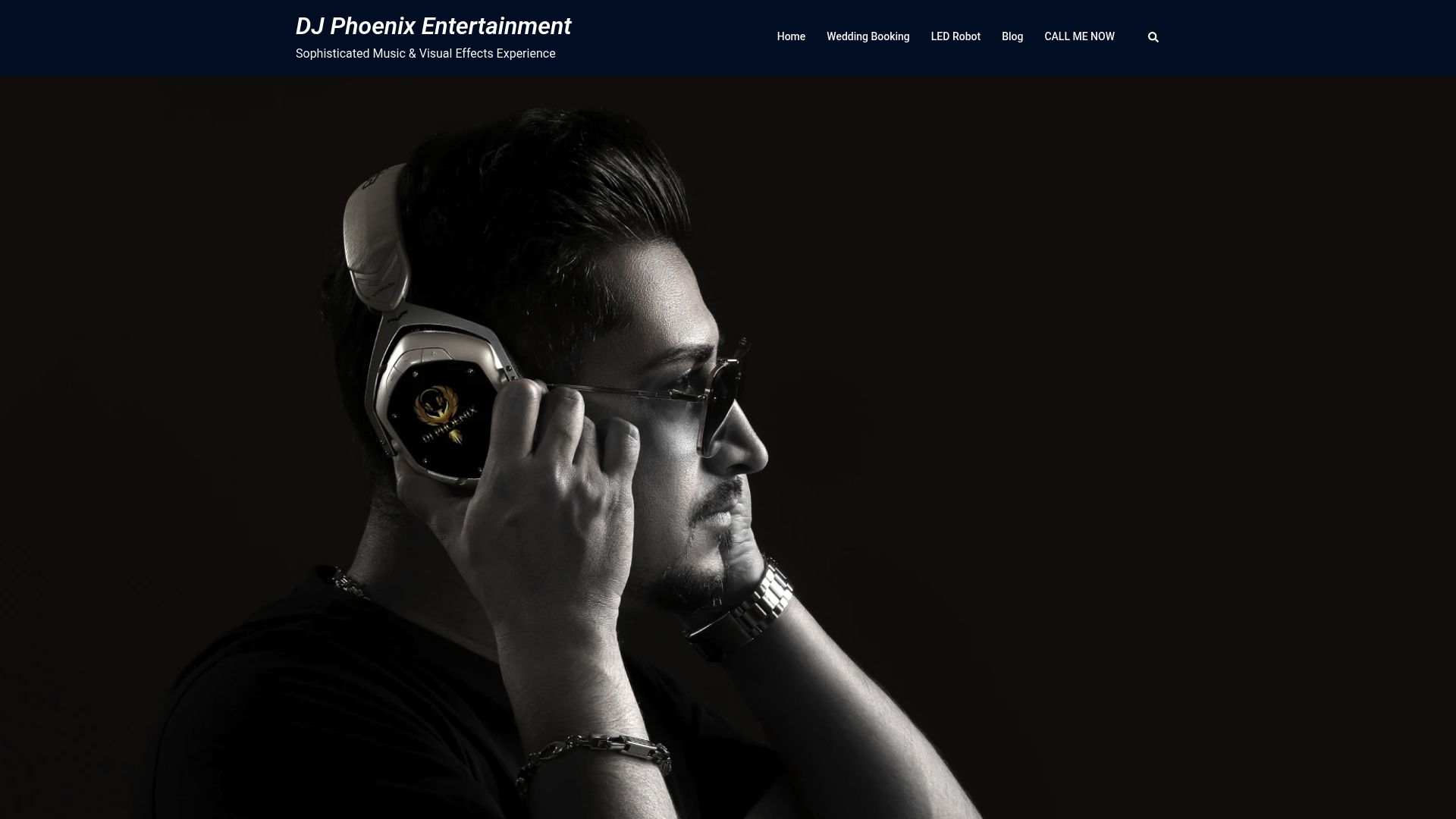
From the initial music brief to the last dance, Dj-phoenix manages licensing checks, vendor coordination, and on-night request handling with the calibre of service that prestigious clients like Mercedes-Benz have trusted. View the DJ performance gallery to hear the range and artistry firsthand, then book a consultation to walk through your must-plays, your banned tracks, and every moment in between.
Sources
- The Knot — wedding songs to skip
- Brides — 32 songs to avoid playing at your wedding
- Canada Wedding Guide — wedding music licensing (Canada)
- SOCAN — Who pays for music?
- Re:Sound — tariffs
This article is general information, not a substitute for advice from a qualified lawyer. Consult a qualified legal professional about your own circumstances before acting on anything here.