For corporate and large events, hire a professional DJ when you need live crowd reading, announcements and seamless pacing. Use a playlist system when music is purely background and budget is the priority. On the night, a DJ carries the responsibility for keeping the room moving. A playlist puts that responsibility squarely on whoever you assign to babysit the laptop.
The strongest reasons planners lean one way or the other come down to three things:
- Crowd reading: a DJ adjusts tempo and genre in real time based on how the room is actually behaving, not how you predicted it would behave.
- Announcements and timing: award presentations, sponsor shout outs and program transitions need a live voice, not a queued track.
- Reliability under pressure: a professional brings redundancy and problem-solving instincts a playlist cannot.
If you’re hiring a DJ, confirm the microphone plan and run-of-show timeline this week. If you’re going the playlist route, assign a named technical lead now and test your backup device before the event, not during it.
Key takeaways
A professional DJ earns its cost by absorbing live responsibility for timing, transitions and crowd response that a playlist system structurally cannot provide.
| Point | Details |
|---|---|
| Match music to event goal | Hire a DJ for programs needing announcements or dancing; use a playlist for pure background settings. |
| DJs own the risk | A DJ absorbs technical and pacing responsibility that otherwise falls on a designated staff member. |
| Playlists need real ownership | Assign a technical lead, download tracks locally, and test backup devices before doors open. |
| Hybrid saves budget without losing control | Run a playlist through dinner, then hand off to a DJ for the program’s live segments. |
| Dj-phoenix fits corporate handoffs | Dj-phoenix builds curated, multicultural-ready sets and manages live transitions for corporate clients including Mercedes-Benz and FW Sports. |
Table of Contents
- Corporate DJ vs playlist system: weighing the operational trade-offs
- How do you decide between a DJ and a playlist for your event?
- What do setup, equipment and pricing actually look like?
- Can you combine a DJ and a playlist system?
- What does a working DJ actually check before a corporate booking?
- Tools and reading for planners building either option
- Why the “just make a playlist” advice undersells corporate stakes
- Book a DJ who treats corporate events as production, not playback
- Frequently asked questions
- Sources
Corporate DJ vs playlist system: weighing the operational trade-offs
The comparison isn’t DJ versus laptop. It’s live judgement versus fixed programming, and each has a real cost.
Why planners hire a professional DJ
- Live energy control. A DJ reads dance floor engagement, guest age mix and even alcohol service pace, then adjusts the set in real time. A playlist, however cleverly built, can’t respond to a room that’s flatter than expected at 8:45 pm.
- Emcee and announcement duties. Award ceremonies, executive remarks and sponsor recognitions need someone who can hold a microphone, read a teleprompter cue, and glide back into music without dead air.
- Seamless transitions. Beatmatching and phrasing between tracks is a skill, not a setting. Industry explainers on the DJ versus playlist decision consistently point to this as the difference guests notice most, even if they can’t name it.
The trade-offs are real too. Professional DJ fees run in higher bands than a Bluetooth speaker and a Spotify account, scheduling a DJ months out requires lead time, and stylistic fit varies from one performer to the next, so vetting matters.
Why planners choose a playlist system
Cost efficiency is the obvious draw. A playlist system costs whatever your streaming subscription and speaker rental run, full stop. It’s also predictable: what you build is what plays, with no risk of a DJ misreading the room. And it hands the client full creative control over exactly which forty tracks get airtime.
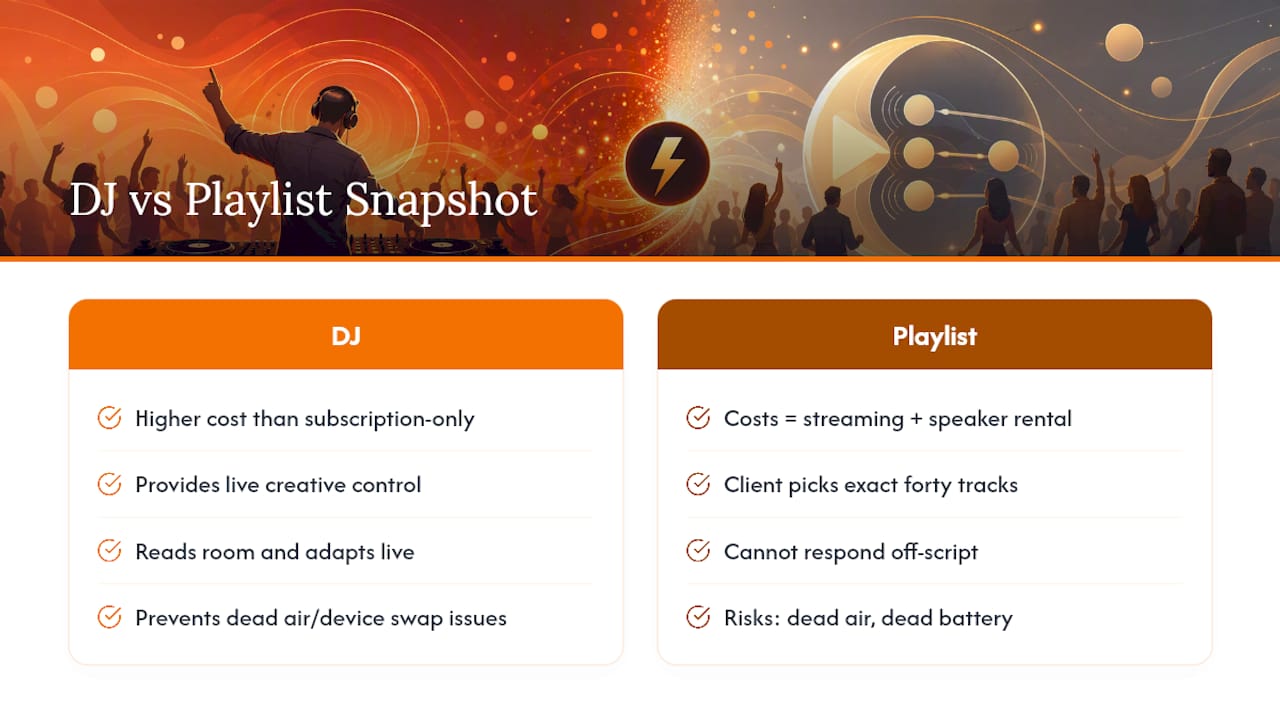
The downside shows up the moment something goes off-script. Playlists can’t respond to a stalled agenda, a late keynote, or a dance floor that needs a mood shift. Someone still has to own the technical setup, and rough transitions between tracks (a jarring genre jump, an abrupt fade) are common failure points. The most frequent breakdowns are dead air during a device swap, a dead battery mid-event, and a playlist that never accounts for the pause when the CEO steps up to speak. A DJ mitigates every one of these simply by being present and paying attention.
Pro Tip: If cost is the deciding factor, ask a DJ for an “essentials” package covering only the highest-risk hours (arrival and program) rather than the full evening. You get live control where it matters most and save on the quieter stretches.
How do you decide between a DJ and a playlist for your event?
Start with the event’s actual objective, not its budget line. A networking reception, a formal awards dinner and a product launch after-party all demand different things from your music.
- Match format to goal. Pure networking tolerates background music; a formal programme with speeches needs live pacing; a celebration or after-party benefits from a DJ who can build energy.
- Know your guest mix. A multigenerational or multicultural guest list has wider musical expectations than a single-department team event, and a DJ can pivot genre far faster than a pre-built list.
- Check venue sound constraints. Some venues cap decibel levels or restrict outside audio equipment, which affects whether a playlist setup is even viable without professional gear.
- Weigh timeline complexity. If your run-of-show has variable timing (a keynote that might run long, an awards segment with unknown pacing), you need someone who can stretch or compress music live.
- Calculate true cost, not sticker price. A playlist looks cheaper until you count staff hours spent building it, testing it, and monitoring it during the event; that’s paid labour too, just not itemized as one.
LiventGroup’s planning framework recommends hiring a DJ specifically when the experience needs to be curated live to shape how guests move through the evening. Before you finalize either route, get explicit sign-off from whoever owns the event budget, and name one person as responsible for music on the night, whether that’s a DJ’s contract or your own staff member.
What do setup, equipment and pricing actually look like?
A professional DJ typically arrives with a full sound system, wireless microphones, backup laptops, redundant power, and often lighting, all tested well before doors open. A playlist host needs to supply or rent their own speakers, a stable device, a backup device, and a plan for who manages volume as the room fills and empties.
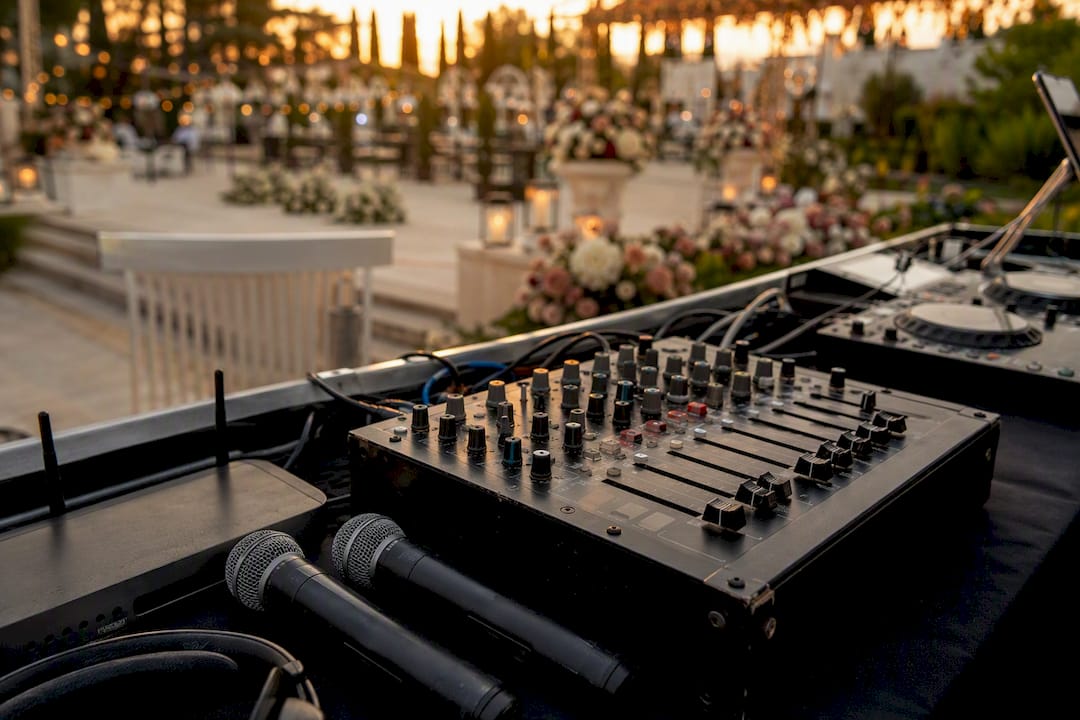
Soundcheck for a DJ usually happens sixty to ninety minutes before guest arrival, with mic checks for any speaking segments built into that window. Planners running their own playlist should budget similar prep time, since testing venue Wi-Fi, Bluetooth range, and volume zoning takes longer than most hosts expect.
Cost drivers for DJ services scale with hours booked, travel distance, whether emcee duties are included, and whether the event needs multi-room audio coverage. Reviewing sound system rental costs and sample packages gives a realistic sense of how these pieces add up before you request quotes.
For a DIY playlist setup, the operational checklist looks like this:
- Download every track locally; streaming apps can drop connection at the worst moment.
- Test the exact device and cable you’ll use on-site, not a similar one at home.
- Assign volume zoning so networking areas and the dance floor aren’t fighting the same mix.
- Have a second device pre-loaded and charged as a backup, not an afterthought.
Can you combine a DJ and a playlist system?
Yes, and it’s often the smartest budget move available. The common hybrid pattern runs a curated playlist during arrival and dinner, when Eventbrite’s guidance on matching music to event phases suggests lower-energy, conversational tracks, then hands control to a live DJ once the program shifts into dancing or announcements.
- Export the dinner playlist ahead of time using a tool built for handoff, such as RemixCRM’s DJ-ready export formats, so the DJ can pre-analyze tracks and build cue points rather than scrambling live.
- Set a specific handoff minute in the run-of-show (for example, “DJ takes the booth at 8:30 pm sharp”) and name who confirms that transition happens.
- Rehearse the handoff moment if the event includes a formal announcement right after the switch.
Pro Tip: Build the dinner playlist collaboratively with PartyMusicPlaylist’s event playlist creator, which lets you collect guest input and export a DJ-ready file in one step, so your DJ isn’t guessing at your crowd’s taste.
What does a working DJ actually check before a corporate booking?
Reza has watched a stalled playlist kill momentum at a product launch, and watched a well-timed genre pivot save a flat networking hour more than once. Sound level matters as much as song choice: networking segments sit quieter, around conversational volume, while dance segments need enough presence to shift a room’s energy without drowning out nearby speech.
Three things get confirmed before any corporate booking is locked in:
- Full setup and equipment list, matched against the venue’s power and space.
- A written microphone plan for every speaking segment.
- A signed-off timeline agreement, including who has final say on last-minute changes.
Nobody remembers a playlist that worked. Everybody remembers the ninety seconds of dead air when a device died and nobody knew who was supposed to fix it.
Tools and reading for planners building either option
- RemixCRM’s Spotify integration for DJ-ready export workflows.
- PartyMusicPlaylist for collaborative playlist building.
- Eventbrite’s playlist guidance for corporate event phases.
Why the “just make a playlist” advice undersells corporate stakes
Most general advice on this topic treats music as an amenity, something nice to have rather than something that carries operational risk. That framing works for a backyard barbecue. It falls apart the moment your event includes a CEO speaking, an awards segment with unpredictable timing, or a room of guests from wildly different cultural backgrounds who each expect something different from the dance floor.
The research consistently backs one judgement: the deciding factor isn’t budget, it’s who owns responsibility when something changes mid-event. A playlist can sound identical to a DJ’s set for the first twenty minutes. What it can’t do is notice the room has gone quiet and fix it in real time.
If you take one thing from this comparison, prioritize mapping your event’s actual pressure points (live announcements, unpredictable timing, guest diversity) before you compare price tags. Budget conversations should happen after that mapping, not instead of it.
Book a DJ who treats corporate events as production, not playback
Dj-phoenix gives corporate planners something a pieced-together playlist setup structurally can’t: one accountable professional handling live transitions, microphone duties, and crowd reading, so nobody on your team is troubleshooting audio during a keynote.

Where a DIY playlist asks your staff to double as sound techs, Dj-phoenix arrives with tested equipment, a rehearsed run-of-show, and experience curating for multicultural corporate guest lists, having handled bookings for clients including Mercedes-Benz and FW Sports. That track record matters most exactly where playlists struggle: award segments, executive remarks, and rooms where guest musical tastes vary widely.
If your event includes any live program element, start by reviewing Dj-phoenix’s corporate DJ services in Toronto and request a quote based on your run-of-show, not a generic hourly rate.
Frequently asked questions
Is a playlist system ever the right call for a corporate event?
Yes, for purely background settings like a quiet office reception or a small internal meeting where no announcements or dancing are planned. Once your event includes a program, awards, or a dance floor, live judgement starts to matter more than cost savings.
How much more does a DJ cost compared to a playlist system?
Pricing depends on hours booked, travel, and whether emcee duties are included, so there’s no single number that applies everywhere. A useful way to compare is to add up the staff hours a playlist setup actually requires, since that labour has a real cost even when it’s not itemized.
Can one person manage both a playlist and live event duties?
Technically yes, but it’s risky. Whoever owns the playlist needs to be dedicated to that task during the event, not also managing check-in, catering, or the run-of-show.
What’s the biggest technical risk with a playlist system?
Device failure and connectivity loss are the most common failure points, followed by nobody being assigned to manage volume as the room fills. A tested backup device and a named technical lead solve most of this.
Does a hybrid approach actually save money?
Often, yes. Running a playlist through arrival and dinner, then bringing in a DJ only for the program and dance segments, cuts DJ hours without losing live control exactly when you need it most.
Sources
- RemixCRM docs — Spotify integration
- PartyMusicPlaylist — event playlist creator
- Event DJ vs playlist — Gatwicksound Photobooth