Yes, tipping your wedding DJ is optional but widely expected, and the industry-standard baseline is straightforward: plan for $50 to $150 for a typical reception. That figure comes from The Knot’s tipping guide, the most commonly cited benchmark for US couples. A second useful check is percentage-based tip of roughly 10 to 15% of your contracted DJ fee, which scales the tip to match what you actually spent. Additional crew members, such as a lighting tech or a second operator, typically receive $20 to $50 each.
Before you set aside a single dollar, open your contract. Some DJ companies already bake a service charge or mandatory gratuity into the invoice, and Zola’s vendor tipping guide confirms that when that line item exists, an extra cash tip is not required. A short thank-you note or a public review still goes a long way.
Here’s the cheat sheet in full:
- Standard tip: $50 to $150 for a solo DJ who delivered a solid, professional set
- Percent check: a percentage roughly between 10 and 15% of the total DJ fee, which is useful when your budget runs above or below average
- Crew tips: $20 to $50 per additional technician, assistant, or second DJ
- Contract clause: if gratuity is already included, skip the extra cash and consider a review instead
Quick stat: Couples who tip across a typical vendor lineup, DJ included, often add $500 to $1,500 to their overall wedding budget for gratuities, and choosing the best tequila for weddings can also enhance your reception experience. Building that line item into your budget early prevents a scramble on the day.
Key Takeaways
| Point | Details |
|---|---|
| Check the contract first | If gratuity or a service fee is already included, an extra tip isn’t required, though a review still helps. |
| Use two number checks | Apply the $50 to $150 baseline and the 10 to 15% fee rule as a sanity check against each other. |
| Tip crew separately | Budget $20 to $50 per additional technician or assistant, distinct from the lead DJ’s tip. |
| Prepare envelopes early | Label envelopes in advance and delegate handoff to a planner or trusted person, not yourself. |
| Match effort to reward | Above-and-beyond moments, AV fixes, seamless MC work, justify pushing toward $150 or more. |
| Book with clarity from the start | DJ Phoenix Entertainment builds clear timelines and playlist access into every wedding booking, the same groundwork that tends to earn stronger tips on the night. |
Table of Contents
- Who to tip at your wedding: DJs and the entertainment team
- How much to tip a wedding DJ
- When and how to hand the tip: timing and delivery
- When to increase or decrease the tip
- Budgeting for gratuities without the day-of scramble
- DJ Phoenix’s perspective: what earns a bigger tip
- What the conventional tipping advice gets wrong
- Book DJ Phoenix Entertainment for your wedding
- Sources
Who to tip at your wedding: DJs and the entertainment team
Wedding DJ tipping rarely happens in isolation. Most receptions involve a small cluster of entertainment professionals, each with a different claim on your gratitude, and knowing who’s on that list before the big day keeps you from missing someone who’s quietly expecting a thank-you.
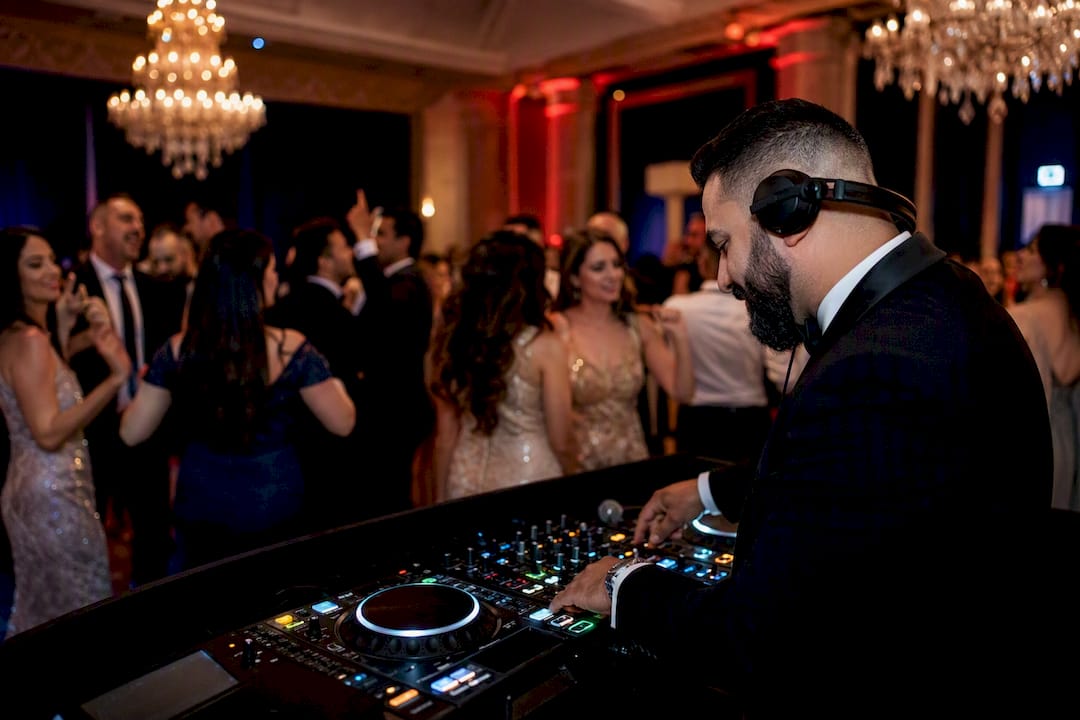
Start with the DJ booth itself. If your DJ owns the company, tipping is a gesture of appreciation rather than an obligation baked into their livelihood. If your DJ is an employee of a larger entertainment firm, the calculus shifts: that person is working an hourly or per-event rate set by someone else, and the tip functions much closer to the way it does for a server or a valet. Brides’ tipping guide draws this distinction directly, recommending 10 to 15% of the fee for employee DJs and a flatter $50 to $100 baseline for owner-operators.
Beyond the person on the mic, several other roles often deserve consideration:
- DJ assistant or technician who handles lighting, cabling, or a second sound board
- Emcee, if that role is separate from the DJ (common at larger or more formal receptions)
- Reception band members, when you’ve hired live musicians alongside or instead of a DJ
- Ceremony musicians, a string quartet or soloist who performed before the reception even started
Entertainment tipping etiquette gets murkier once you look past the DJ booth. Photographers, videographers, and day-of coordinators frequently work as small-business owners, and industry consensus treats their gratuity as appreciated but optional, similar to an owner-operator DJ. Venue staff and catering teams sit on the opposite end of the spectrum. Banquet captains, servers, and bartenders are almost always employees, often working a shift that runs well past midnight, and a tip in that world is closer to standard practice than a bonus.
Pro Tip: Ask your DJ directly, or check with your day-of coordinator, whether they’re the business owner or a booked employee. It’s a fair question, and the answer changes how you should think about the amount.
The employer/employee distinction matters practically, not just philosophically. An owner who sets their own rates has already priced their labour into the contract; a tip is pure upside for them, appreciated but not something their monthly budget depends on. An employee, by contrast, is usually paid a flat rate for the gig regardless of how long it runs or how well it goes, which means your tip is often the only mechanism for rewarding exceptional performance. That’s worth remembering when you’re deciding whether to round up.
If you booked your entertainment through a larger production company, it’s also worth asking who specifically will be on-site. Some companies rotate DJs based on availability, and the person confirmed at your initial consultation may not be the one behind the booth on your wedding night. Understanding how to choose the right DJ for your wedding upfront, including who owns the relationship with you, makes the eventual tipping decision far less confusing.
How much to tip a wedding DJ
Wedding DJ gratuity guidelines exist for one reason: nobody wants to stand in a hallway at 11 p.m. doing mental math while their DJ packs up speakers. The industry has converged on a few clear numbers, and once you understand the logic behind them, applying your own version takes about thirty seconds.
1. The standard range: $50 to $150. This is the figure The Knot cites as the default for a DJ who did the job well, kept the dance floor moving, and handled the reception timeline without drama. Most couples land somewhere in the middle of this range, around $75 to $100, for a standard four-hour reception with no unusual complications.
2. The percentage cross-check: 10 to 15% of the contracted fee. This method scales naturally with what you’re already spending. Some etiquette guides recommend leaning toward the higher end of that percentage specifically when the DJ is an employee rather than the business owner.
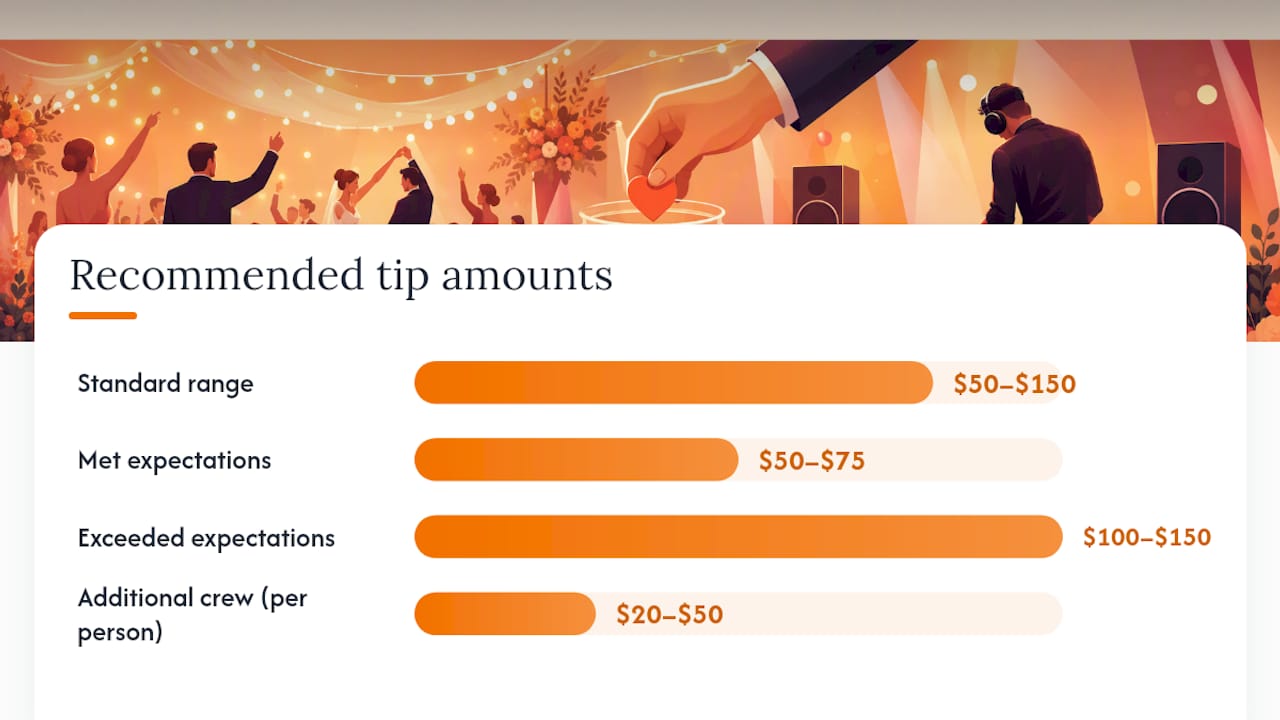
3. The graded scale for performance quality. Not every reception is identical, and tip amounts should reflect that. One useful framework breaks it down as $50 to $75 for a DJ who met expectations, $100 to $150 for one who exceeded them, and $150 or more for genuinely above-and-beyond service, think emergency problem-solving, expert crowd-reading, or seamless emcee work layered on top of the music.
4. Additional crew: $20 to $50 per person. If your DJ brought a second technician, an assistant managing uplighting, or a co-emcee, industry guides typically recommend tipping each of them separately in that range rather than folding them into the lead DJ’s tip and hoping it gets shared.
Here’s how those numbers play out in practice for a few common scenarios:
- Standard four-hour reception, solo DJ, no MC duties. A tip in the $75 to $125 range covers this comfortably, sitting near the middle of the standard baseline.
- DJ who also serves as emcee for toasts, introductions, and the cake cutting. The added responsibility justifies pushing toward $150, since the person is effectively performing two jobs.
- $1,200 DJ fee, average service, no complications. Using the percentage method, 10 to 15% lands you at $120 to $180, a good sanity check against a flat $100 tip that might undershoot for a higher-budget package.
- DJ who kept the party running through a power outage or a scheduling collapse. This is where the $150 or more above-and-beyond tier applies. Problem-solving under pressure is exactly the kind of effort a flat baseline doesn’t capture.
- Multiple crew members present (DJ plus lighting tech plus assistant). Budget the DJ’s tip separately from the $20 to $50 per additional person, so the math doesn’t accidentally shortchange the support staff.
None of these numbers are rigid law. They’re reference points, and your own sense of how the night actually went should carry real weight in the final figure. A DJ who checked in constantly, adjusted the playlist on the fly for a multicultural guest list, and kept the energy high from cocktail hour to last dance has earned more consideration than one who simply pressed play on a preset list.
When and how to hand the tip: timing and delivery
Do you tip a DJ at the very end of the night, or does it happen some other way? Timing trips up more couples than the dollar amount itself, mostly because nobody wants to be counting cash while guests are saying goodbye.
The most common and cleanest approach is handing the tip directly to the DJ as they’re packing up equipment at the end of the reception. By that point, the performance is complete, so you’re tipping based on the actual night rather than an estimate. It also gives you a natural moment to say thank you in person, which matters more to most performers than the amount itself.
If that window gets missed, because you’re swept into photos, family goodbyes, or simply exhausted, two solid alternatives exist:
- Delegate to your day-of coordinator or planner, who can hand over prepared envelopes at the agreed moment even if you’re unavailable.
- Send a digital transfer the next day via Venmo or Zelle, provided you confirm in advance that the DJ accepts that method. Cash remains the preferred format for most DJs, largely because it’s immediate and requires no processing delay, but a prompt digital tip with a thank-you message is a fair substitute if cash isn’t on hand.
Cash carries one clear advantage: privacy. Nobody else needs to see the amount, there’s no digital record tied to a shared account, and it can be handed over in a folded envelope without ceremony. Digital transfers trade that privacy for convenience, particularly useful if you’re settling gratuities the morning after when your head is clearer and your wallet is easier to find than it was at 1 a.m.
1. Prepare labelled envelopes before the wedding day, not during it. Write each recipient’s name on the outside, seal the correct amount inside, and stack them in the order you plan to distribute them.
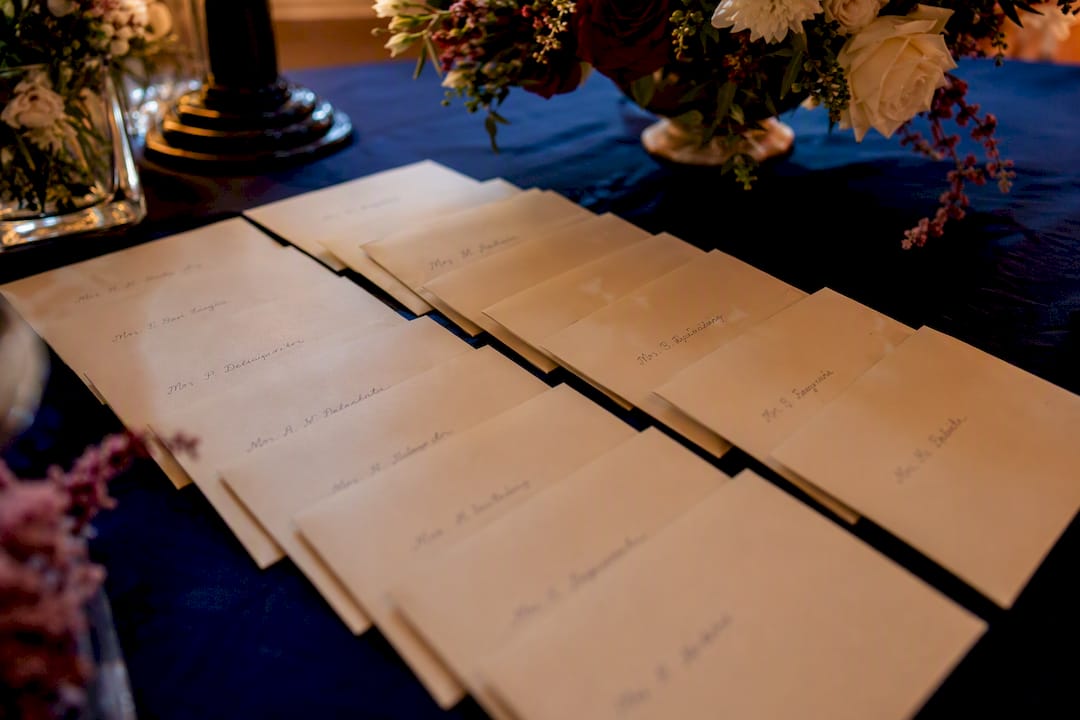
2. Delegate distribution to someone who isn’t you. A wedding planner, a trusted family member, or even a reliable member of the bridal party can handle the actual handoff so you’re not managing logistics during your own reception.
3. Include a short thank-you note with each envelope. A few sentences acknowledging specific moments, “thank you for keeping the dance floor packed all night”, cost nothing and mean more than the cash alone.
Pro Tip: Give the full stack of labelled envelopes to your coordinator or a designated family member before the ceremony even starts. That way, gratuity distribution happens automatically as vendors wrap up, and you never have to think about it again on the day itself.
This system works because it separates the decision (made calmly, weeks in advance) from the execution (happening in real time, when you have zero bandwidth left to think about cash). Best practice from wedding planning guides consistently points to advance preparation as the single biggest stress reducer around vendor gratuities.
When to increase or decrease the tip
Tipping ranges give you a starting point, not a fixed rule, and several objective factors should push your final number up or down from that baseline.
Ownership status is the first lever. An owner-operator DJ has already set their own rates and built their business around them, so a tip in that context is closer to a bonus than an obligation, and many owners say they value a strong review or referral just as much as extra cash.
Scope and hours matter just as much as the fee itself. A DJ contracted for a standard four-hour reception is a different job than one who also covered ceremony sound, ran a first-look playlist, handled a late-running schedule, or travelled a significant distance for the booking. Reviewing your wedding DJ timeline against what actually happened on the day is a useful exercise before finalizing the amount, since scope creep on the night (an extra hour, an unplanned encore) deserves recognition.
Several situations reasonably justify a higher tip:
- The DJ fixed an unexpected AV or sound issue without missing a beat
- The reception ran late and the DJ stayed without complaint or extra billing
- The DJ read the room well enough to rescue a slow dance floor
- The DJ also handled emcee duties, effectively performing two jobs for one fee
A few situations can justify tipping toward the lower end of the standard range, without abandoning the gesture entirely:
- The set felt generic, with minimal reading of the crowd or guest requests
- Communication before the wedding was inconsistent or hard to reach
- The service matched expectations exactly, with nothing exceptional either way
One more variable worth checking: some venues attach mandatory service fees or union-negotiated rules to vendor payments, which can change what’s actually expected. Always confirm this against your venue contract before assuming a standard tip applies on top of an already-included charge.
Budgeting for gratuities without the day-of scramble
The single biggest mistake couples make with wedding DJ tipping isn’t picking the wrong number, it’s forgetting to plan for it until the week of the wedding. Treat gratuity as its own line item from the moment you build your budget spreadsheet, not as an afterthought squeezed in after the final vendor invoices arrive.
For a mid-sized wedding with a full vendor roster, DJ, photographer, coordinator, catering staff, and a few others, total gratuities commonly add $500 to $1,500 to the overall wedding budget. That’s a meaningful sum, and it’s far easier to absorb when it’s planned for in January than when it surfaces as a surprise the week before the wedding.
Here’s a simple way to organize the math for a typical 100-guest wedding:
- List every vendor who might expect a tip, separating employees (near-certain expectation) from owner-operators (appreciated, not mandatory).
- Assign a range to each name, using the DJ figures above as your anchor and adjusting catering and venue staff based on their contracted service charges.
- Total the low and high end of every range to get a budget bracket rather than a single number, giving yourself flexibility as the night unfolds.
- Withdraw cash in the final week and store it in labelled envelopes, so the money exists physically before you need it.
| Vendor role | Typical gratuity range |
|---|---|
| Lead DJ (standard service) | $50 to $150 |
| Lead DJ (exceptional or MC duties) | $150 or more |
| Additional DJ crew or technician | $20 to $50 each |
| Ceremony musicians | $20 to $50 per musician |
Practical prep matters as much as the math. Print a one-page cheat sheet listing every recipient’s name, role, and envelope amount, then hand the whole stack to your day-of coordinator. A printed reference sheet like this removes almost all day-of friction, because nobody has to remember numbers from memory while managing a wedding.
If cash is genuinely tight, you’re not without options. A detailed, specific public review carries real weight for small vendor businesses, and many owner-operators say a strong referral matters as much as a larger tip. A thoughtful gift is another route, though it requires more personalization to land well. A staged digital transfer a few days after the wedding, once regular bills have cleared, is a reasonable middle ground, provided you tell the vendor in advance so they’re not left wondering.
DJ Phoenix’s perspective: what earns a bigger tip
Performers notice specific things long before the dance floor fills up, and gratuity often reflects those details as much as the music itself. A clear timeline handed over in advance, direct access to a couple’s must-play and do-not-play lists, and one single point of contact during the reception, rather than three different relatives all trying to make requests, consistently correlate with a smoother night and, in turn, a better tip.
- Fixing an unexpected sound or AV failure mid-reception without missing a beat
- Reading a stalling dance floor and shifting the set to bring energy back
- Handling emcee duties seamlessly alongside the music, effectively doing two jobs
Operational readiness matters as much as talent. When a DJ walks into a venue with clear power access, a confirmed setup location, and a locked-in timing sheet for toasts and introductions, the entire performance tends to run tighter, and that groundwork often shows up directly in how the night is remembered.
Presentation counts too. A labelled envelope handed over with a short, specific thank-you card, mentioning an actual moment from the night, lands better than cash passed over silently. A follow-up review or a referral to a future couple is a welcome gesture on top of a fair tip, never a replacement for one when the DJ is an employee working someone else’s rate.
What the conventional tipping advice gets wrong
Most tipping guides hand couples a number and stop there, and that’s the gap worth naming. The dollar range matters less than the sequence: check the contract, confirm who’s an employee versus an owner, then apply the percentage rule as a sanity check rather than a starting point. Couples who skip straight to “what’s the average tip” often either overpay a DJ who already had gratuity built into the invoice or underpay someone who genuinely rescued their reception timeline.
The bigger blind spot is logistics, not math. A perfectly calculated tip handed over in a chaotic, unlabelled scramble at midnight loses most of its emotional value. The couples who get this right treat envelope prep and delegation as seriously as the dollar amount itself, because a DJ remembers being thanked properly far longer than they remember the exact figure inside the envelope.
Prioritize the contract check first, the delegation plan second, and the percentage math third. That order, more than any specific number, is what actually prevents day-of stress.
— Reza
Book DJ Phoenix Entertainment for your wedding
Dj-phoenix gives couples the exact groundwork that earns strong tips organically, a locked-in timeline, direct playlist input, and one point of contact all night, built into every wedding booking from the start rather than left to chance. That’s the difference between hoping your DJ reads the room and knowing they’re set up to succeed before the first song plays.

Dj-phoenix specializes in multicultural celebrations and high-energy receptions, with experience serving clients including Mercedes-Benz and FW Sports, and brings the same sound quality and crowd-reading skill to weddings across the DJ’s service area. If clear communication, curated playlists for diverse guest lists, and seamless emcee work matter to you, that’s precisely the gap Dj-phoenix fills. Browse the DJ performance gallery to see the work firsthand, then reach out to check availability for your wedding date and get a straightforward quote.
Sources
For printable checklists and fuller vendor-by-vendor ranges beyond the DJ booth, a few US wedding-industry guides are worth bookmarking:
- How much to tip wedding vendors with a printable guide | The Knot
- Wedding tipping guide: who to tip and how much | Brides
- A guide to tipping wedding vendors | Zola