A balanced 20 song playlist, split evenly between holiday classics and broad party anthems and sequenced across four event phases, keeps a corporate holiday party inclusive and energetic without ever feeling forced. Copy the template below into Spotify or Apple Music, hand it to your DJ, or use it as the backbone for a professional set. Either path works. What matters is the structure, not who presses play.
TL;DR:
- Playing a balanced mix of holiday classics and party anthems, with about 30 to 40 percent from the 1990s to 2010s, suits most office crowds.
- Organizing music into four phases with varying tempo and volume helps maintain energy and flow throughout the event.
- For larger or more formal events, hiring a professional DJ ensures smooth transitions, crowd reading, and equipment troubleshooting.
- Emphasizing inclusive, secular winter songs and carefully managing requests reduces the risk of offending colleagues and keeps everyone comfortable.
- Using proper sound setup, checking decibel levels, and understanding licensing requirements prevent technical issues and legal complications.
Table of Contents
- The 20-song corporate holiday party playlist you can copy right now
- How to sequence music across four phases of an office holiday event
- Genre mix, era balance, and mistakes that sink a playlist
- Your copy-and-play 20-song template by phase
- DJ vs playlist system: when a pro earns their fee
- Making room for every tradition on the floor
- Instrumental options for the quieter moments
- Technical setup and equipment that actually works at your venue
- Music licensing: what planners actually need to know
- A planner’s week-of checklist
- Let Dj-phoenix handle the playlist while you handle everything else
- Sources
- FAQ
The 20-song corporate holiday party playlist you can copy right now
This mix is built for the four moments every office party moves through: guests trickling in, dinner conversation, the dance floor waking up, and the graceful exit. It leans on proven festive standards and universally recognized anthems, avoiding anything with explicit lyrics or lyrics that skew too personal or political for a mixed office crowd.
- “Sleigh Ride” – The Ronettes (arrival)
- “It’s the Most Wonderful Time of the Year” – Andy Williams (arrival)
- “Uptown Funk” – Mark Ronson ft. Bruno Mars (warm-up)
- “Underneath the Tree” – Kelly Clarkson (warm-up)
- “September” – Earth, Wind & Fire (warm-up)
- “All I Want for Christmas Is You” – Mariah Carey (warm-up)
- “Don’t Stop ‘Til You Get Enough” – Michael Jackson (peak)
- “Rockin’ Around the Christmas Tree” – Brenda Lee (peak)
- “I Wanna Dance with Somebody” – Whitney Houston (peak)
- “Santa Tell Me” – Ariana Grande (peak)
- “Levitating” – Dua Lipa (peak)
- “Jingle Bell Rock” – Bobby Helms (peak)
- “Can’t Stop the Feeling!” – Justin Timberlake (peak)
- “Last Christmas” – Wham! (peak, transition)
- “24K Magic” – Bruno Mars (peak)
- “Happy” – Pharrell Williams (peak)
- “Feliz Navidad” – José Feliciano (wind-down, crowd-pleaser)
- “This Christmas” – Donny Hathaway (wind-down)
- “White Christmas” – Bing Crosby (wind-down)
- “Have Yourself a Merry Little Christmas” – Frank Sinatra (wind-down)
How to sequence music across four phases of an office holiday event
The phase-based sequencing model organizes an evening around four distinct energy states rather than a single climbing curve, and it’s the single biggest factor separating a playlist that works from one that just plays.
- Arrival (first 30 to 45 minutes): Keep it at 80 to 100 BPM and low in volume, around 60 to 65 decibels, so people can find their name tags and greet colleagues without shouting.
- Dinner and mingling: Stay instrumental-leaning or soft vocal, moderate volume, nothing louder than a comfortable conversation.
- Peak dance window (typically 60 to 90 minutes): This is where you save your heavy hitters, pushing tempo to 110 to 128 BPM and volume up to build real momentum.
- Wind-down: Ease tempo and volume back down over the final 20 to 30 minutes, signalling that the night is closing without an abrupt cutoff.
Transition cues matter as much as song choice. Watch the floor. If people are still at tables when you hit your third peak-window track, hold back a track or two and let dinner breathe longer.
Genre mix, era balance, and mistakes that sink a playlist
Aim for 30 to 40 percent classic decades tracks, 30 to 40 percent from the 1990s through 2010s, and 20 to 30 percent current hits. That spread covers a 25-year-old associate and a 60-year-old executive on the same floor without either feeling ignored.
The most common mistake is loading the list with 80 percent holiday songs. A roughly 50/50 split between holiday tracks and general party anthems prevents the set from feeling like a loop of the same five carols on repeat.
- Crowd-source requests two weeks ahead, but set a clear submission deadline and vet every entry for workplace suitability before it goes live.
- Cap requests at one or two per person to avoid one enthusiastic karaoke fan hijacking the queue.
- Keep a running “do not play” note for anything with explicit lyrics, even in edited form, since office tolerance for edge cases varies widely.
Pro Tip: Carry a decibel meter app on your phone and check it during the peak window. Most venues cap noise around 85 to 90 decibels, and a quick volume check avoids an awkward conversation with venue staff mid-event.
Your copy-and-play 20-song template by phase
This is the same 20-track list above, reorganized into playable mini-sets of three or four songs each. Crossfading within a mini-set, rather than jumping song to song at random, keeps momentum from dipping between tracks.
Arrival mini-set (holiday-specific): “Sleigh Ride,” “It’s the Most Wonderful Time of the Year.”
Warm-up mini-set (mixed): “Underneath the Tree,” “September,” “All I Want for Christmas Is You,” “Uptown Funk.”
Peak mini-set one (party anthems): “Don’t Stop ‘Til You Get Enough,” “I Wanna Dance with Somebody,” “Levitating,” “Happy.”
Peak mini-set two (holiday plus anthems): “Rockin’ Around the Christmas Tree,” “Santa Tell Me,” “Jingle Bell Rock,” “Can’t Stop the Feeling!,” “24K Magic.”
Transition: “Last Christmas” bridges peak energy back down.
Wind-down mini-set (holiday-specific): “Feliz Navidad,” “This Christmas,” “White Christmas,” “Have Yourself a Merry Little Christmas.”
DJ vs playlist system: when a pro earns their fee
A phone plugged into a speaker handles a small office gathering fine. A professional DJ earns their fee the moment the room gets bigger, the agenda gets formal, or the stakes get higher.
- Reading the room in real time and adjusting tempo before the dance floor empties out.
- Handling mic duties for award announcements, executive remarks, or a surprise toast.
- Managing crossfades and mini-sets so transitions never feel like dead air.
- Troubleshooting equipment failures on the spot instead of during a scramble.
Dj-phoenix has built playlists and run live sets for clients including Mercedes-Benz and FW Sports, and that pattern holds across almost every account: the bigger and more visible the event, the more a trained ear on the crowd outperforms a fixed algorithm.
Making room for every tradition on the floor
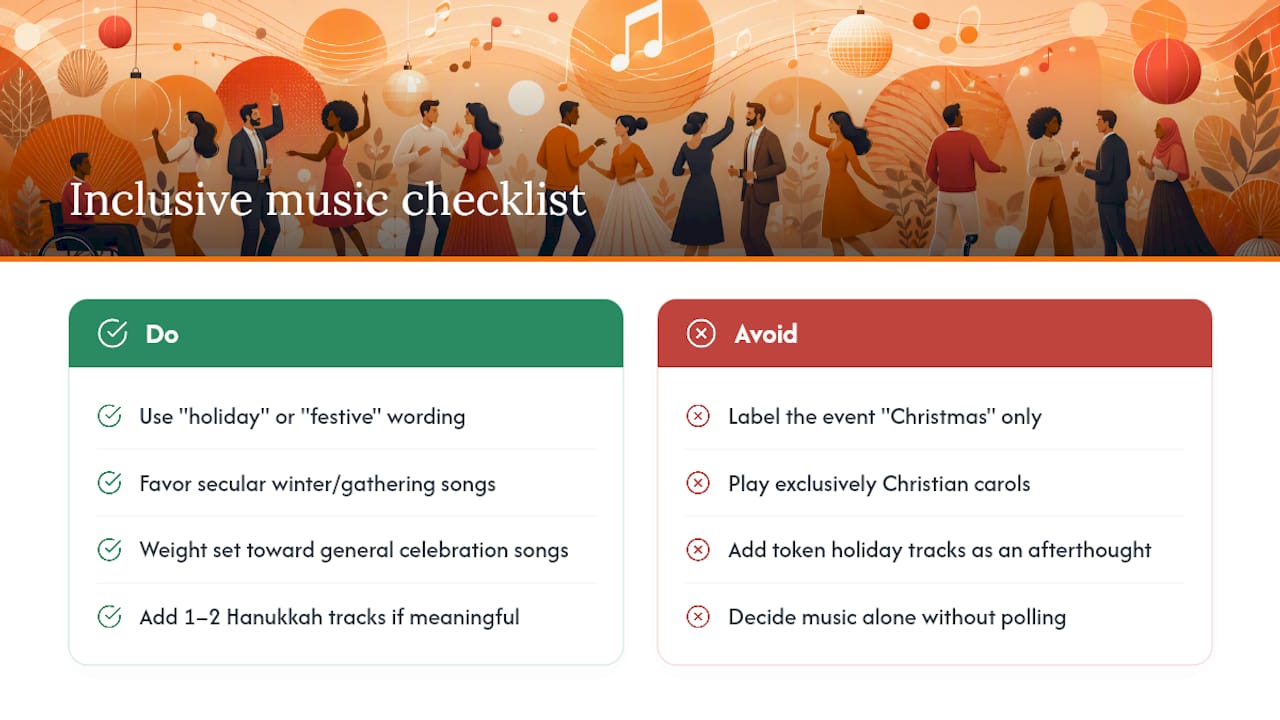
An office holiday party rarely serves a single tradition, and treating it as strictly a Christmas event alienates colleagues who celebrate Hanukkah, Kwanzaa, Diwali, Lunar New Year, or nothing religious at all. The safest framing is “holiday” or “festive,” not “Christmas,” in every invite and announcement, and the music should follow that same logic.
Lean on songs about winter, gathering, gratitude, and celebration rather than exclusively Christian religious content. “Sleigh Ride,” “Winter Wonderland,” and “Let It Snow” celebrate the season without referencing a specific faith, which makes them safer anchors than overtly religious carols like “Silent Night” or “O Holy Night.”
If your office has a meaningful population observing Hanukkah, adding one or two well-known tracks such as a tasteful “Hanukkah, Oh Hanukkah” arrangement signals genuine inclusion rather than tokenism, but don’t force it if it feels like an afterthought. The better move for most offices is simply weighting the set toward secular winter and general celebration songs, then letting the 50/50 holiday-to-anthem split absorb the rest of the room’s diversity naturally.
Ask your event committee, or send a short anonymous survey, about any songs or themes people would rather avoid. A five-minute internal poll catches blind spots a planner working alone would never anticipate, and it costs nothing but a Google Form.
Instrumental options for the quieter moments
Not every minute of a corporate holiday party needs vocals and a beat. Dinner service, executive remarks, award presentations, and early arrival all benefit from instrumental or low-key arrangements that support conversation instead of competing with it.
Instrumental jazz versions of holiday standards, such as a Vince Guaraldi style “Christmas Time Is Here,” work well as ambient dinner music because they carry the seasonal mood without pulling attention away from tablemates. Acoustic or piano covers of contemporary pop hits serve the same purpose during arrival, giving the room a familiar, comfortable texture at a volume where people can still hear each other.
Background music also protects you during formal segments. If your CEO is delivering remarks or your team is presenting year-end awards, cut to something purely instrumental and quiet, around 50 to 60 decibels, so the speaker never has to compete with a chorus. Many event playlists on Spotify and Apple Music, including sets built specifically for office holiday parties, include a dedicated instrumental block for exactly this reason.
Pro Tip: Build a five-song instrumental buffer you can drop in on short notice. Nothing derails a planner’s confidence faster than a surprise toast starting while “Uptown Funk” is still blasting.
Technical setup and equipment that actually works at your venue
Sound quality depends far more on equipment matching the room than on the playlist itself. A ballroom holding 200 people needs a fundamentally different setup than a restaurant’s private dining room holding 30, and mismatched gear is the single fastest way to sink an otherwise great song selection.
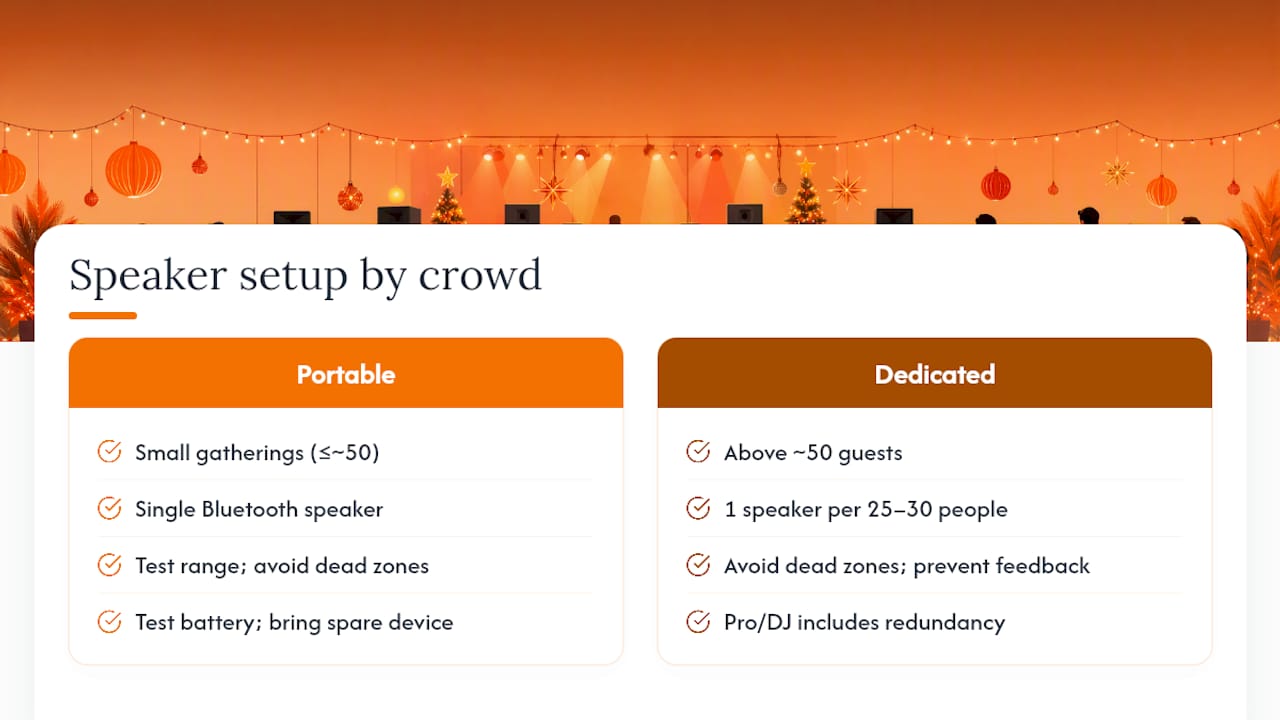
For small gatherings, a single portable Bluetooth speaker often suffices, provided you test its range and battery life beforehand. For anything above roughly 50 guests, you need at least one dedicated speaker per 25 to 30 people, positioned to avoid dead zones and feedback loops near open mics.
Confirm three things with your venue at least a week out: available power outlets and their locations, whether the venue has house sound you can plug into, and any decibel restrictions written into your rental agreement. Many hotel ballrooms and event spaces cap volume after a certain hour, and finding that out mid-party is far worse than building it into your plan early.
If you’re running the music yourself off a laptop or phone, bring a backup device loaded with the same playlist and a spare aux cable or Bluetooth pairing already tested. A professional DJ setup solves most of this automatically, since equipment redundancy and venue compatibility checks are standard parts of a pro’s pre-event routine rather than an afterthought squeezed in the night before.
Music licensing: what planners actually need to know
Playing recorded music at a private company event generally falls under different rules than playing it in a public-facing business like a retail store or restaurant that plays music all year for customers. Most corporate holiday parties, held as closed, invitation-only gatherings for staff, do not require the venue-style public performance licences that bars and retailers carry year-round.
That said, the specifics depend on your venue and how the event is structured. If you’re hosting inside a hotel, restaurant, or event space that already holds a public performance licence through a performance rights organization, the venue’s existing licence typically covers the music played during your event. If you’re renting a private space with no existing licence and streaming music through a personal Spotify or Apple Music account, check that account’s terms of service, since personal streaming subscriptions are generally licensed for private, non-commercial listening rather than events.
The simplest way to remove any doubt is to ask your venue directly whether their existing licensing covers a private corporate function, or to hire a professional DJ, since DJs typically carry their own performance licensing as part of doing business. This is one area where a quick email to your venue’s events coordinator saves far more hassle than trying to interpret licensing terms yourself.
A planner’s week-of checklist
In the final week, I always tell planners to lock the guest-submitted requests first and cut anything with explicit lyrics or a tone that doesn’t fit a professional room. Confirm your song order and the venue’s volume limits with whoever’s running sound, whether that’s you, a colleague, or a hired DJ.
Keep three backup “rescue” mini-sets ready, three songs each, in case the energy dips unexpectedly. And print a physical copy of the final playlist order. Phones die, Wi-Fi drops, and a paper backup has saved more than one event from an awkward silence.
— Reza
Let Dj-phoenix handle the playlist while you handle everything else
Building and sequencing a 20-song set is manageable for a smaller office gathering, but once the guest list climbs past 75 people, or the evening includes award presentations, executive remarks, or multiple rooms, the margin for error shrinks fast. Dj-phoenix removes that risk entirely: instead of you troubleshooting a dead Bluetooth speaker or fielding a colleague’s fifth song request mid-dinner, a professional handles playlist curation, live mixing, mic duties, and sound equipment as one coordinated package.
A professional DJ can curate and execute multicultural, high-energy sets for clients, reading the room in real time rather than relying on a fixed running order. Services for planners include full DJ services for corporate events, custom playlist consultation, sound system rental, and emcee support for announcements or award segments. Browse the DJ performance gallery to see past corporate sets in action, then request a consultation to check availability for your event date.
FAQ
What are some good songs for an office Christmas party?
Mix recognizable holiday classics like “Jingle Bell Rock” and “Feliz Navidad” with broad party anthems like “Uptown Funk” and “I Wanna Dance with Somebody,” keeping the split close to 50/50 to avoid monotony.
What are some good songs for corporate events?
Universal crowd-pleasers with clean lyrics and moderate to high energy, such as “Don’t Stop ‘Til You Get Enough,” “Can’t Stop the Feeling!,” and “24K Magic,” work across nearly any corporate audience regardless of age.
What games can you play at an office Christmas party?
Music-based games like a holiday song trivia round or a “name that tune” contest during the dinner phase pair naturally with a curated playlist and give quieter guests an easy way to join in.
What are some good songs for a holiday party?
Beyond straight Christmas songs, general winter and celebration tracks like “Sleigh Ride” and “Let It Snow” work well because they set a festive tone without leaning on any single religious tradition, keeping the mix inclusive for a diverse office.