A great Persian wedding playlist pairs classic aroosi anthems with modern dance remixes, and you do not need to build one from nothing. Start with a proven set: Leila Forouhar’s Aroosi, Viguen’s Shah Doomad for the couple’s entrance, and Mobarak Bad the moment the dance floor opens. Add a bilingual ballad for mixed-culture guests during the first dance, then bring in a bass-heavy remix to launch the group dancing.
For an instant option, Boutique Sound Studio’s Persian Wedding 2026 playlist on Spotify is built specifically for dancing and energy, and you can hand it straight to a DJ or play it yourself.
- Aroosi (Leila Forouhar): the genre-defining wedding anthem, ideal for the reception opener or first big group dance.
- Shah Doomad (Viguen): a regal, celebratory number tailor-made for the groom’s entrance.
- Mobarak Bad: the traditional congratulatory song guests expect the moment the couple takes the floor.
- Gole Aroos (Aref): a warmer, romantic pick for a quieter transition between high-energy sets.
- Ahay Aghaye Damad (Martik): a party favourite that reliably pulls even reluctant dancers off their chairs.
Key Takeaways
The most reliable Persian wedding playlist blends classic aroosi anthems with modern remixes, sequenced by moment and adjusted live for the generational mix in the room.
| Point | Details |
|---|---|
| Start with proven tracks | Aroosi, Shah Doomad, Mobarak Bad, Gole Aroos, and Ahay Aghaye Damad cover the core moments. |
| Sequence by moment | Arrival, entrance, first dance, dance floor, and send-off each need a distinct tempo range. |
| Bridge old and new | Use remixes of familiar melodies to move between traditional and modern tracks without losing the crowd. |
| Source music legally | Stream for personal reference, but use licensed DJ pools or purchased tracks for public playback. |
| Hire for live adaptability | Dj-phoenix reads the room and adjusts the set live, something a fixed playlist cannot do on its own. |
Table of Contents
- Building your Persian wedding playlist moment by moment
- 25 must-have Persian wedding songs for your setlist
- Sequencing your playlist for maximum energy
- Where to legally source Persian wedding music
- Traditional roots, modern energy: balancing both styles
- Persian instruments that shape the sound of the celebration
- Reflecting regional traditions in your song choices
- Adjusting the playlist across generations and guest tastes
- Reading the room: Reza’s perspective on Persian wedding music
- Let Dj-phoenix bring this playlist to life
- Sources
Building your Persian wedding playlist moment by moment
A Persian wedding playlist works best when it is organized by moment, not by mood alone. Guests arrive, the couple enters, the first dance happens, and then the floor opens. Each stage calls for a different tempo and a different emotional register, and getting the order wrong is the fastest way to flatten a room that should be building toward its peak.
- Guest arrival. Keep things elegant and unobtrusive. Instrumental santur or tar pieces, or gentle aroosi classics played at low volume, set a warm tone without competing with conversation.
- Bride entrance. This moment calls for something regal but restrained. An instrumental arrangement of a well-known aroosi song, or a slowed-down version of a classic, lets guests recognize the melody without overwhelming the emotion of the walk. DJ Taba’s ceremony guide notes that instrumental or stripped-down versions preserve the dignity of the moment while still carrying cultural weight.
- First dance. Slow Persian love songs work well here, and for mixed-culture weddings, a bilingual track (Persian verses with English or Arabic phrasing) helps both families feel included.
- Dance floor. This is where aroosi hits earn their keep. Group-friendly tracks with clear, repeatable steps get grandparents and cousins moving together, while a run of high-tempo remixes keeps the younger crowd engaged.
- Send-off. Close on something loud, joyful, and familiar. A well-known chorus that the whole room can sing gives the night a proper finish.
Pro Tip: Keep two or three instrumental versions of your favourite aroosi songs loaded and ready. They work for the ceremony, for photo moments, and as a quiet buffer between high-energy blocks without repeating a full vocal track twice in one night.
25 must-have Persian wedding songs for your setlist
Guest expectations for a Persian wedding playlist cluster around a fairly consistent set of songs, something borne out repeatedly in community discussions where Persian wedding guests compare notes on essential tracks. The list below blends decades-old staples with newer additions, and many of the classics on it trace back to the 43 Persian Wedding & Party Songs (Aroosi) compilation, a multi-disc collection first released in the 1990s and 2000s that still anchors most modern setlists.
- Aroosi — Leila Forouhar. Traditional. The genre’s signature song; best for the reception opener.
- Shah Doomad — Viguen. Traditional. Reserved for the groom’s grand entrance.
- Mobarak Bad. Traditional. Played the instant the couple is announced as married.
- Gole Aroos — Aref. Traditional. A softer number for slow transitions.
- Aroosi — Shohreh. Traditional. An alternate take on the aroosi theme, useful for variety.
- Ahay Aghaye Damad — Martik. Modern/party. High-energy floor filler.
- Bandari remixes (various artists). Modern. Group-dance staples that never lose the room.
- Latest Andy tracks. Modern. Popular with younger guests and mixed-generation crowds.
- Sasy Mankan hits. Modern remix. Reliable for a late-night energy spike.
- Persian bandari medleys. Traditional/remix hybrid. Built for coordinated group dancing.
Rounding out the remaining 15 slots with regional favourites, family-requested classics, and current chart tracks keeps the set flexible enough to fit any guest list without losing its Persian bridal music core.
Sequencing your playlist for maximum energy
Order matters as much as song choice. A workable formula runs: open slow (60 to 90 BPM) for arrivals, build through mid-tempo aroosi tracks (95 to 115 BPM), hit a first peak with group dance hits (118 to 128 BPM), reset briefly with a ballad, then climb to a second, bigger peak before winding down.
- Open with instrumentals, build with mid-tempo classics, peak with bandari and remix blocks, reset once, peak again, then wind down.
- Bridge Persian traditional tracks into Western pop by matching key and tempo rather than cutting cold between genres.
- Keep a backup track cued for every scripted moment: entrance, cake cutting, first dance.
- Hand control to a live DJ once the floor is full. Reading a live room in real time is where a pre-made playlist runs out of range.
Pro Tip: Never let more than two slow songs play back to back after 9 p.m. Two is a mood; three is a lull you will have to fight to recover from.
Where to legally source Persian wedding music
Streaming playlists on Spotify or Apple Music are perfectly fine for personal listening and pre-wedding planning, but DJs need licensed sources for public performance.
- Use streaming platforms to build your own reference playlist and share song lists with your DJ.
- For actual DJ playback, licensed DJ pools and purchased tracks are the safer route than a personal streaming account.
- Dj-phoenix’s guide to legally obtaining Iranian music walks through licensed sources and practical file formats.
- Keep backups in MP3 or FLAC on a USB drive, and download an offline copy of your streaming playlist in case venue Wi-Fi fails.
Traditional roots, modern energy: balancing both styles
The strongest Persian wedding playlist does not pick a side between old and new. It layers them. Traditional aroosi songs like Mobarak Bad and Shah Doomad carry cultural recognition that no remix replaces. Every generation in the room knows the melody, and that shared recognition is what gets people out of their seats in the first place.
Modern tracks and remixes serve a different function. They keep momentum going once the floor is full, especially for guests under thirty who may not know every traditional lyric but respond instantly to a strong bassline. The trick is transition, not substitution: bring in a bandari remix of a familiar aroosi melody rather than jumping straight to an unrelated pop track. That keeps the thread of Persian wedding dance songs intact even as the tempo climbs.
Couples increasingly ask for a roughly even split, with traditional songs anchoring the ceremony and early reception, and modern remixes carrying the back half of the night. That balance also gives a DJ room to adjust live, leaning more traditional if the older generation dominates the floor, or pushing further into remix territory if the crowd skews younger.
Persian instruments that shape the sound of the celebration
A handful of instruments give traditional Persian music its unmistakable character, and recognizing them helps couples explain their musical preferences to a DJ or live musician. The santur, a hammered dulcimer with a bright, cascading tone, often opens ceremony music because it sounds elegant without overwhelming quiet conversation. The tar, a long-necked lute, carries much of the melodic weight in classic aroosi recordings and gives those songs their distinctive twang.
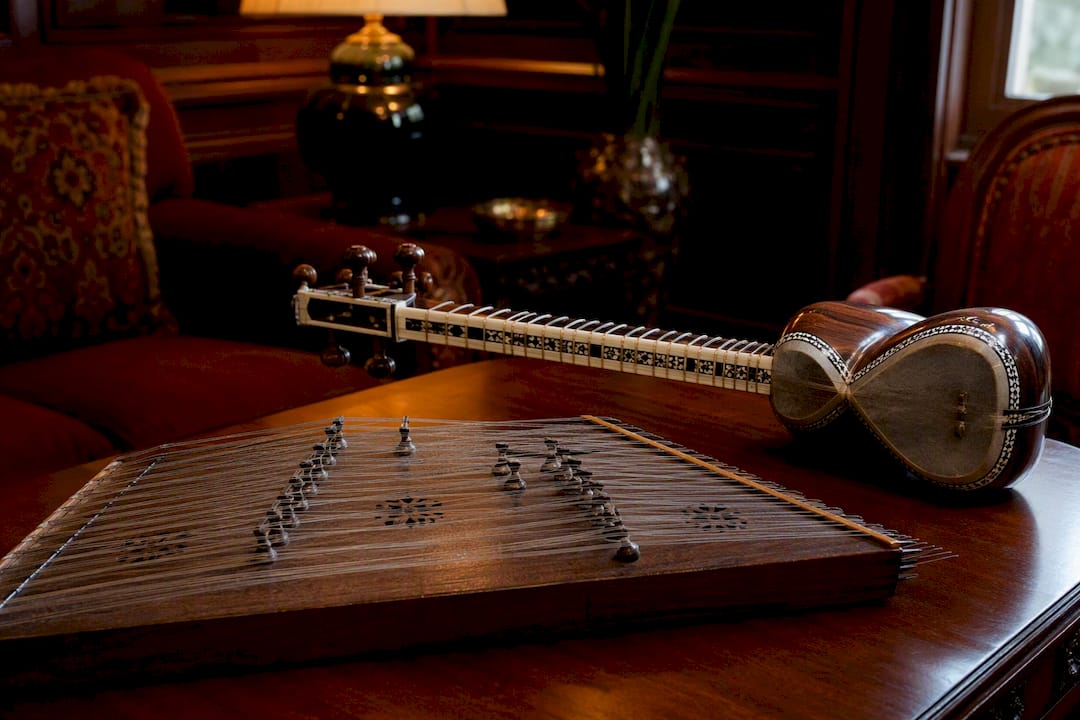
The daf, a large frame drum, provides the driving rhythm behind bandari and group dance tracks. It is the instrument most directly responsible for the physical urge to dance in Persian wedding dance songs. The ney, a reed flute with a breathy, haunting tone, appears more often in slower, emotional pieces suited to the first dance or quiet ceremony transitions.
Knowing these instruments matters practically, not just culturally. If a couple wants their ceremony to feel more traditional, requesting santur and ney-led instrumentals gives a DJ a clear direction. If the goal is maximum floor energy, daf-driven bandari tracks are the ones to prioritize.
Reflecting regional traditions in your song choices
Persian wedding customs vary by region, and a playlist that acknowledges that variation feels more personal than a generic set. Families with roots in the Caspian region often favour Gilaki and Mazandarani folk melodies alongside standard aroosi tracks, while families from southern Iran lean harder into bandari rhythms, which explains why bandari has become almost a genre unto itself at Persian wedding dance playlist events nationwide.
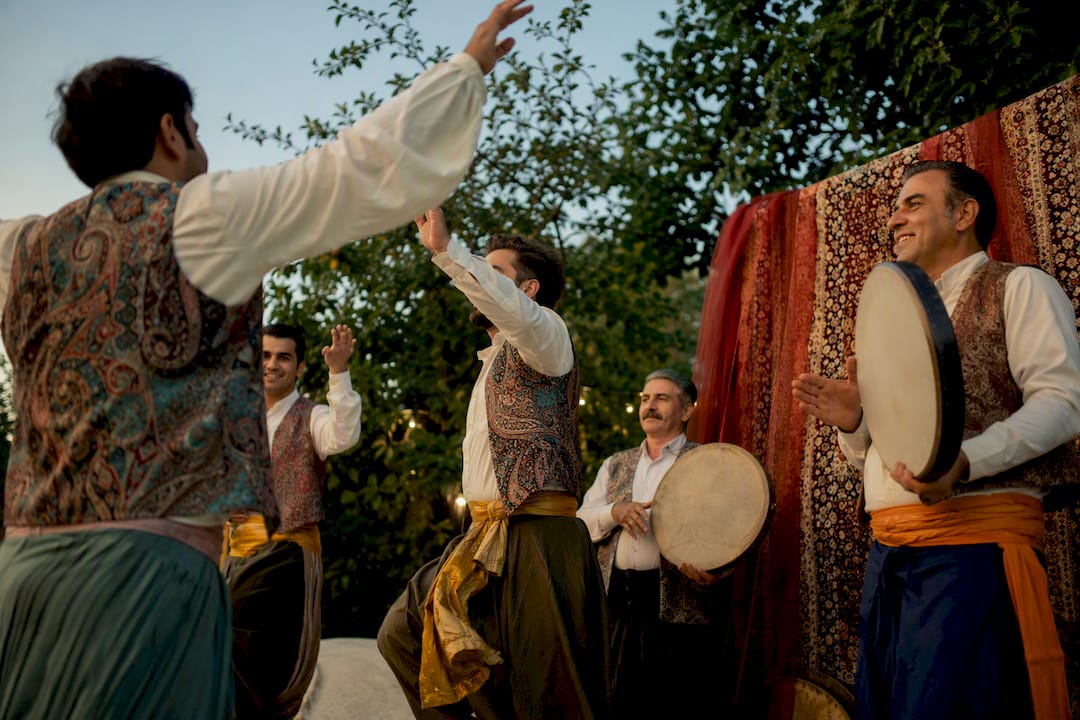
Azeri-Persian families frequently request specific folk dances with their own instrumentation, distinct from the santur-and-tar sound most guests associate with mainstream Persian wedding music. Kurdish-Persian celebrations often include line-dance music with a different rhythmic structure entirely, built for large group formations rather than couple dancing.
None of this means overhauling a full setlist. It usually means adding three or four regionally specific tracks at strategic points, often right after the core aroosi block, so extended family members hear something that reflects their specific background. A short conversation with both families before the wedding about which regional styles matter to them is worth more than guessing.
Adjusting the playlist across generations and guest tastes
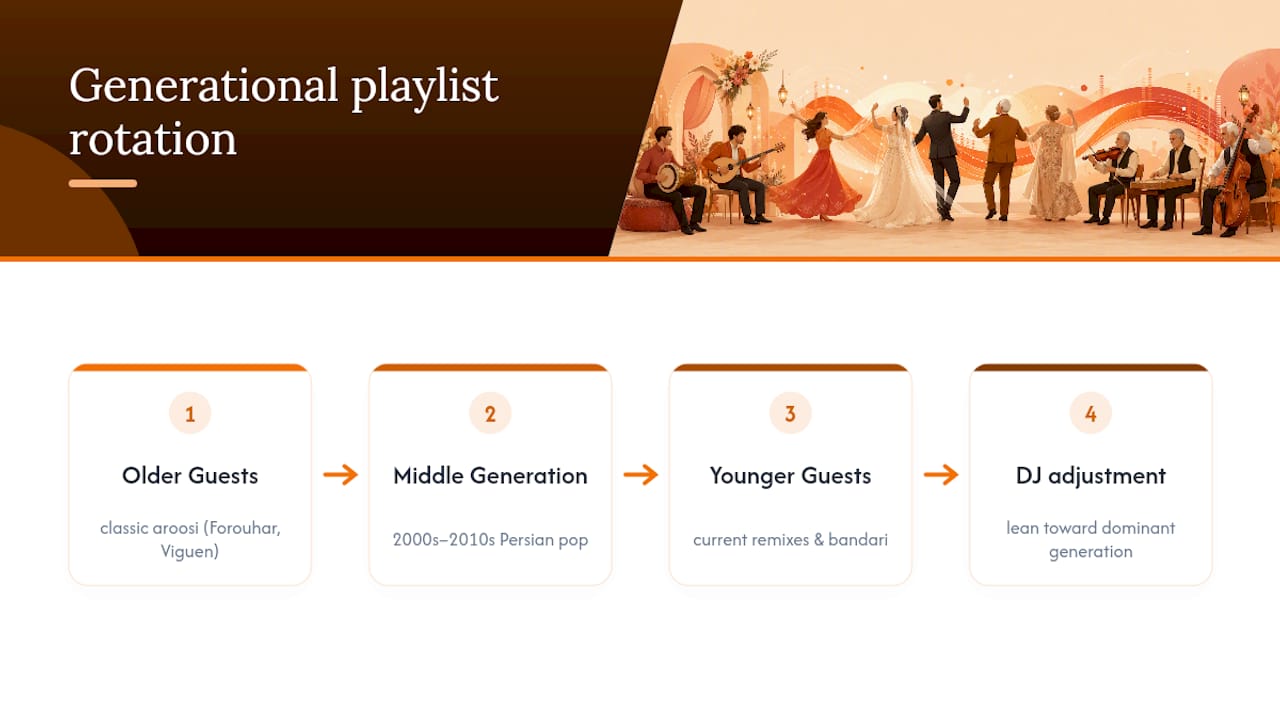
A Persian wedding guest list typically spans at least three generations, and each one responds to something different. Grandparents and older relatives tend to favour the classic aroosi catalogue: Leila Forouhar, Viguen, and other artists whose songs have soundtracked weddings for decades. Skipping these tracks in favour of an all-modern set is one of the fastest ways to leave older guests sitting down all night.
Middle-generation guests, often the parents’ peers, respond well to a mix: recognizable classics plus popular 2000s and 2010s Persian pop. Younger guests, cousins and friends of the couple, want current remixes and bandari-influenced dance tracks layered on top of the traditional core.
The practical answer is not three separate playlists. It is one sequenced set that rotates through all three registers every twenty to thirty minutes, so no single generation is stuck watching from the sidelines for too long. A DJ who can read which generation currently dominates the floor and lean the next few songs toward them will keep far more people dancing than one who runs a fixed set list start to finish.
Reading the room: Reza’s perspective on Persian wedding music
Two signals tell me when to shift styles mid-reception: a sudden drop in dancers under forty, or a cluster of older relatives drifting toward their tables. Either one means it’s time to bring back a classic aroosi track before the energy fully deflates.
What works consistently is treating remixes as bridges, not replacements. A bandari remix of a familiar melody keeps grandparents nodding along while giving younger guests the tempo they came for. That overlap, more than any single song choice, is what keeps three generations on the same dance floor at once.
— Reza
Let Dj-phoenix bring this playlist to life
A playlist on paper is only half the job. Dj-phoenix built its reputation reading multicultural crowds in real time, blending aroosi classics with modern remixes without the awkward genre jumps a fixed playlist can’t avoid. That skill, curating for diverse audiences while keeping a room dancing, is exactly what separates a DJ from a Spotify queue on a laptop.

Our services for Persian weddings cover full playlist curation, professional sound equipment, bilingual emcee work, and the kind of cultural fluency that comes from working weddings across multiple communities, including clients like Mercedes-Benz and FW Sports who expect the same precision at corporate events — learn how to enhance your reception with a wedding sangria bar setup guide. If you are ready to see how this translates live, browse our DJ performance gallery or head to Dj-phoenix to check available dates and request a quote for your celebration.
Sources
- Boutique: Persian Wedding 2026 (Spotify playlist)
- 43 Persian Wedding & Party Songs (Aroosi) – Album (Apple Music)