
Music is the single most powerful force shaping the atmosphere and emotional experience of a wedding day. While flowers and lighting set the visual tone, music governs how guests feel at every moment, from the quiet reverence of the processional to the full energy of the dance floor. The role of music in wedding ambiance extends far beyond background noise. It signals transitions, primes emotions, and creates the memories guests carry home. Understanding how to use music with intention gives you a level of control over your wedding’s atmosphere that no other element can match.
How does music shape the role of music in wedding ambiance?
Music shapes wedding ambiance by controlling the emotional state of every person in the room, often without them realising it. Prelude music primes guests psychologically for the formality and emotional weight of the ceremony through tempo and style choices alone. Couples who underestimate this power miss one of the most effective tools available to them. The atmosphere you create before a single vow is spoken depends entirely on what is playing as guests find their seats.
Tempo is the primary lever. 60–80 BPM induces reverence and calm, making it ideal for the ceremony. Rates above 120 BPM trigger high-energy celebration, which is exactly what you want on the dance floor. The gap between those two ranges is not arbitrary. It reflects how the human nervous system responds to rhythmic input, and a skilled music professional uses that response deliberately.
Music controls atmosphere, fills silence, signals transitions, influences guest behaviour, and creates lasting memories. That is a remarkable range of functions for something most couples treat as a finishing touch. Treating music as a structural element, rather than decoration, changes how you plan your entire wedding day.
How tempo and style set the mood at each wedding phase
Each phase of a wedding day calls for a distinct musical character. Matching tempo and style to each segment keeps guests emotionally engaged without exhausting them.
- Ceremony (20–30 minutes): Classical string quartet, acoustic guitar, or solo piano work best. Tempos in the 60–80 BPM range create reverence. Prelude music starts 20–30 minutes before the ceremony to welcome guests and establish a romantic, ambient mood.
- Cocktail hour: Jazz standards, acoustic covers, and light bossa nova maintain energy without demanding attention. Guests are mingling, so music should support conversation rather than compete with it.
- Dinner (60–90 minutes): Soft, melodic playlists at low volume allow guests to talk comfortably. Think Frank Sinatra, Norah Jones, or curated acoustic sets. The goal is warmth, not excitement.
- Dance reception (3–5 hours): Upbeat, rhythm-driven tracks above 120 BPM. Energy should build progressively rather than peak immediately.
Pro Tip: Use tempo as a deliberate tool to manage guest energy. If the room feels flat during dinner, nudge the BPM up by 10–15 points. If guests look restless before the first dance, bring it down briefly to reset expectations.
The style choices within each segment matter as much as tempo. A jazz trio during cocktail hour signals sophistication and gives the event a sense of occasion. An acoustic cover of a well-known pop song does the same thing with a warmer, more personal feel. Neither is wrong. Both communicate intentional care to your guests.
Music as the invisible master of ceremonies
Music functions as an invisible master of ceremonies, guiding guest attention and behaviour through every moment of the wedding without a single verbal instruction. When the processional begins, guests stand. When dinner music fades and an upbeat track rises, guests move toward the dance floor. These responses are not accidental. They are the result of deliberate musical cues.
Sound transitions between wedding segments must be planned meticulously to avoid jarring shifts and maintain emotional continuity. A poorly timed silence between the ceremony and cocktail hour can deflate the room in seconds. A smooth crossfade or a live musician filling that gap keeps energy intact and guests at ease.
| Wedding segment | Typical duration | Music purpose |
|---|---|---|
| Prelude | 20–30 minutes | Welcome guests, establish romantic mood |
| Ceremony | 20–30 minutes | Signal formality, support emotional moments |
| Cocktail hour | 45–60 minutes | Sustain energy, encourage conversation |
| Dinner | 60–90 minutes | Create warmth, allow relaxed interaction |
| Dance reception | 3–5 hours | Build energy, keep guests on the floor |
Pro Tip: Plan every transition in advance, including what plays during the walk from the ceremony to the reception space. Transition planning is where amateur playlists fall apart and professional DJs earn their fee.
The difference between a wedding that flows and one that feels disjointed almost always comes down to how well the music transitions are managed. Silence is not neutral. In a room full of guests, unexpected silence reads as a mistake. Planned silence, used sparingly, reads as drama.
Live music vs. recorded playlists: which creates better atmosphere?
The choice between live musicians and a professional DJ or recorded playlist is one of the most consequential decisions you will make for your wedding’s atmosphere. Both approaches have genuine strengths, and the right choice depends on your priorities.
What live music does exceptionally well
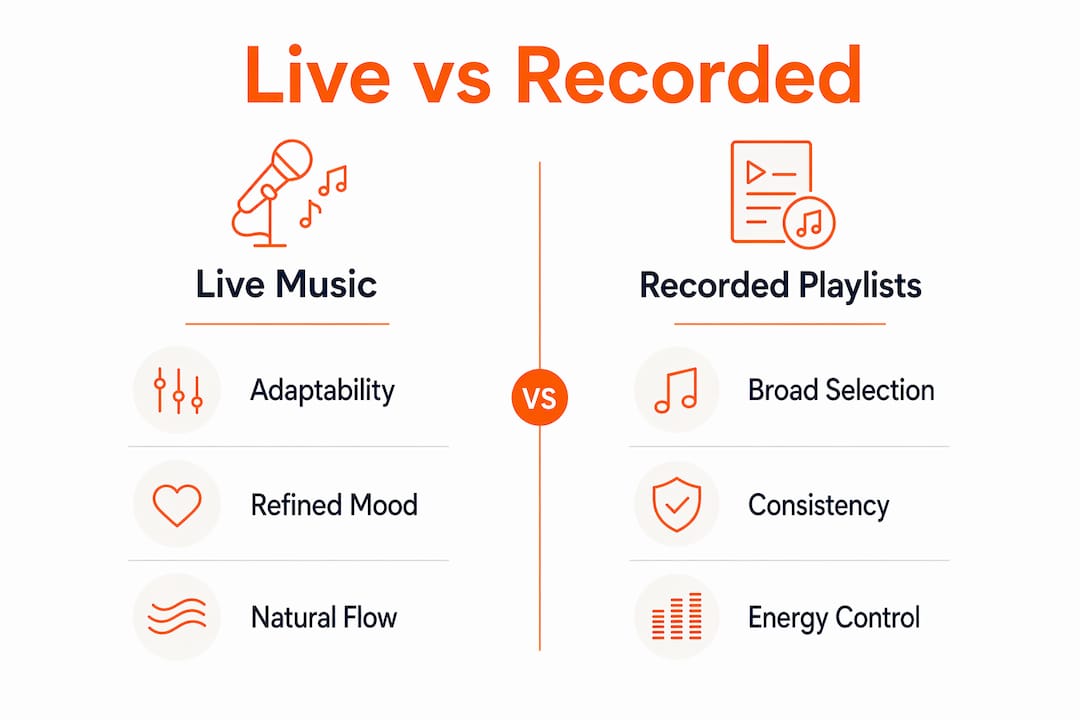
Live music adapts to event timing in real time, filling pauses naturally in a way that fixed playlists cannot. If the flower girl takes longer than expected to walk the aisle, a live musician extends the piece without any awkward repetition or abrupt cut. That flexibility is irreplaceable during ceremonies, where timing is unpredictable.
Live musicians add social meaning to a room, causing guests to behave with greater refinement and feel the space as purposeful. This is not a small effect. The presence of a live performer signals intentional care and elevates the perceived calibre of the entire event. Guests speak more quietly, sit more attentively, and engage more thoughtfully with one another.
What recorded playlists and professional DJs offer
A professional DJ or curated playlist offers consistency and breadth that live musicians cannot match. A DJ can move from classical to R&B to Afrobeats within a single evening, reading the crowd and adjusting in real time. For multicultural weddings or receptions with diverse guest demographics, that flexibility is a significant advantage.
| Feature | Live musicians | Professional DJ or playlist |
|---|---|---|
| Adaptability during ceremony | Excellent | Limited |
| Musical range across genres | Narrow | Extensive |
| Atmosphere and refinement | Very high | High |
| Crowd-reading ability | Moderate | Excellent (with skilled DJ) |
| Consistency across long events | Variable | Consistent |
The most sophisticated approach combines both. A live string quartet or acoustic duo for the ceremony and cocktail hour, followed by a professional DJ for the reception, gives you the emotional depth of live performance and the energy management of an expert DJ. Dj-phoenix specialises in exactly this kind of artistry, reading the crowd and transitioning between musical styles with the fluency that multicultural weddings demand.
How to plan your wedding music playlist for the ideal energy arc
A well-planned wedding music playlist is not a random collection of favourite songs. It is a structured arc that starts gently, builds deliberately, and peaks at the right moment. Getting that arc right keeps guests engaged for the entire event.
- Establish your playlist size based on event length. A 6-hour wedding requires 80–100 songs; a 4-hour reception needs 50–70 to cover all segments without repetition. Undershooting this number forces awkward repeats.
- Start dinner with low-volume, sophisticated music. The transition from ceremony to dinner is a natural energy dip. Lean into it with soft, melodic tracks that let guests decompress and connect.
- Build tempo and energy gradually toward the dance peak. Increase BPM incrementally across the dinner and early reception period. Guests should feel the energy rising without noticing the mechanism behind it.
- Avoid starting the reception at maximum energy. Starting at peak energy causes an early crash that leaves guests exhausted before the night’s best moments arrive. The gradual build is not just a preference. It is the difference between a dance floor that stays full and one that empties by 9:00 PM.
- Give your DJ a vibe guideline and a “never play” list. Flexible DJ guidelines improve party flow far more than rigid song orders. A skilled DJ reads the room in real time and responds to what guests actually want, not what you predicted they would want three months earlier.
For couples planning virtual or hybrid weddings, the energy arc principle applies equally. Remote guests need the same musical cues to feel connected to each phase of the event.
The most common mistake couples make is treating the playlist as a personal favourites list rather than an atmospheric tool. Your guests’ collective energy matters more than any individual song preference. A professional DJ balances both with the experience and pedigree to make it feel effortless.
Key takeaways
Music is the structural foundation of wedding ambiance, and intentional planning across tempo, transitions, and energy arc determines whether guests feel moved or merely present.
| Point | Details |
|---|---|
| Tempo controls emotion | Use 60–80 BPM for ceremony reverence and 120+ BPM for dance floor energy. |
| Transitions define flow | Plan every musical shift between segments to prevent energy dips and awkward silences. |
| Live music elevates atmosphere | Live performers signal intentional care and refine guest behaviour in ways recordings cannot fully replicate. |
| Build energy gradually | Start soft at dinner and increase BPM progressively to sustain guest engagement through the reception. |
| Trust professional guidelines | Give your DJ a vibe brief and exclusion list rather than a rigid song order for better real-time results. |
What I have learned about music and wedding atmosphere
After years of working weddings across a wide range of cultures and venues, I have come to one firm conclusion: the couples who remember their wedding most vividly are almost always the ones who treated music as architecture, not decoration.
The moments guests describe years later are rarely the centrepieces or the cake. They describe the feeling in the room when the processional began, the energy shift when the first dance ended and the floor opened up, the unexpected song that made an older relative stand up and move. Every one of those moments is a music decision.
What surprises most couples is how much the background music matters. The soft jazz during cocktail hour, the acoustic set during dinner, these are not filler. They are the emotional connective tissue between the ceremony’s formality and the reception’s celebration. When that tissue is missing or poorly chosen, the wedding feels like a series of disconnected events rather than a single, coherent experience.
My honest advice is to trust a music professional who has read rooms like yours before. Give them your vision, your cultural context, your “never play” list, and then let them do what they do best. The couples who micromanage every track often end up with a technically correct playlist and an emotionally flat room. The couples who trust their DJ’s artistry get something far more valuable: a room that feels alive.
— Reza
Crafting your wedding atmosphere with Dj-phoenix
Every couple deserves a wedding where the music feels as considered as the vows themselves. Dj-phoenix brings years of elite experience to weddings across Toronto, Montreal, and Ottawa, with a particular artistry for multicultural events where the musical range must be both broad and precise.
From bespoke playlist curation to real-time crowd reading and flawless segment transitions, Dj-phoenix manages the full energy arc of your wedding day with the calibre that prestigious clients like Mercedes-Benz and FW Sports have come to expect. Whether you are planning a Persian wedding, a multicultural celebration, or a classic reception, the wedding packages are designed to match your vision with professional precision. Explore what a truly intentional musical experience looks like for your day.
FAQ
How early should wedding music start before the ceremony?
Prelude music should begin 20–30 minutes before the ceremony to welcome guests and establish the romantic, ambient mood that prepares them emotionally for the vows.
How many songs do I need for my wedding playlist?
A 6-hour wedding requires 80–100 songs, while a 4-hour reception needs 50–70. Undershooting that number risks awkward repetition across segments.
Is a live band or a DJ better for wedding atmosphere?
Live musicians excel at ceremony adaptability and elevating guest refinement, while a professional DJ offers broader musical range and superior crowd-reading for the reception. Many couples use both.
What tempo is best for wedding ceremony music?
Ceremony music at 60–80 BPM induces reverence and calm. Tempos above 120 BPM are reserved for the dance reception, where high energy is the goal.
Should I give my DJ a strict song list or general guidelines?
General vibe guidelines and a “never play” list produce better results than rigid song orders. A skilled DJ reads the room in real time and adjusts to what guests actually respond to.