Hiring professional live sound and an experienced DJ is the single most effective step you can take to protect message clarity, attendee engagement, and brand perception at any corporate event. Poor audio is not merely an inconvenience; audio clarity and consistent coverage directly shape how audiences perceive your brand and whether they retain what they hear. Three questions belong in every RFQ before you sign a contract: Can you provide a STIPA or STI report post-commissioning? What is your redundancy strategy if a primary component fails? Will you conduct a documented rehearsal run-through with the DJ integrated into the run-of-show?
Pro Tip: Add those three questions to your RFQ template now. Vendors who cannot answer them clearly are signalling an operational risk you cannot afford on event day.
Key takeaways
Professional sound at corporate events is not a production luxury; it is the infrastructure that determines whether your message reaches every seat, your brand impression holds, and your programme runs without incident.
| Point | Details |
|---|---|
| Specify STI/STIPA targets | Require a minimum STI of 0.60 and a post-commissioning STIPA report in every proposal. |
| Control RT60 and noise floor | Target RT60 under 0.8 seconds and background noise at — for speech clarity. |
| Demand redundancy documentation | Require a named backup mixer, spare wireless channels, and redundant signal paths as contract terms. |
| Brief the DJ early | Integrate the DJ into the run-of-show from the planning stage so music shapes pacing across the full event. |
| Dj-phoenix for corporate events | Dj-phoenix delivers site surveys, STIPA-verified commissioning, and integrated DJ programming for corporate events across the United States. |
Table of Contents
- Why professional live sound matters for corporate events
- What does “good” audio look like? Measurable goals for your RFP
- How professional systems deliver intelligibility and even coverage
- Quick venue checks every planner should request before the event
- How to specify the system: topologies and a 600-seat ballroom example
- How to choose a vendor and what to require in proposals
- Commissioning and testing: the checks that prove the system works
- Day-of operations and maintenance checklist for reliable performance
- What we have learned at DJ Phoenix Entertainment
- Dj-phoenix corporate services: what to expect when you book
- Sources
Why professional live sound matters for corporate events
The business case for professional audio is measurable, not theoretical. High-fidelity audio measurably improves message retention, and engineers must preserve a speech bandwidth of roughly 80 Hz to 15 kHz with strong signal-to-noise ratio to reduce listener fatigue across a full programme. When attendees strain to hear a keynote, cognitive load rises and retention drops, regardless of how compelling the content is.
Direct business impacts include:
- Audience comprehension of keynotes, panel discussions, and announcements
- Perceived event quality and the brand impression it leaves on clients and partners
- Dwell time and social content creation, both of which extend your event’s reach beyond the room
- Smoother transitions between programme segments, which professional PA hire with an on-site engineer is specifically designed to protect
Pro Tip: Brief your DJ at the same time you brief your AV team. Integrating the DJ into planning early shapes arrival atmosphere, networking energy, and pacing across the whole event, not only the after-dinner segment. Treat music as infrastructure, not decoration.
What does “good” audio look like? Measurable goals for your RFP
Planners who specify measurable targets get comparable proposals. The industry standard for speech-first corporate events is the Speech Transmission Index (STI) and its portable measurement variant, STIPA. For most conferences, the primary objective is speech intelligibility, and achieving approximately 95% intelligibility requires directing sound to listeners and minimising reflective energy.
Require vendors to include STIPA reports as a contract deliverable, not an optional extra. A proposal that lists equipment without measurement targets is a kit list, not a specification.
How professional systems deliver intelligibility and even coverage
Speaker selection is where intelligibility is won or lost before a single note plays. Point-source cabinets suit small to mid-sized rooms with low ceilings; compact line arrays, whose behaviour is explained in detail in line-array engineering references), control vertical dispersion in large ballrooms and keep energy off reflective rear walls. Column speakers excel in reverberant spaces such as atria and stone-walled venues. Subwoofers add weight to music segments; front fills and near-field monitors serve the front rows that main arrays overshoot.
DSP is the system’s intelligence layer. It handles EQ, delay alignment between arrays and fill speakers, feedback suppression, and automated mixing when multiple presenters share the stage. Networked audio protocols, specifically Dante and AES67, future-proof routing and redundancy by carrying multiple audio channels over standard Ethernet, which matters enormously for hybrid events where a remote audience depends on a clean digital feed.
For hybrid and streamed events, prioritise a high-SNR digital chain and use resilient transport protocols such as SRT with redundant encoders to protect message delivery to remote audiences.
| Dimension | Point-source | Compact line array | Column speaker |
|---|---|---|---|
| Speech intelligibility | Good in small rooms | Excellent in large rooms | Excellent in reverberant rooms |
| Coverage uniformity | Moderate | High with proper aim | High vertically |
| Scalability | Limited | Modular, highly scalable | Limited |
| Redundancy | Simple swap | Requires rigging plan | Simple swap |
| Typical use | Boardrooms, breakouts | Ballrooms, theatres | Atria, lobbies |
Pro Tip: Specify 3–6 dB of amplifier headroom above your target SPL. That reserve prevents clipping during unexpected peaks and is the difference between a clean, authoritative sound and one that distorts at the worst possible moment. In large rooms with bass-heavy music segments, cardioid subwoofer configurations reduce rear-stage energy and protect the mix.
Quick venue checks every planner should request before the event
Acoustic risk assessment belongs at the start of the planning process, not the week before load-in. Send this checklist to your venue or vendor during the site-survey phase:
- Request an RT60 measurement or estimate for the room at expected occupancy.
- Confirm background noise levels (HVAC, street noise, adjacent rooms) with a dB(A) reading.
- Document ceiling height, surface materials (glass, concrete, carpet, drape), and audience layout.
- Identify any balconies, columns, or overhangs that will create coverage shadows.
- Ask whether acoustic treatment (panels, drape, carpet) is available or can be brought in.
Visible signs of problematic acoustics include bare concrete or glass walls, high ceilings with no absorptive finish, and parallel hard surfaces facing each other. Electronic reverberation control through DSP can help, but it does not replace physical treatment in severely reverberant rooms.
Pro Tip: Visit the Dj-phoenix event venues guide for a practical overview of venue logistics and acoustic considerations that complement your site-survey checklist.
How to specify the system: topologies and a 600-seat ballroom example
Three topology tiers cover most corporate scenarios:
Small meeting (up to 80 seats): A pair of full-range point-source speakers on stands, a compact digital mixer with built-in DSP, and one or two wireless microphone systems. Rental cost is modest and setup is straightforward.
Mid-sized conference (80–300 seats): Compact line arrays or column speakers flown or pole-mounted, a dedicated DSP processor, a digital mixer with automated mixing for multiple mics, and a subwoofer pair for music segments. Dante networking is worth specifying here for routing flexibility.
600-seat ballroom: Flown left-right compact line arrays with a centre cluster for the front zone, delay fills under balconies, cardioid subwoofers in a front-of-stage arc, and a networked DSP system with automatic microphone mixing. A redundant digital mixer on a Dante network provides single-fault tolerance. Allow four to six hours for rigging, system tuning, and STIPA verification before rehearsal.
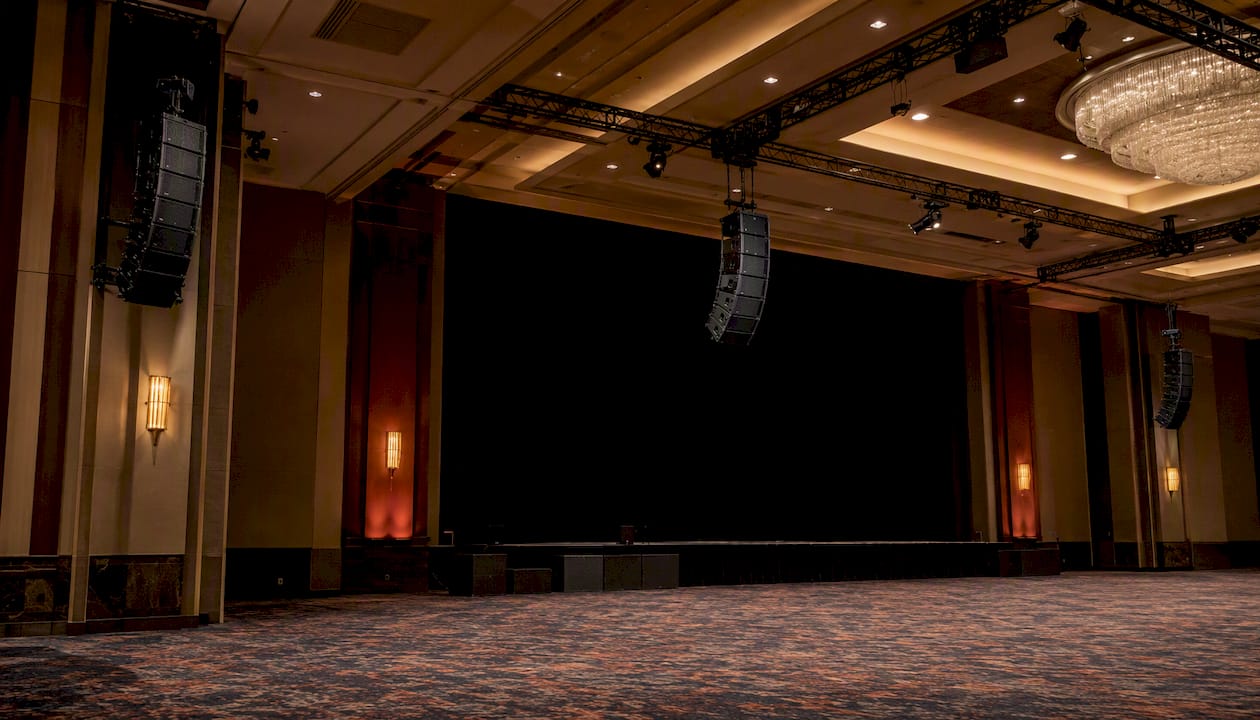
Rental versus purchase: for events held fewer than four times per year in the same room, rental from a professional supplier with an on-site engineer is almost always the better total cost of ownership. Active (self-powered) speakers reduce amplifier rack complexity; passive systems allow more granular amplifier matching but require careful power budgeting.
How to choose a vendor and what to require in proposals
Mandatory proposal elements that separate professional suppliers from commodity rental houses:
- STIPA or STI measurement methodology and sample reports from comparable events
- Rigging and mounting plans with load calculations for flown systems
- Redundancy strategy: backup mixer, spare wireless channels, redundant signal paths
- Named operator staffing with stated experience level
- Warranty and service terms, including on-site response time for failures
- Customer references from corporate events of similar scale
Score proposals across speech intelligibility documentation, coverage uniformity evidence, scalability for your room, redundancy depth, and total cost of ownership including operator fees and travel.
Pro Tip: Require documented tuning presets and a rehearsal run-through as explicit contract deliverables. A vendor who tunes the system and saves named presets for your event configuration can restore a known-good state in minutes if something changes on event day. That discipline is a mark of genuine operational pedigree.
Commissioning and testing: the checks that prove the system works
No system should be accepted without measured evidence. Require these tests before the event opens:
- STIPA/STI sweep: confirms speech intelligibility meets the 0.60 threshold at multiple seat positions
- Swept-sine measurement: verifies system linearity and identifies any driver or amplifier faults
- Walk-the-room SPL check: confirms even coverage within ±3 dB across the audience area
- Documented presets: saved and labelled configurations for speech, music, and hybrid modes
If targets are not met, the remedial sequence is: retuning and EQ adjustment first, then acoustic treatment, then speaker repositioning. Document every remedial step so the final preset reflects the corrected state.
Day-of operations and maintenance checklist for reliable performance
Consistent delivery on event day depends on disciplined pre-show procedure. Essential checks:
- RF scan across the full wireless frequency range; confirm no active interference on assigned channels.
- Battery check and replacement on all wireless transmitters, regardless of remaining charge.
- Firmware confirmation: no pending updates that could trigger a reboot mid-event.
- Connector and cable integrity check at every patch point.
- Walk-the-room SPL verification with the room at near-full occupancy if possible.
- Recall saved DSP presets and confirm system responds as documented.
Operator responsibilities during the event include live mixing for presenter level consistency, mic handover protocols between speakers, and coordinating with the DJ on music level transitions between programme segments. The DJ integration point is critical: the operator and DJ must agree on cue signals before the event begins.
Pro Tip: Single-fault tolerance is the standard for professional corporate events. That means a backup mixer ready to switch in under two minutes, redundant signal paths from stage to FOH, and at least two spare wireless channels pre-scanned and ready. Sports event DJ equipment guidance covers redundancy principles that translate directly to corporate event operations.
What we have learned at DJ Phoenix Entertainment
At Dj-phoenix, the most consistent lesson across corporate events, from brand activations for Mercedes-Benz to large-scale sports productions with FW Sports, is that the briefing conversation determines the outcome. When a planner shares the event’s objectives, the run-of-show and the audience profile before load-in, the DJ can shape every musical moment with intention: the arrival energy that sets the tone, the subtle tempo shift that signals a transition from networking to programme, and the closing sequence that sends attendees out on a high note.
Treating the DJ as part of your corporate event strategy rather than an end-of-night add-on changes the entire arc of the event. Music becomes a pacing tool, not background noise. The synergy between a calibrated sound system and a DJ who understands corporate objectives is what separates a polished, memorable event from one that simply ran on schedule.
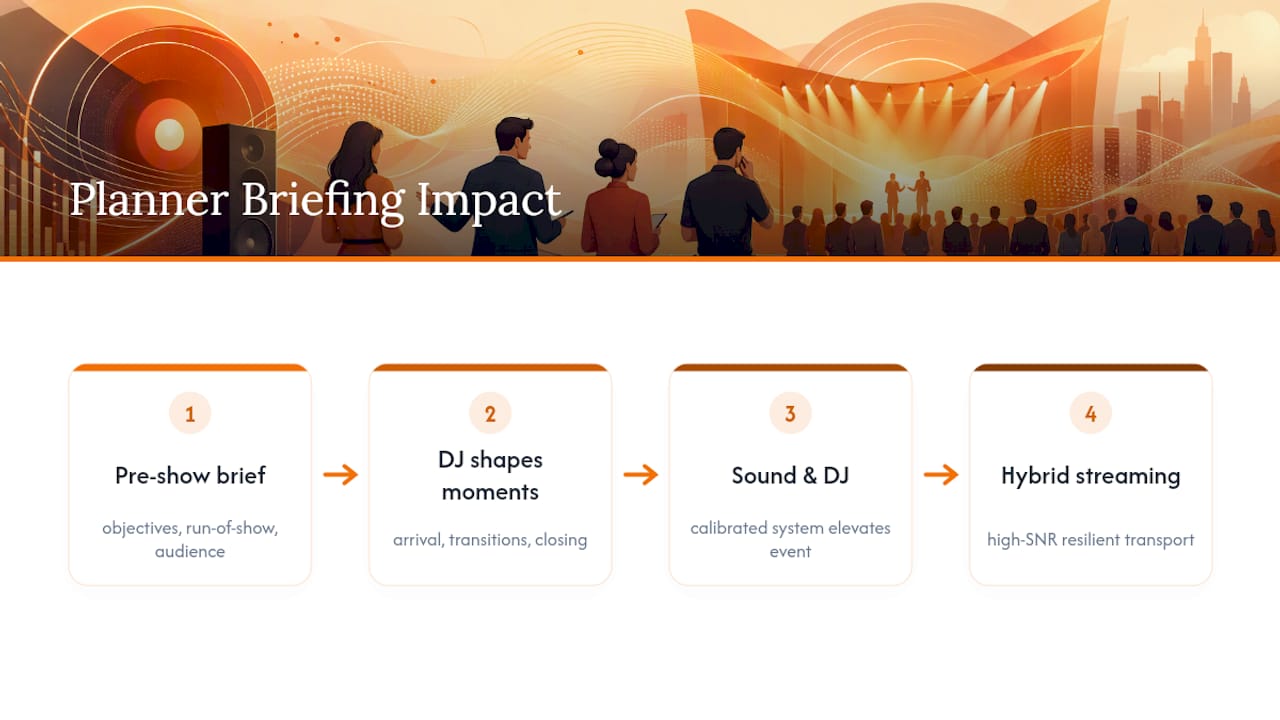
For hybrid events, that same discipline extends to the streaming chain. A high-SNR digital signal path and resilient transport protect the remote audience’s experience with the same rigour applied to the room.
Dj-phoenix corporate services: what to expect when you book
Dj-phoenix brings a full-service approach to corporate audio that goes well beyond showing up with speakers. The process begins with a site survey and acoustic assessment, moves through system specification and commissioning with documented STIPA verification, and concludes with a rehearsal run-through that integrates the DJ into the run-of-show before a single guest arrives. On event day, a dedicated operator manages the system while the DJ handles programme pacing, mic transitions, and energy management across every segment.
Services available to corporate planners include professional DJ performance with stage management, sound-system rental scaled to your room, operator staffing, and audience engagement strategy tailored to your brand objectives. Clients such as Mercedes-Benz and FW Sports have trusted this calibre of delivery for events where brand reputation is on the line.
To discuss your event’s requirements and receive a proposal that includes measured STI targets and documented presets, visit the Dj-phoenix corporate events page and request a consultation.
Sources
A short list of authoritative references for planners who want to go deeper on the technical and strategic dimensions covered above:
- Corporate AV: Choosing pro sound systems for conferences
- The impact of high-fidelity audio on corporate message retention
- The importance of sound in corporate events
When reviewing vendor proposals, ask for STIPA reports and walk-the-room SPL data from events of comparable scale. A supplier who can produce that evidence has already demonstrated the operational discipline your event deserves.