A wedding after-party is a separate, high-energy gathering that continues once your reception officially ends, and it deserves its own dedicated music plan rather than a stretched-out version of your dinner and dance set. The reception carries the sentimental weight: first dances, speeches, generational crowd-pleasers. The after-party exists purely for movement. Fewer ballads, no obligatory line dances for great-aunts, just continuous, danceable tracks built for a room that already wants to be there.
The fastest solution: hand your DJ (or your own playlist) this shortlist and build outward from it.
- “Uptown Funk” — Mark Ronson ft. Bruno Mars
- “Levitating” — Dua Lipa
- “I Wanna Dance with Somebody” — Whitney Houston
- “About Damn Time” — Lizzo
- “Mr. Brightside” — The Killers
- “One Dance” — Drake ft. Wizkid & Kyla
- “Dancing Queen” — ABBA
- “Sicko Mode” — Travis Scott
- “Cake by the Ocean” — DNCE
Editor’s callout: Most after-party sets run up to two hours, and depending on song length and mixing style, the playlist needs enough tracks to stay full and continuous without repeating an artist too soon.
Key Takeaways
The most effective wedding after-party playlist pairs a short, high-energy song list with a clear three-phase sequencing plan and a tight DJ brief.
| Point | Details |
|---|---|
| Define the after-party separately | Treat it as its own musical event with a focused, high-BPM set, not a reception extension. |
| Sequence in three phases | Warm up at 100 to 115 BPM, peak at 120 to 128 BPM, then save top anchors for the final 30 to 45 minutes. |
| Keep the DJ brief short | Give 10 to 15 must-plays and 2 to 5 do-not-plays so the DJ can still read the room. |
| Confirm venue logistics early | Check noise ordinances, curfews, and overtime rates before booking your after-party space. |
| Hire a pro for real crowd reading | Dj-phoenix curates playlists and adjusts live to keep the floor full beyond what a fixed list can do. |
Table of Contents
- Curated wedding after party playlist ideas by genre and mood
- How to sequence your after party for maximum energy
- What to tell your DJ: must-plays, do-not-plays, and anchors
- Venue, timing, and who runs the music
- Reading the room: practitioner tips that keep the floor full
- Why the “just make a playlist” advice misses the point
- Book a professional DJ for your after party
- Sources
Curated wedding after party playlist ideas by genre and mood
Building a full playlist from scratch at 11 p.m. the night before your wedding is a bad use of your time. Start from a proven shape instead, then swap in songs that fit your crowd. Every list below assumes a roughly 60-minute core set, since that’s the sweet spot most venues and DJs work with before a hard curfew or noise ordinance kicks in.
1. High-energy pop and dance
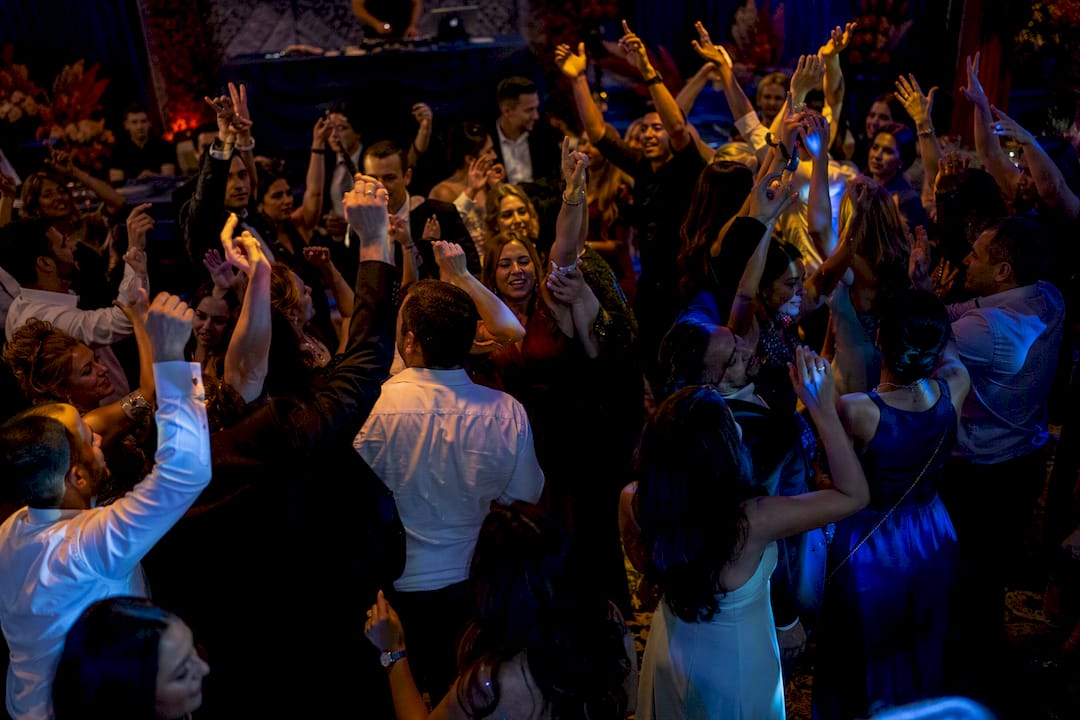
This is the backbone of almost every successful after-party, because pop-dance hits are the songs the widest range of guests already know the words to. A 60-minute pop and dance set needs roughly 16 to 20 songs at typical dance-track lengths of three to three-and-a-half minutes each. Lean on tracks with a steady four-on-the-floor beat: think “Blinding Lights” by The Weeknd, “Don’t Start Now” by Dua Lipa, and “Can’t Stop the Feeling!” by Justin Timberlake. These work because they rarely require a lyrical explanation, everyone already knows the chorus.
2. EDM and remix-driven sets
If your crowd skews younger or you’re hosting at a venue with a real sound system, an EDM-leaning set with remixes and club edits will outperform radio versions almost every time. Club edits typically extend intros and outros for cleaner mixing, which matters more here than in a reception set because after-party transitions need to stay seamless to hold energy. Ask your DJ specifically for remix or extended versions of songs like “One Kiss” by Calvin Harris and Dua Lipa, or “Titanium” by David Guetta ft. Sia. A pure EDM hour can run leaner on song count, around 14 to 18 tracks, since many club edits stretch past four minutes.
3. Hip-hop and R&B for rhythmic floor fill
Hip-hop and R&B tracks are often the most reliable floor-fillers of the entire night because the beat is instantly recognizable within the first two seconds. Songs like “In Da Club” by 50 Cent, “Yeah!” by Usher ft. Lil Jon and Ludacris, and newer cuts from artists in contemporary hip-hop and R&B rotations give you rhythmic consistency that pop alone can’t. Budget around 18 to 22 songs for a full hour here, since hip-hop tracks tend to run shorter and mix cleanly back to back.
4. Throwback singalong block
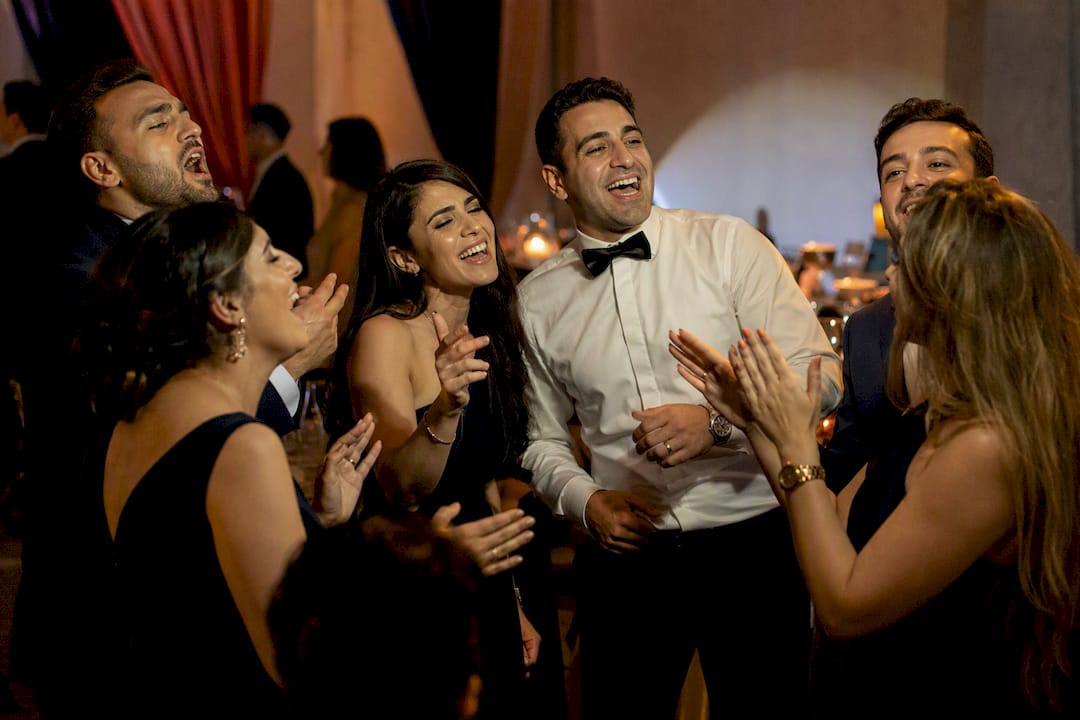
Cross-generational appeal matters even at an after-party, especially if parents, aunts, and uncles are sticking around past midnight. A throwback block bridges the gap: “Mr. Brightside,” “Dancing Queen,” “September” by Earth, Wind & Fire, “Livin’ on a Prayer” by Bon Jovi. These songs work at any after-party because guests sing before they dance, and singing together is its own form of floor commitment. Fifteen to eighteen throwback songs comfortably fill 45 to 60 minutes given their typically longer runtimes.
5. Country and line dance integration
For couples with a country-leaning guest list, don’t abandon the genre entirely at the after-party, just concentrate it. Pick three or four high-tempo country hits (think anything built for a boot-scoot rather than a slow two-step) and cluster them together early in the set rather than scattering them throughout. Trying to weave country into an EDM-heavy hour usually kills momentum on both ends.
Adjusting playlist length
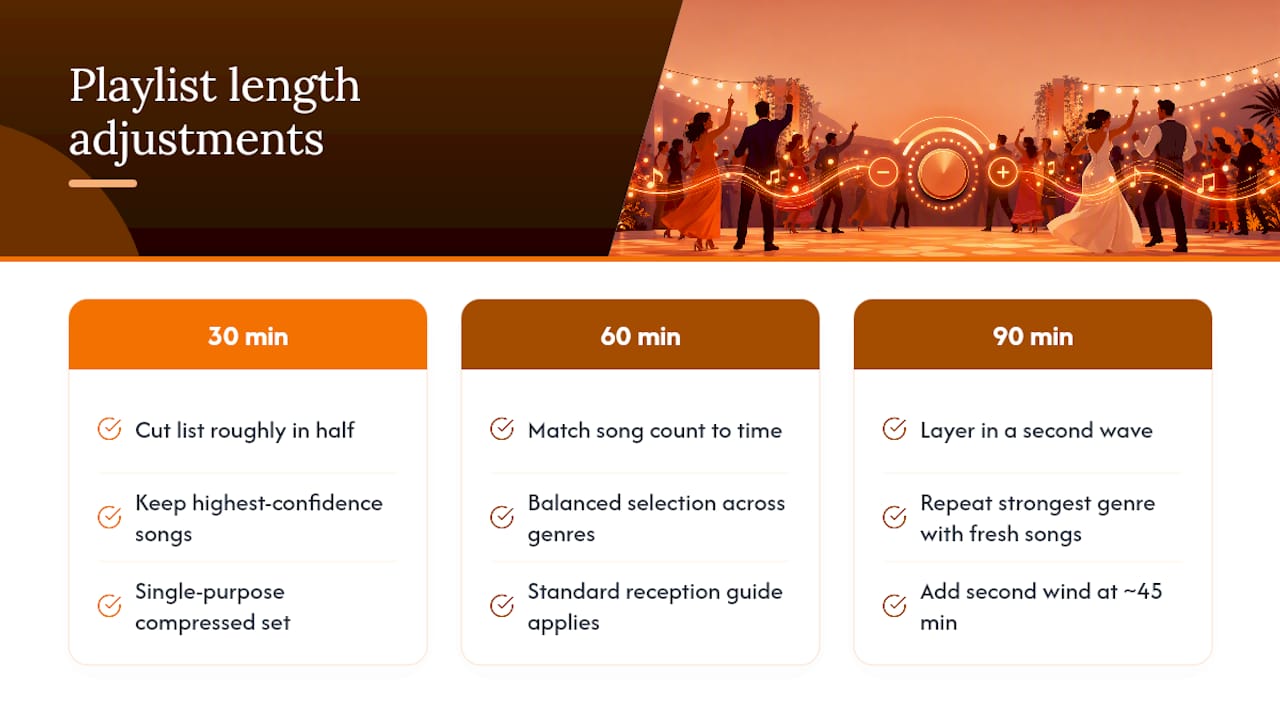
To compress any of these into a 30-minute set, cut the list roughly in half and keep only your highest-confidence songs, the ones you’re certain will fill the floor. To expand to 90 minutes, don’t just add more of the same genre. Layer in a second wave: repeat your strongest genre category with fresh songs after roughly 45 minutes, giving the set a second wind instead of a flat plateau. The reception playlist guide approach of matching song count to available time applies directly here, just compressed into a shorter, single-purpose window.
How to sequence your after party for maximum energy
Treat the after-party as its own musical event with its own brief, not an extension of the reception. That distinction changes how your DJ builds the set. A reception has to serve dinner, speeches, family dances, and open dancing all in one night. An after-party has one job: keep the floor full for a short, intense window. That singular focus is what lets you sequence deliberately instead of reactively.
The most reliable structure breaks into three phases:
- Warm-up (first 15 to 30 minutes): Start at a moderate tempo, roughly 100 to 115 BPM, with familiar, low-commitment songs that get people off their chairs without demanding much.
- Sustained peak (next 45 to 60 minutes): Push tempo into the 120 to 128 BPM range and stay there. This is where your strongest, most recognizable tracks live, mixed with a couple of surprises to keep attention.
- Final anchors (last 30 to 45 minutes): Save your two or three absolute biggest singalong or dance anthems for this window. A well-sequenced set builds toward these rather than spending them early, because momentum that peaks too soon has nowhere left to go.
Moving between genres without losing the floor comes down to tempo bridges. Jumping straight from a slow hip-hop groove to a 128 BPM EDM track jars people out of the moment. A skilled DJ ramps tempo gradually across two or three songs, or uses a percussion-only breakdown to reset the energy before climbing again.
If you need a breather moment (and most after-parties benefit from exactly one), place it around the 40-minute mark, never in the final anchor stretch. One slightly slower, still-danceable song gives tired feet a break without emptying the floor.
Pro Tip: Ask your DJ to keep crossfades between eight and sixteen seconds during the peak block. Shorter fades feel abrupt and break the crowd’s rhythm; longer fades during peak energy can feel like the set is stalling.
What to tell your DJ: must-plays, do-not-plays, and anchors
Your DJ brief should be short enough to fit on one page. Pro DJs generally recommend a must-play list of 10 to 15 songs, no more. Beyond that number, you’re not giving guidance, you’re handing over a full setlist and removing the DJ’s ability to read the room in real time.
- Must-plays (10 to 15 songs): Include two or three genuine anchor songs you want saved for the final 30 minutes, not played early out of excitement.
- Do-not-plays (2 to 5 items): Keep this list specific and polite. “No breakup songs” or “please skip anything by [artist]” works better than a vague “nothing sad.”
- Guest requests: Decide upfront whether requests get filtered through your music manager or go straight to the DJ. A filtered policy protects your must-plays; an open policy builds goodwill but risks derailing your sequencing.
A clear do-not-play list protects your priorities while still giving your DJ room to work.
Venue, timing, and who runs the music
Where you host your after-party shapes almost everything else. A nearby bar keeps costs down but limits your control over sound quality and closing time. A hotel lounge, especially one attached to your wedding block, offers convenience and often a later curfew, though sound systems vary wildly in quality. An on-site permitted area at your reception venue is the smoothest option logistically, assuming the venue allows extended hours.
Before locking in a location, confirm three things directly with the venue:
- Noise ordinances and curfew times, especially for outdoor or shared-building spaces.
- Whether your existing DJ contract covers overtime, or whether a new booking is required.
- Power and sound equipment availability, since a bar’s house speakers are rarely built for a dance floor.
Your DJ brief for this phase should include the full timeline, your must-play and do-not-play lists, your request policy, and any overtime rates in writing before the big day. Assign one person, a wedding party member or your planner, as the designated music point of contact. If your DJ needs a decision mid-set, that person makes the call so the couple never has to step off the dance floor to manage logistics. Have a simple backup plan too, a phone with a pre-loaded playlist and a Bluetooth speaker covers you if equipment fails.
Reading the room: practitioner tips that keep the floor full
A cooling floor shows itself early if you know what to watch for: guests drifting toward the bar mid-song, phones coming out, or a noticeable drop in singing along. When that happens, a pro DJ won’t wait it out. They’ll cut to a proven crowd-pleaser immediately, adjust tempo up rather than down, or bring the newlyweds back onto the floor, since your own energy on the dance floor during warm-up and peak moments is one of the most reliable ways to keep guests dancing alongside you.
Transitions matter more than most couples realize. Tempo ramps (gradually increasing BPM across two or three songs) keep momentum climbing instead of resetting it. Percussion fills bridge genre gaps without a jarring stop. Mashups let a skilled DJ blend a familiar hook into an unexpected genre shift, which often re-engages a floor that’s gone quiet.
When one genre dominates too long or requests pile up faster than they can be worked in, the fix isn’t to abandon the plan. It’s to insert one high-confidence anchor song to reset the room, then return to the brief.
Pro Tip: If the floor empties fast, resist the urge to play it safe with something slow. A sudden, unexpected genre switch, say, from pop straight into an old-school hip-hop anthem, often pulls people back faster than another predictable pop hit.
Why the “just make a playlist” advice misses the point
Most wedding content treats the after-party playlist as a song list problem: pick 25 tracks, hit shuffle, done. That’s incomplete advice. A static playlist can’t respond when the floor empties because a slow song crept in too early, or when forty guests suddenly want the same request. Song selection matters, but sequencing and real-time reading matter more, and editorial listicles rarely cover either.
The conventional wisdom oversells the reception playlist as a template you can extend into the after-party. It can’t be, because the goals are different: one entertains a room full of different generations, the other keeps a smaller, self-selected crowd moving for a short, intense window. Treating them the same is why so many after-parties fizzle by midnight.
If you take one thing from this guide, prioritize the brief over the playlist. A tight must-play list, a clear do-not-play list, and a sequencing plan matter more than the exact fortieth song on your list. Song choice is replaceable in the moment; a missing plan is not.
— Reza
Book a professional DJ for your after party
A curated playlist gets you started, but a professional DJ who reads your specific crowd in real time is what actually keeps a floor full for two straight hours. Dj-phoenix builds after-party sets around live crowd feedback rather than a fixed list, adjusting tempo, genre, and anchor timing on the fly, something no pre-made playlist can do.
Dj-phoenix’s after-party services cover playlist curation across genres, emcee support to keep transitions smooth, and professional sound equipment rental sized to your venue, whether that’s a hotel lounge or an on-site space. Couples working with multicultural guest lists or blended music tastes benefit especially from a DJ experienced at reading diverse crowds without losing momentum between genre shifts.
If your after-party venue has a hard curfew, a smaller sound system, or a guest list spanning several musical tastes, hiring a pro is strongly worth it over a DIY playlist. Browse the DJ performance gallery to hear how sets like this come together, or reach out through Dj-phoenix to check availability and get a quote for your date.