A wedding DJ typically costs within a broad range for the middle range of bookings nationwide, with a median cost according to WeddingDJFinder’s 2026 industry index. That figure covers a standard reception only. Ceremony sound, cocktail hour, lighting, and travel almost always ride on top as separate line items, so treat any quote below $1,000 with a healthy dose of scrutiny.
TL;DR:
- Lower-cost options often cover only four hours with minimal services, while premium packages include multiple staff, elaborate lighting, and full-day coverage, exceeding $3,000.
- Additional fees frequently apply for ceremony sound, cocktail music, lighting, travel, and overtime, making upfront, itemized quotes essential.
- Experience, equipment quality, logistics, and date season significantly influence a DJ’s final price, with last-minute bookings often costing more.
- Clear, detailed, itemized contracts that specify hours, extras, and policies prevent unexpected costs and ensure quality service.
Table of Contents
- Wedding DJ cost: average price snapshot and survey data
- What do wedding DJ packages typically include at each price tier?
- What factors actually drive a wedding DJ’s price?
- What hidden fees show up on a wedding DJ invoice?
- How much should you budget for a DJ based on guest count?
- How do you book a wedding DJ and what belongs in the contract?
- How Reza reads a wedding DJ quote before recommending it
- Why transparent, itemized pricing changes everything
- Get a clear, itemized DJ quote for your wedding
- Sources
Wedding DJ cost: average price snapshot and survey data
Three major industry sources land in slightly different places, and knowing why matters more than memorizing the numbers. WeddingDJFinder’s national index pulled data from 9,422 working DJs and found a median of $1,400, with the middle 50% of bookings falling between $650 and $2,685. That spread is wide because it blends everything from a solo operator with a laptop and two speakers to a full production crew running lighting rigs and backup systems. WeddingWire’s cost guide reports a lower average, with most couples paying within a mid-range band. The Knot’s Real Weddings study puts the average higher than WeddingWire’s estimate. None of these numbers are wrong. They’re sampling different pools of vendors, different regions, and different definitions of what counts as a “wedding DJ” package.
Why the range matters more than the average: A quote sitting at the 25th percentile ($650 nationally) usually signals a newer DJ, a shorter booking window, or a stripped-down package. A quote near the 75th percentile ($2,685) often reflects a full-service operation with lighting, an MC, and redundant equipment. Knowing where a quote falls on that curve tells you more than the dollar figure alone.
A few things consistently move these averages up or down:
- Market size. Major metros and destination-wedding hotspots run well above the national median, while smaller cities and rural markets often land near or below the 25th percentile.
- Season and day of week. Peak wedding months (typically May through October) and Saturday dates command premium pricing across nearly every market.
- Booking timeline. DJs booked less than 90 days out often charge a premium for last-minute scheduling, especially during peak season.
The takeaway: use the national median as a planning anchor, not a promise. Your actual quote depends heavily on where you live, when you’re getting married, and what “included” actually means to the vendor you’re calling.
What do wedding DJ packages typically include at each price tier?
Not every DJ package covers the same ground, and the price tag often tells you exactly where the line gets drawn. Breaking the market into four rough tiers helps you judge whether a quote represents genuine value or a stripped-down offer dressed up with a nice website.
- Entry-level ($500–$900). Usually a solo DJ with basic sound equipment, four hours of reception coverage, and minimal MC involvement. Lighting, ceremony audio, and cocktail-hour music are almost always extra, if offered at all. This tier suits couples with a tight budget who plan to handle their own playlist curation and timeline coordination.
- Mid-market ($900–$1,800). This is where most couples land. Expect five to six hours of coverage, a dedicated MC who handles announcements and transitions, basic dance-floor lighting, and a consultation call to build the playlist. Backup equipment is more common at this level, though not universal.
- Experienced ($1,800–$3,000). DJs at this tier typically bring a proven track record, better sound systems, uplighting or monogram projection, and a more thorough planning process, often including an in-person or video consultation and a detailed timeline document.
- Premium ($3,000+). Full production packages with multiple staff, elaborate lighting design, ceremony and cocktail-hour coverage bundled in, and DJs who’ve worked prestigious venues or corporate clients. This tier often includes redundant equipment setups so a single failure never stops the music.
For a typical 5 hour reception, illustrative all-in totals look roughly like this once add-ons are factored in:
- Entry-level all-in: $700 to $1,100 (reception only, no ceremony or lighting)
- Mid-market all-in: $1,400 to $2,200 (reception plus basic lighting, sometimes ceremony)
- Premium all-in: $3,000 to $5,000+ (full ceremony-to-send-off coverage with production)
Dj-phoenix structures its wedding packages around this exact logic, laying out what’s included at each level so couples aren’t left guessing what a “reception package” actually covers. If your budget sits at the lower end, it’s worth looking at what a cheaper wedding DJ option actually includes before assuming it’s a bargain.
What factors actually drive a wedding DJ’s price?
Two DJs quoting the same dollar figure can be offering wildly different value, and the difference almost always comes down to five factors hiding inside the fine print.
Hours covered and overtime structure. Most reception packages run four to six hours. Overtime commonly runs $100 to $250 per hour, but the more important detail is how “event end time” gets defined in the contract. Some DJs count from ceremony start, others from reception start, and that gap can quietly eat an hour of coverage you thought you’d paid for.
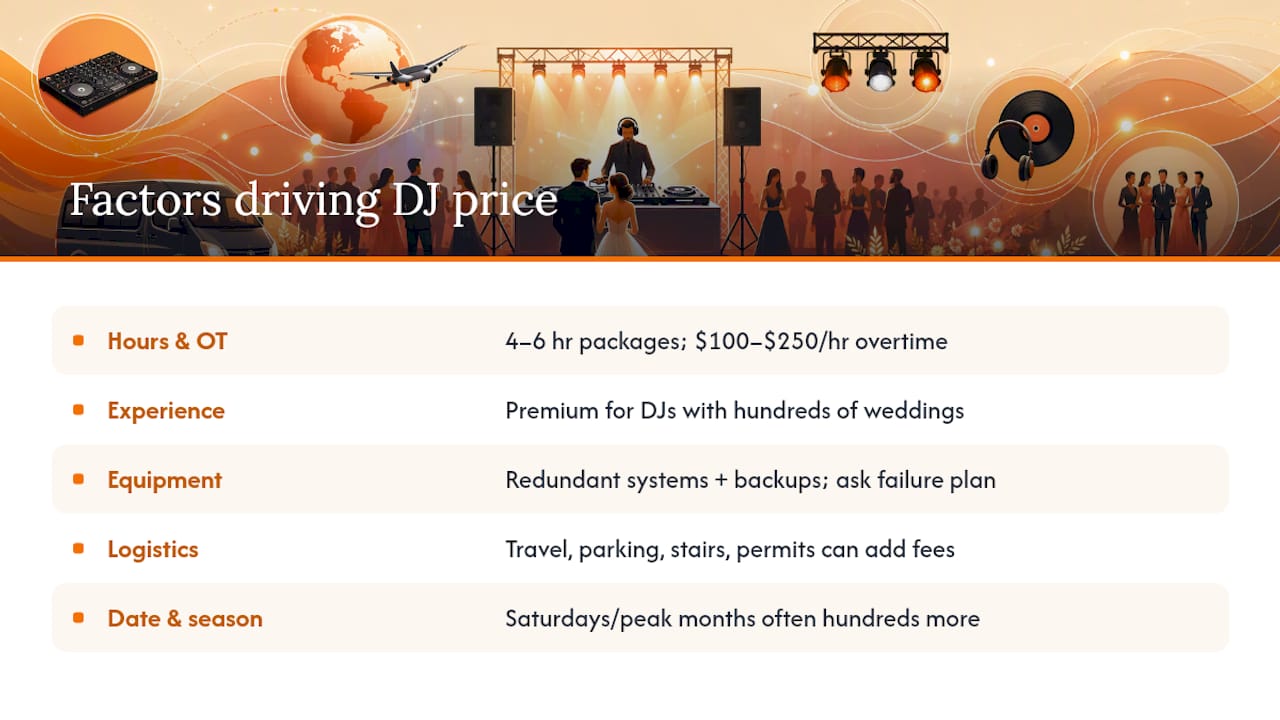
Experience and reputation. A DJ who has worked hundreds of weddings and reads a room well commands a premium over someone still building a portfolio. This isn’t just ego pricing. Experienced DJs make fewer transition mistakes, handle awkward moments (a delayed bridal party, a technical glitch) without the dance floor noticing, and know how to pace a night so energy peaks at the right moments.
Equipment and backups. A single speaker and a laptop is not the same investment as a redundant sound system with a backup mixer and spare cabling. Ask directly what happens if a piece of equipment fails mid-reception. If the answer is vague, that’s a signal.
Logistics. Travel distance, load-in complexity (stairs, tight parking, freight elevators), and venue permit requirements all add cost. Travel fees often scale with distance and can include tolls, parking, or staging labour, sometimes surfacing only as a post-event invoice if nobody nailed down a cap beforehand.
Date and season. Saturday dates in peak months routinely cost more than a Tuesday in February, sometimes by several hundred dollars for the exact same package.
Pro Tip: Ask every DJ the same question, word for word: “What is the exact overtime rate per hour, and how is event end time defined?” The answers will vary more than you expect, and the differences reveal a lot about how carefully that vendor runs their business.
What hidden fees show up on a wedding DJ invoice?
The quoted price rarely tells the whole story. WeddingDJFinder’s research found that only a small share of DJs publish their pricing publicly, which means most couples are comparing verbal or emailed quotes that may not itemize everything the same way.
The most common add-ons to watch for:
- Ceremony sound. Often requires a second, separate audio setup since ceremonies frequently happen in a different location than the reception. This commonly adds $200 to $500 on top of the reception fee.
- Cocktail-hour music. Another semi-separate setup, typically adding $100 to $300 depending on whether it’s the same system or a dedicated speaker.
- Uplighting and lighting packages. Priced per fixture or as a flat package, ranging from a couple hundred dollars for basic accent lighting to over a thousand for a full room transformation.
- Travel and parking. Rarely disclosed upfront unless you ask directly for a capped travel estimate.
- Vendor overtime meal or wait fees. Some venues require vendor meals; some DJs charge a wait fee if the timeline slips significantly.
Vague language is the biggest red flag in any contract. Phrases like “additional fees may apply” or “pricing subject to change based on venue requirements” without specifics should prompt a direct follow-up question before you sign anything.
How much should you budget for a DJ based on guest count?
Guest count affects DJ pricing less directly than most couples assume; a DJ playing for 50 guests uses roughly the same equipment as one playing for 150. What guest count really drives is venue size, which affects sound coverage needs, and reception length, which affects hours booked.
Here’s how sample all-in budgets typically shake out across tiers:
Adding ceremony coverage typically adds $200 to $500 to any of these figures, and lighting packages add another few hundred to over a thousand depending on scope. If you’re weighing a DJ against a live band, comparing the two formats directly is worth doing before you lock in a budget line, since bands generally run higher per The Knot’s cost comparison.
For overall budget allocation, Zola recommends dedicating roughly 3% of the total wedding budget to music and entertainment. On a $30,000 wedding, that puts you around $900, which tracks closely with the mid-market tier for smaller guest counts but may require trimming elsewhere for larger receptions with full production needs.
How do you book a wedding DJ and what belongs in the contract?
Booking a DJ isn’t just picking a date and paying a deposit. The contract is where vague verbal promises either become enforceable commitments or quietly disappear. Here’s the order to work through it:
- Book 9 to 12 months out for peak-season Saturday dates in major markets; 6 months is often fine for off-peak dates or smaller markets.
- Expect a deposit of 25% to 50% of the total package price to hold your date, with the balance due somewhere between 30 and 7 days before the event.
- Confirm exact hours and overtime rate in writing, including how the DJ defines “event end time.”
- Ask about backup equipment and what the contingency plan looks like if something fails.
- Get the cancellation and refund policy in writing, including what happens if the wedding is postponed rather than cancelled outright.
- Verify liability insurance, especially if your venue requires proof of coverage from vendors.
- Request a written timeline at least a few weeks before the wedding so the DJ knows exactly when to cue the entrance, toasts, and first dance.
Pro Tip: Bring your questions to the consultation call, not the contract signing. A DJ who answers overtime and backup-equipment questions clearly and immediately, without hedging, is usually the same DJ who runs a tight, well-organized reception.
A detailed timeline template like the one on Dj-phoenix’s booking guide can help you map out exactly when each moment needs to happen.
How Reza reads a wedding DJ quote before recommending it
After years of building custom playlists for multicultural celebrations and high-profile clients including Mercedes-Benz and FW Sports, Reza has developed a short mental checklist for evaluating any DJ quote, including quotes from competitors couples are comparing against Dj-phoenix.
- Does the quote specify exact hours, or does it say something vague like “full reception coverage”?
- Is the overtime rate a flat number, or does the contract avoid mentioning it entirely?
- Does the vendor mention backup equipment without being asked?
- Is ceremony and cocktail-hour coverage itemized separately, or bundled in a way that’s hard to verify?
The biggest mistake couples make when comparing quotes is assuming two similar dollar figures represent similar value. I’ve seen quotes that look nearly identical on paper, where one includes a backup sound system and a detailed written timeline, and the other includes neither. The gap only becomes obvious the week of the wedding, when it’s too late to fix.
A common hidden-cost scenario: a couple books what looks like a complete package, only to discover during the final planning call that ceremony audio was never included and now costs an extra few hundred dollars, with two weeks left before the wedding. That scenario is entirely avoidable if the itemized breakdown gets requested during the initial consultation rather than assumed from a website price.
Why transparent, itemized pricing changes everything
Working across weddings, corporate events, and multicultural celebrations has taught me that the couples who feel most confident on their wedding day are rarely the ones who paid the most. They’re the ones who knew exactly what they were paying for, months before the reception started. A quote with every hour, every add-on, and every contingency spelled out in writing removes the anxiety that builds when details stay vague. Clarity upfront is what prevents the awkward last-minute invoice, and it’s the single habit I’d want every couple to walk away with from this guide.
— Reza
Get a clear, itemized DJ quote for your wedding
Comparing vague quotes against each other is exactly the friction this guide has walked you through, and it’s the reason Dj-phoenix builds every wedding proposal as a fully itemized breakdown rather than a single bottom-line number. You’ll see reception hours, ceremony and cocktail-hour audio, lighting, and travel listed separately from the start, so there’s no guessing what happens if your timeline runs long or your venue has tricky load-in.
Dj-phoenix brings the same crowd-reading expertise used for clients like Mercedes-Benz and FW Sports to weddings, with playlist curation built specifically for multicultural celebrations and guest lists that span generations and tastes. Browse the performance gallery to see that production quality in action, then reach out for a written, itemized quote built around your actual guest count, venue, and timeline. If you’re still narrowing down what to look for, the DJ selection guide is a useful next stop before you request pricing.
Sources
This guide draws on the following industry data and budgeting resources:
- Wedding DJ Prices in 2026: Data From 9,422 DJs Nationwide | WeddingDJFinder
- Wedding DJ Cost Guide | WeddingWire
- The Average Cost of Hiring a Band or DJ for Your Wedding | The Knot
- How much does a wedding DJ cost? | Paperlust