For most product launches, a curated DJ, sometimes paired with a live element, gives you the best control over pacing, energy, and the reveal itself. That means building a cue sheet early, briefing your AV team on the exact transition, and rehearsing the moment before guests arrive. Music should ease networking, hold the room during the reveal, then release into celebration.
TL;DR:
- A scripted cue sheet with clear roles and buffer time is essential to coordinate music, lighting, and visuals during the reveal, preventing synchronization issues.
- Hybrid DJ and live setups are recommended for flagship launches to combine spectacle with precise control, while DJ-only options are more budget-friendly for smaller or B2B events.
- Budgeting depends on format and duration, with live bands costing between $3,000 and $12,000, and custom arrangements or travel adding to costs.
- Briefing a DJ requires specific experience with scripted cues and technical requirements, not just wedding-style playing skills, to ensure seamless transitions.
- Building a consistent sonic identity throughout the event reinforces brand recognition, especially when integrating custom stings, call-and-response, and culturally relevant tracks.
Table of Contents
- Choosing the right musical format for your product launch
- How do you build a run of show for the reveal?
- Curating a playlist and sonic identity for each event phase
- Technical coordination: sound system, stage plot, and AV integration
- What does product launch music actually cost?
- How do you brief and hire a DJ for a product launch?
- Using music to reinforce your brand’s message
- Coordinating music with visuals and multimedia during the reveal
- Planning for music-related technical problems on the night
- Planner perspective: what actually separates a good launch from a great one
- How Dj-phoenix helps you execute launch music that actually lands
- Sources
Choosing the right musical format for your product launch
The format you choose sets the emotional architecture of the whole event. A DJ-only setup gives you the tightest control: instant transitions, real-time reading of the room, and a smaller technical footprint that fits almost any venue, from a rooftop reveal to a downtown showroom.
A live band brings visceral spectacle, ideal when the product itself is aspirational or lifestyle-driven, like a flagship vehicle or a luxury fashion line. The trade-off is staging complexity. Bands need more square footage, more input channels, and more rehearsal time to nail a precise cue.
A hybrid DJ-plus-live setup often lands closest to what serious brand launches need. Live musicians or hybrid elements are frequently recommended for flagship launches that want spectacle, while a DJ handles the connective tissue between segments and keeps the energy consistent when the band isn’t playing.
Match the format to your audience and product:
- Tech or B2B product reveal: DJ-only, subtle underscoring, minimal stage footprint.
- Consumer lifestyle or flagship launch: hybrid DJ and live instrumentation for spectacle.
- Large-scale or multi-brand event: DJ with a stage plot flexible enough to slot in a live cameo.
Whichever you pick, footprint and staging decisions ripple into your AV budget, so lock the format before you finalize the floor plan.
How do you build a run of show for the reveal?
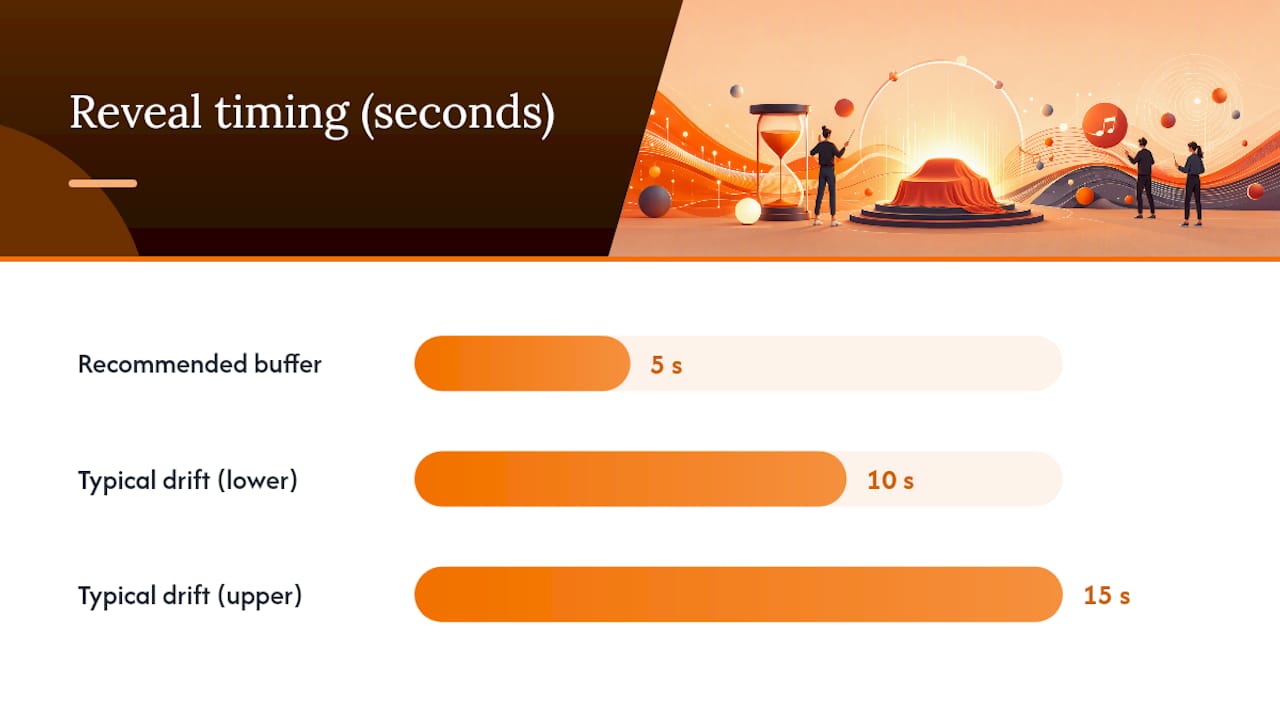
A cue sheet is the single document that keeps your DJ, AV operator, and stage manager reading from the same script. Without one, even a well-rehearsed reveal can drift by ten or fifteen seconds, and that gap is exactly where things go visibly wrong in front of your guests.
Your cue sheet needs these fields, distributed to every person touching sound or light that night:
- Segment name and start time (arrival, speeches, reveal, celebration).
- Track or cue name, with exact run time and fade points.
- Trigger person, meaning who calls the cue, verbally or by hand signal.
- Transition type, whether it’s a hard cut, a fade, or a deliberate pause.
- Backup cue, in case the primary track fails or timing slips.
Documenting the exact sequence, what plays before the reveal, the transition point, any silence, and the post-reveal song, is what actually lets a cue sheet coordinate the reveal across band, DJ, AV, and stage management without a single missed handoff.
Assign one cue caller. Not two, not “whoever’s closest to the laptop.” One person owns the go signal, and everyone else executes on their mark. Rehearse the transition at least once during soundcheck, running the exact pause and launch sequence so musicians can adjust their dynamics to how the room actually sounds, not how it sounded in a rehearsal studio.
Pro Tip: Build a five-second buffer into every transition on your cue sheet. Live rooms are never as quiet as you expect, and that buffer is what saves you when a guest’s phone rings mid-reveal.
Curating a playlist and sonic identity for each event phase
Music has a different job in every phase of your launch, and treating the whole night as one playlist is where most events lose their edge. During arrival and networking, music needs to sit under conversation, not over it. During the reveal, it needs to build tension and then deliver a payoff. After the reveal, it needs to release energy and turn a room of standing guests into a room of dancing ones.
A tailored soundscape does more than fill silence. Industry voices consistently point to sonic branding as the layer that ties music to brand identity and makes a launch memorable days later, not just enjoyable in the moment. A short custom sting, built specifically for your product’s reveal, does more for brand recall than any generic build-up track ever will.
Build an energy profile by phase:
- Arrival: 60 to 90 minutes, low-mid tempo, conversational volume, genre matched to guest demographics.
- Reveal: a deliberate pause or near-silence, then a high-impact cue timed to the unveil.
- Post-reveal: high-energy, dance-forward, extended set that rewards guests for staying.
Brief your DJ with a must-play list, a do-not-play list, target tempo ranges, and any cultural notes relevant to your guest list, particularly for multicultural audiences where the wrong genre choice reads as tone-deaf rather than neutral.
Technical coordination: sound system, stage plot, and AV integration
Speech and performance audio need separate channels, always. Standard production guidance calls for dedicated channels for presentation and live-music audio, with quick-switch capability so a CEO’s remarks don’t fight a DJ’s fade for the same speaker output.
Before the doors open, confirm:
- Wireless mic frequencies are checked against other RF devices in the venue.
- A stage plot exists showing every input, monitor, and cable run.
- A backup audio source, a second laptop or a redundant mixer, is staged and tested.
- Volume zones are mapped so networking areas stay quieter than the stage.
Professional sound quality isn’t a luxury line item here. It’s the difference between a keynote that lands and one that gets lost in feedback. A properly specified PA system handles the dynamic range between a whispered product tagline and a full-volume post-reveal drop without distortion, and that range is exactly what a launch event demands.
What does product launch music actually cost?
Budgets scale with format and duration, so lock your format decision before you request quotes. DJ-only setups are the most cost-efficient option and scale cleanly with event length. Hybrid and full-band setups cost more because they carry more labour, more gear, and more rehearsal time.
Live bands built for flagship launches commonly run US$3,000 to $12,000, depending on ensemble size and whether the arrangement includes custom material written for the brand.
Factors that move the number:
- Custom composition or a bespoke sonic sting for the reveal.
- Travel and load-in for out-of-market talent.
- Total performance duration, including arrival and post-reveal sets.
- Rental-grade sound equipment versus venue house systems.
Book your DJ or band six to ten weeks out for a standard launch, and closer to twelve weeks if you want custom arrangements. Schedule your rehearsal and soundcheck window at least one day before doors open, never same-day.
How do you brief and hire a DJ for a product launch?
A DJ who’s played weddings all year isn’t automatically ready to run a corporate reveal. The skill set overlaps, but the stakes are different: a missed cue at a launch reads as a brand failure, not just an awkward pause on the dance floor.
Ask these questions before you book:
- Have you run a scripted reveal moment before, and can you describe how the cue was triggered?
- How do you coordinate with AV and a stage manager during a live segment?
- What’s your fallback if a cue is missed or a track fails mid-transition?
- Can you work from a written cue sheet rather than improvising the whole set?
- What PA and mixing equipment do you bring, and what do you need from the venue?
Request a rider listing PA specifications, number of inputs required, and a basic stage plot. Ask to see a performance gallery or set reel from a comparable corporate or brand event, not just a wedding highlight reel. If a candidate can’t answer the cueing question specifically, treat that as a red flag regardless of how polished their demo sounds.
Using music to reinforce your brand’s message
Music does more than fill air between speeches. It’s one of the fastest ways to signal brand identity before a single word of copy reaches the guest. A tempo, a genre, even the choice between a live saxophone riff and a synth pad tells your audience something about the product before they’ve seen it.
Repetition builds recognition. If your brand has a signature sonic motif, a jingle fragment, a specific instrument, or a rhythmic signature, weaving it through the arrival set and echoing it in the reveal sting creates a through-line guests register even if they can’t name it. This is the same principle behind sonic branding in retail and broadcast, applied to a single night instead of a year-round campaign.
Engagement techniques worth building into your run of show:
- Call-and-response moments, where the DJ prompts a crowd reaction tied to the brand tagline.
- Tempo shifts that mirror the presentation arc, slowing for storytelling, building for the reveal.
- Localized or culturally specific selections during networking segments, which read as genuine hospitality rather than generic background filler.
Live entertainment tends to outperform recorded playback on attendee engagement, a pattern reflected in industry reporting on event entertainment choices. A DJ who can read a room and adjust in real time delivers a brand experience a fixed playlist simply can’t replicate.
Coordinating music with visuals and multimedia during the reveal
The reveal moment is rarely music alone. It’s a synchronized stack of lighting, screen content, and sound, and the second any one of those elements drifts out of sync, the whole moment feels amateurish instead of engineered.
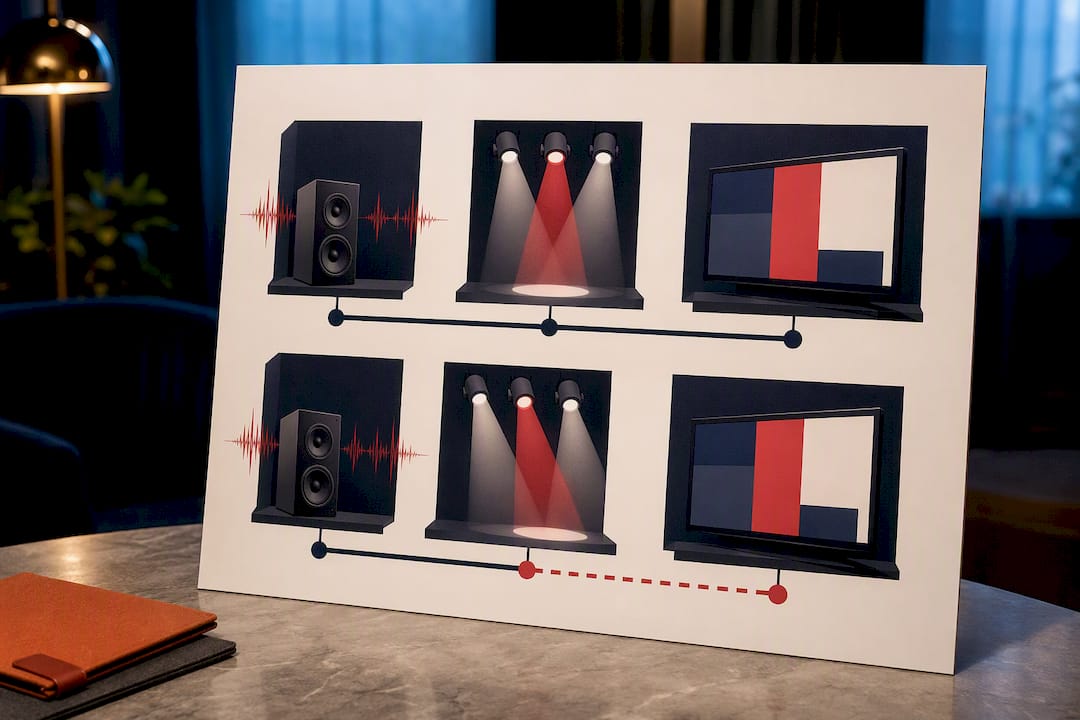
Your cue sheet should list lighting and video cues alongside audio cues, on the same timeline, not in a separate document your lighting operator has never seen. If a screen reveal happens on beat four of a musical build, write “beat four” on the sheet, not “when the video hits.”
Coordinate these elements as one system:
- LED walls or projection screens timed to musical builds, not the reverse.
- Lighting cues that shift in colour temperature or intensity at the same trigger point as the audio drop.
- Confetti, pyrotechnics, or reveal mechanisms (curtains, covers, stage lifts) tied to the identical cue as the musical payoff.
Run a full technical rehearsal with every department present, not a DJ-only soundcheck and a separate AV test. The two systems need to be tested together, at least once, at full volume, in the actual room. A mismatch you catch in rehearsal is a fix. A mismatch you catch live, in front of your guests and your product, is a story that outlives the launch for the wrong reasons.
Planning for music-related technical problems on the night
Equipment fails. Wireless mics drop. A laptop freezes at the worst possible second. The question isn’t whether something will glitch during your launch, it’s whether you’ve built a system that survives the glitch without the room noticing.
Every launch needs a backup audio source staged and tested before doors open, not scrambled together after a failure. That means a second laptop with the full set mirrored, a spare wireless mic with fresh batteries, and a backup mixer channel ready to fail over without a visible scramble on stage.
Build these safeguards into your plan:
- Redundant playback devices, with the reveal track loaded on both.
- A wired backup mic staged near the podium in case wireless frequencies get jammed by other devices in the venue.
- A rehearsed silence protocol, so if a cue genuinely fails, your cue caller knows to hold the room verbally rather than let dead air stretch awkwardly.
- A single point of contact for technical issues, so a problem doesn’t trigger three people fixing three different things simultaneously.
The goal isn’t a flawless night. It’s a night where flaws are invisible to everyone except your production team.
Planner perspective: what actually separates a good launch from a great one
Most planners over-invest in loudness and under-invest in restraint. The real skill isn’t building energy, it’s knowing when to hold back so the room can breathe before the reveal. A well-placed silence often lands harder than another decibel of volume. Rehearse the transition, name one cue caller, and walk the room five minutes before doors open to confirm every channel actually works.
— Reza
How Dj-phoenix helps you execute launch music that actually lands
Dj-phoenix builds cue-sheet-driven sets for corporate and brand events instead of showing up with a generic playlist and hoping the room cooperates. That distinction matters most at the exact moment your competitors’ events tend to fall apart: the reveal itself, where a missed transition becomes the story instead of your product.
Dj-phoenix knows how to read a corporate room, coordinate with AV teams, and hold a cue without drifting. Services include curated DJ sets built around your brand’s sonic identity, cue-sheet coordination with your stage and AV team, rehearsal support before doors open, and professional sound system rental.
Review the performance gallery to see how past reveals were staged, then request an availability check for your launch date. If your event involves a corporate reveal specifically, the corporate event DJ services page outlines the technical support included with every booking.
Sources
These sources informed the timing, budget, and coordination guidance throughout this article, including the uRequest Live guide to live music at product launches, The Hitmen Trio’s launch music strategy piece, and Dennis Smith Entertainment’s take on launch party engagement. For sequencing your broader launch plan, see this brand launch checklist for founders.
- How to Plan a Product Launch Party with Live Music | uRequest Live Blog
- Music for Product Launch: The Ultimate Strategy for a High-Impact Debut