Most private party DJs charge $500 to $2,500 per event, with a straightforward backyard birthday or milestone party landing closer to $400 to $1,200. Weddings and corporate events sit at the top of that range because they demand longer coverage, formal emceeing, and higher production stakes. The biggest swing factors are hours booked, the DJ’s experience level, and how many add-ons like lighting or a photo booth get layered onto the base package.
TL;DR:
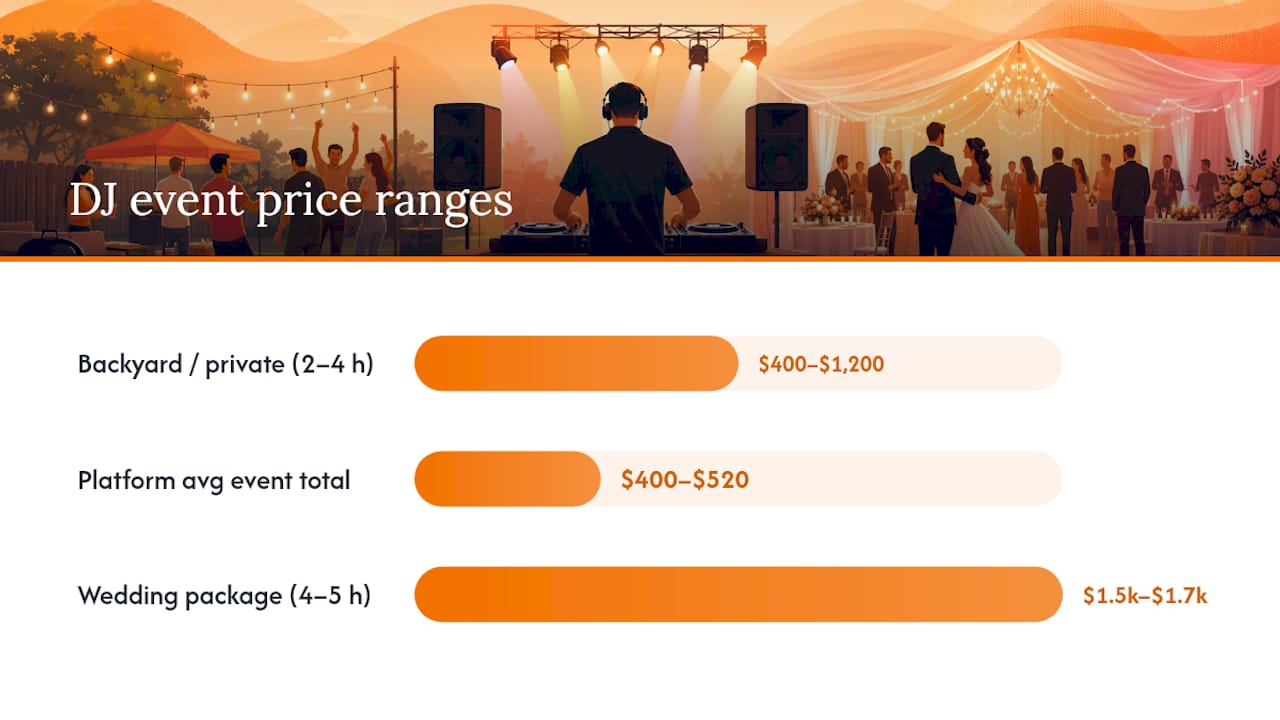
- Most private party DJs charge between $400 and $1,200 for 2 to 4 hours, with weddings averaging $1,500 to $1,700 for a full package.
- Additional costs often include uplighting ($300–$600), photo booths ($400–$700), and overtime ($100–$250 per extra hour).
- Experience, event type, guest count, and location significantly influence the final quote, with peak times and larger markets raising prices.
- Booking a professional with backup equipment and a clear contract reduces the risk of technical issues ruining your event.
- For high-stakes events like weddings or corporate functions, investing in an experienced DJ provides essential reliability and event management.
Table of Contents
- Average party DJ prices by event type
- What actually determines your DJ quote
- What’s included in a standard package, and what costs extra
- Turning an hourly rate into a real budget
- Vetting a DJ before you book: questions and red flags
- Why experience and professionalism change what you’re paying for
- Pro DJ or amateur: what the cheaper option actually costs you
- An editorial take on getting this budget right
- How Dj-phoenix takes the guesswork out of your quote
- Sources
Average party DJ prices by event type
The range you’re quoted depends heavily on what kind of gathering you’re hosting, and treating every DJ inquiry the same way is where most hosts go wrong on budget.
A backyard or private party booking for 2 to 4 hours typically runs $400 to $1,200 total, according to pricing data compiled by UseCalcPro. That band covers a solo operator with a compact PA system and playlist curation on the low end, up to a seasoned DJ with dance lighting and full emcee involvement on the high end. Birthday parties follow a similar tiered structure, but the tier depends heavily on the milestone being celebrated.
Statistic Callout: Platform booking data from The Bash shows the average DJ hourly rate sits near $100 to $115, with typical bookings running 4 to 4.5 hours. That converts to an average event total of roughly $400 to $520, before add-ons or travel are factored in.
Birthday pricing breaks down along these lines:
- Kids’ birthday parties (2 to 3 hours): often the most affordable tier, since production demands are lower and there’s no formal MC script to manage.
- Adult milestone birthdays (30th, 40th, 50th): priced closer to standard private party rates, especially when the host wants a dance floor built into the evening.
- Sweet 16 and quinceañera celebrations: these command premium rates because they usually require a court presentation, choreographed dances, and more involved emcee work, a pattern confirmed by birthday-specific pricing breakdowns from Quotably.
Weddings operate on a different pricing model entirely; understanding your complete event budget, including details like wedding invitation cost, helps in making informed trade-offs across all wedding expenses. Instead of a straight hourly rate, most wedding DJs quote a flat package covering a 4 to 5 hour reception, and that package typically averages $1,500 to $1,700. Corporate events land somewhere between private parties and weddings, since companies often want a polished MC presence and reliable equipment but without the extended ceremony and reception structure a wedding requires. A school dance, meanwhile, tends to price closer to the private party tier, though chaperone coordination and stricter venue rules can nudge costs upward slightly.
Where you live matters too. Metro-area DJs generally charge more than DJs in smaller markets, reflecting higher demand and higher costs of doing business. Peak dates, think Saturday nights in June or New Year’s Eve, routinely carry a premium of several hundred dollars over a quiet Tuesday booking in February. If your date is flexible, that alone can be one of the more meaningful levers you have on price.
What actually determines your DJ quote
Two DJs quoting the same event type can land $500 apart, and the gap almost never comes down to arbitrary pricing. It comes down to a specific, identifiable set of factors that industry guides consistently point to.
Cueup’s cost guide identifies nine core pricing drivers: location, event type, guest count, duration, DJ experience, equipment needs, special requests, seasonality, and travel distance. Here’s how each one actually moves your number:
- Event type and stakes: A wedding carries more pressure than a backyard party, since there’s no redo on a first dance. DJs price that risk into the quote.
- Hours booked, plus setup and teardown: Most contracts bill setup and packdown time separately from performance hours, and skipping this line item is the single most common budgeting mistake hosts make.
- DJ experience and reliability: A DJ who has worked hundreds of events reads a crowd faster and recovers from technical hiccups smoothly. That track record costs more, and it’s usually worth it for anything high stakes.
- Equipment and production level: A PA sized for 200 guests costs more to run than one built for 30. Add dance-floor lighting, uplighting, or video screens, and the quote climbs accordingly.
- Travel and venue access: Rural venues, multi-floor load-ins, or long drives from the DJ’s home base often trigger travel fees.
- Seasonality and day of week: Saturday evenings in wedding season command the highest rates; weekday and off-season bookings often come in noticeably lower.
Pro Tip: Ask every DJ you’re considering for their overtime rate before you sign anything. A locked timeline is your best defence against a surprise invoice, and DJs often price overtime well above their base hourly rate specifically to discourage runovers.
What’s included in a standard package, and what costs extra
A sensible base package should cover a PA system sized to your guest count, at least one wireless microphone, basic dance-floor lighting, a pre-event planning call, and setup and packdown time. If a quote is missing any of those, ask why before you book.
Anything beyond that baseline usually shows up as an add-on, and these are the ones hosts request most often:
- Uplighting: roughly $300 to $600, transforms a plain venue with coloured wall washes.
- Photo booth: typically $400 to $700, a popular add for birthdays and receptions alike.
- Ceremony audio: around $150 to $400, needed only if your event includes a formal ceremony segment.
- Extra wireless microphones: useful for toasts or speeches, usually a modest add per unit.
- Extra speakers or subwoofers: $200 to $500, worth considering for larger guest counts or outdoor spaces where sound dissipates.
Statistic Callout: Overtime typically bills at $100 to $250 per additional hour, often at a steeper rate than the DJ’s standard hourly price. A party that runs 90 minutes long can easily add $150 to $375 to your final bill.
Bundling add-ons into one package with your DJ is almost always cheaper than hiring separate vendors for lighting or a photo booth. It also means one point of contact managing the whole production, rather than three vendors coordinating on the fly.
Turning an hourly rate into a real budget
Start with the hourly rate, then add setup, teardown, and travel time. Many hosts price only the performance hours and get blindsided when the final invoice includes an hour of load-in they never accounted for.
From there, you have three real levers to pull if the number is higher than you’d like:
- Shift your date or time. Weekday and daytime events routinely undercut Saturday evening pricing.
- Trim coverage hours. A tight 3 hour party with a clear run of show often plays better than a loosely scheduled 5 hour booking anyway.
- Cut add-ons you can live without. Uplighting is a nice touch, not a requirement, for a backyard birthday.
Pro Tip: Get an itemised quote before you commit. If a DJ won’t break down hours, travel, and add-ons into separate line items, that’s your first sign the final invoice might not match what you expected.
A budget DJ can be the right call for a low-stakes gathering where the music is background, not the centrepiece. For a wedding or a corporate event where timing, tone, and crowd management genuinely matter, spending more on an experienced pro tends to pay for itself in fewer surprises.
Vetting a DJ before you book: questions and red flags
The questions you ask in your first message often reveal more than the price quote itself. Ask directly about hours included, travel fees, backup equipment, liability insurance, references from past events, and the exact deposit and cancellation terms.
Watch for these red flags:
- No written contract offered before payment.
- No reviews tied to real, specific events.
- Vague or evasive answers about their equipment setup.
- A very low deposit that’s still somehow non-refundable.
Trust signals run the opposite direction: a signed contract, a certificate of insurance on request, recorded client testimonials you can actually verify, and an itemised invoice that matches what was discussed on the call. Cueup’s guidance on vetting DJs points out that the cheapest quote is often the one missing these reliability investments entirely, and our own checklist for spotting a quality private DJ walks through the same signals in more depth.
A quick phone script that works: “Can you confirm your hourly rate, what’s included, your backup equipment plan, and whether you carry liability insurance?” A confident, specific answer to all four is a good sign. Hesitation on any of them is worth noting.
Why experience and professionalism change what you’re paying for
Booking a DJ isn’t just paying for music. Industry commentary from CapCityBand points out that a professional is also managing your event’s timeline, reading the room, and carrying backup gear in case something fails mid-set. Dj-phoenix built its reputation on exactly that kind of reliability, with a track record that includes clients like Mercedes-Benz and FW Sports and a specialty in curating playlists for multicultural audiences.
A typical private party package might cover several hours of performance, a full PA system, a planning call to map out your must-play list, and MC duties to keep the evening moving, with pricing varying depending on add-ons.
Backup equipment and a pre-event consultation aren’t luxuries. They’re what keeps a technical hiccup from becoming the story of the night.
Pro DJ or amateur: what the cheaper option actually costs you
Hiring a friend with a laptop and some speakers can save you real money upfront, and for a casual, low-stakes gathering, that trade-off might make sense. The math changes fast once your event has a schedule to protect.
A professional brings equipment redundancy, meaning a second speaker or mixer if something fails mid-event, along with the emcee skills to manage toasts, introductions, and transitions without dead air. An amateur setup usually has none of that backup, and if a cable fails or a laptop crashes, there’s no plan B. For a wedding or corporate event where a specific run of show matters, an amateur’s lower price often gets erased the moment something goes wrong at the worst possible moment.
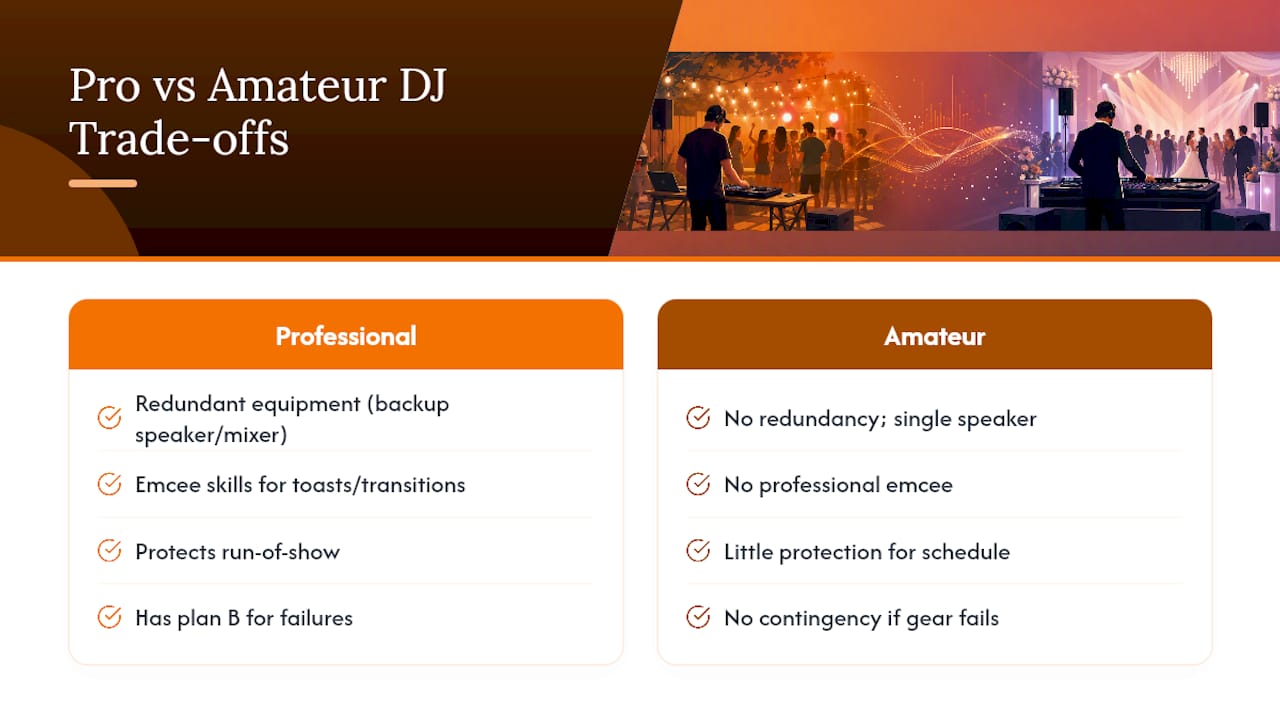
The honest cost-benefit read: for a kids’ birthday party or casual backyard hang, an amateur or budget option is a reasonable bet. For anything with a formal schedule, a paying audience, or a once-only moment like a first dance, the premium for a professional buys insurance against the one failure you can’t undo. Our guide to why an experienced wedding DJ matters breaks down that trade-off in more detail for higher-stakes events.
An editorial take on getting this budget right
Here’s the rule of thumb worth remembering: spend on entertainment in proportion to how much a mistake would cost you socially, not just financially. A backyard birthday can absorb an off night. A wedding reception cannot.
That’s the real filter for choosing between a budget option and a professional. If the event has a fixed schedule, a room full of people watching, and zero tolerance for dead air, pay for experience. If it’s low-key and forgiving, a cheaper option is a fair bet. Either way, run through the vetting checklist above before you sign anything. It costs you nothing and it catches the quotes that look cheap for a reason.
— Reza
How Dj-phoenix takes the guesswork out of your quote
Dj-phoenix is the direct alternative to piecing together a DIY setup or gambling on an unvetted freelancer for your private party. Every booking includes a planning call to map your must-play list, multicultural playlist curation that reads a mixed crowd instead of guessing at it, and backup equipment on hand so a blown cable never becomes your event’s story.
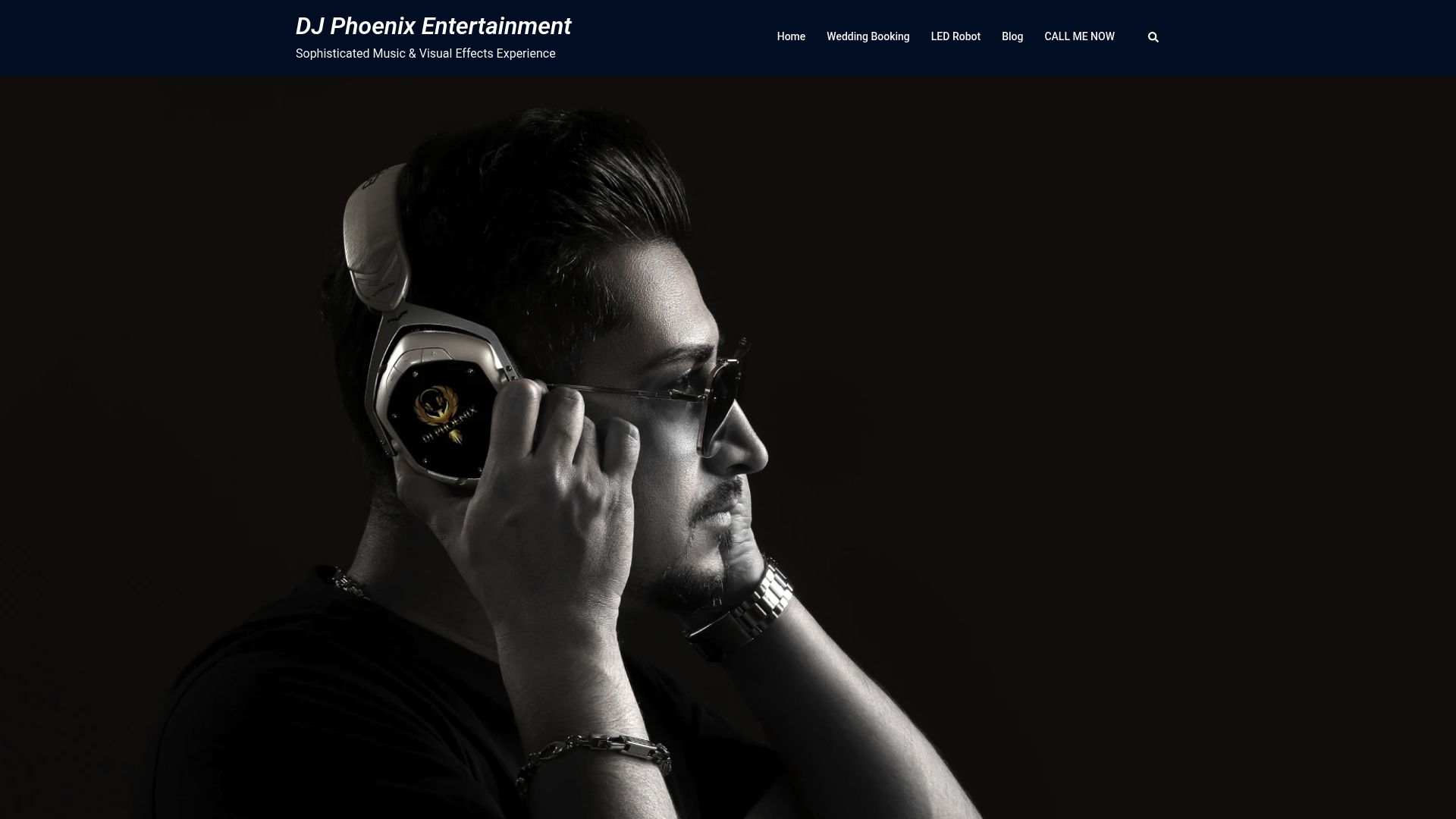
That combination is exactly what separates a party people talk about from one they forget by Monday. Dj-phoenix has delivered that experience for clients ranging from Mercedes-Benz to FW Sports, bringing the same attention to sound quality and crowd reading to a backyard celebration as to a corporate stage. Browse the DJ performance gallery to see the range of events covered, or reach out directly through Dj-phoenix to get a quote scoped to your date, guest count, and must-have add-ons before you commit to anyone.
Sources
These figures come from a mix of pricing calculators and platform booking data, so you can double-check the numbers against your own market:
- DJ Service Cost Calculator — 2026 Event & Wedding DJ Pricing | UseCalcPro
- How Much Does a DJ Cost? – The Bash
- DJ Cost Guide (Cueup)