Yes, the safest way to keep every generation on the dance floor is high-recognition, family-friendly floor-fillers paired with carefully curated clean edits. Songs like “I Wanna Dance With Somebody,” “Uptown Funk,” and “Dancing Queen” anchor a set that grandparents and teenagers both dance to without a wince. The next step is simple: build a must-play list, a do-not-play list, and hand both to your DJ or band well before the reception.
TL;DR:
- Nearly all the top dance-floor hits, including “Uptown Funk” and “Dancing Queen,” are inherently clean in their official releases and suitable for all ages.
- To keep energy high, DJ sets should cycle through different genres every three to four songs, engaging diverse age groups without risking boredom.
- Confirmed clean edits are essential because streaming platforms’ labels are unreliable; always request verified radio or DJ-specific clean versions through a professional music pool.
- Proper planning, including a must-play list, do-not-play list, and timing of special dances, is vital to ensure a smooth, mistake-free reception.
- Communicating detailed cultural, religious, and family preferences in advance allows the DJ to accommodate traditions and avoid playing inappropriate or unintended songs.
Table of Contents
- Clean wedding dance songs that never miss with a mixed crowd
- Choosing lyrically appropriate first-dance and parent-dance songs
- Cocktail hour and dinner music that keeps conversation flowing
- What to keep off your reception playlist
- Building your reception timeline by song count
- DJ Phoenix’s field tactics for cueing and reading the room
- How to find genuinely clean versions of popular songs
- Handling requests for songs that don’t fit your clean playlist
- Clean dance songs across country, hip-hop, pop, and Latin genres
- Respecting cultural and religious preferences in your song choices
- A working DJ’s pre-wedding checklist
- Book DJ Phoenix for a reception that never misses a beat
- Sources
- FAQ
Clean wedding dance songs that never miss with a mixed crowd
A strong reception set is built in layers, not thrown together randomly. Professional DJs organize the night around three roles: openers that pull people onto the floor, anchors that keep them there, and closers that send everyone home smiling.
Party openers need a strong downbeat and instant recognition. These three consistently work:
- “Uptown Funk” — Mark Ronson featuring Bruno Mars, a horn-driven groove almost nobody can resist.
- “I Wanna Dance With Somebody” — Whitney Houston, an unmatched crowd trigger across age groups.
- “September” — Earth, Wind & Fire, a guaranteed singalong from the first bar.
Peak dance-floor anchors carry the bulk of your night. This is where genre rotation matters most; digital DJ pool guidance recommends cycling styles every three to four songs to keep multiple generations engaged instead of losing one age group to boredom.
- “Dancing Queen” — ABBA, a clean, joyful classic with zero editing required.
- “Shake It Off” — Taylor Swift, upbeat and completely clean in its original form.
- “Levitating” — Dua Lipa, a modern disco cut that needs no edit.
- “Can’t Stop the Feeling!” — Justin Timberlake.
- “Mr. Blue Sky” — Electric Light Orchestra.
- “Signed, Sealed, Delivered I’m Yours” — Stevie Wonder.
- “Brown Eyed Girl” — Van Morrison.
- “September” (repeat placement optional for late-night encore).
- “Cha Cha Slide” — DJ Casper, a structured line dance many couples explicitly request or exclude.
- “Electric Slide” — Marcia Griffiths.
- “I Gotta Feeling” — The Black Eyed Peas, though the clean radio edit is essential here.
- “Sweet Caroline” — Neil Diamond, arguably the most reliable singalong in wedding history.
- “Celebration” — Kool & the Gang.
- “Y.M.C.A.” — Village People.
- “Don’t Stop Believin’” — Journey.
- “Get Lucky” — Daft Punk featuring Pharrell Williams.
Singalong closers send the night off on an emotional high:
- “Don’t Stop Me Now” — Queen.
- “Sweet Home Alabama” — Lynyrd Skynyrd.
- “I Will Survive” — Gloria Gaynor.
- “The Time (Dirty Bit)” — The Black Eyed Peas, clean edit required.
- “Wagon Wheel” — Old Crow Medicine Show or Darius Rucker.
Most of these tracks, including “Dancing Queen” and “Levitating,” are inherently clean in their radio and studio releases. Tracks like “I Gotta Feeling” and “The Time (Dirty Bit)” carry mild language in unedited versions and need a clean edit specified in advance, a point covered further under editing guidance below.
Choosing lyrically appropriate first-dance and parent-dance songs
First dances and parent dances get listened to, not danced through. A packed floor forgives a rough lyric because nobody’s paying close attention; a quiet room full of seated guests will catch every word.
Strong first-dance choices with no lyrical red flags include “Perfect” (Ed Sheeran), “Can’t Help Falling in Love” (Elvis Presley or Haley Reinhart), “All of Me” (John Legend), “A Thousand Years” (Christina Perri), “At Last” (Etta James), “Marry Me” (Train), “Better Together” (Jack Johnson), “Thinking Out Loud” (Ed Sheeran), “Lover” (Taylor Swift), “Speechless” (Dan + Shay), “You Are the Best Thing” (Ray LaMontagne), and “XO” (John Mayer). These songs top many 2026 first-dance rankings precisely because their lyrics hold up under close listening.
For parent dances, “My Girl” (The Temptations), “The Way You Look Tonight” (Frank Sinatra), and “Simple Man” (Lynyrd Skynyrd) work well emotionally without risky content.
Cue the party opener before the last parent dance fully ends. That five to ten second overlap keeps the room’s energy from stalling into a cold, awkward pause.
Cocktail hour and dinner music that keeps conversation flowing
Cocktail hour and dinner exist to prime the room, not compete with it. Acoustic and instrumental covers of familiar songs keep guests comfortable while they eat and chat, according to Digital DJ Pool’s playlist guidance.
- Instrumental jazz covers of Motown standards
- Acoustic guitar versions of current pop hits
- Piano covers of classic love songs
- Bossa nova arrangements of familiar tunes
- Soft string quartet renditions during dinner service
Cocktail hour tempo should sit around 80 to 100 BPM, upbeat enough to feel festive without pulling focus from conversation. Dinner music drops lower still, functioning purely as background. Keep volume low enough that guests at the far end of a table can hear each other without leaning in.
What to keep off your reception playlist
Every do-not-play list should name specific songs, not vague genres, since a DJ working from “no rap” or “nothing explicit” is left guessing. Common exclusions include songs with graphic sexual content, drug references, or slurs, even in edited form.
A radio edit removes profanity but often leaves the underlying theme intact. Professional DJs advise that when a song’s theme remains questionable even after editing, the safer move is full exclusion rather than trusting a censored version. The same applies to live performances; a “cleaned” live vocal can still contain ad-libbed language the recording engineer never caught.
Send your DJ a written list with exact song titles and, where relevant, timestamp notes for any track you want trimmed. Dj-phoenix’s do-not-play list guide walks through building that list with real examples.
Building your reception timeline by song count
A full wedding-day music plan breaks down by moment, not by vibe alone. According to Joy’s wedding playlist guide, a typical breakdown looks like this:
- Prelude: 10 to 15 songs, soft and ambient
- Cocktail hour: 20 to 30 songs, upbeat but conversational
- Dinner: 25 to 35 songs, low tempo and background
- Reception dancing: 40 to 60 songs, building from moderate to peak energy
The energy curve matters more than any single song choice: warm up during dinner, open the floor with a universal hit, drive toward peak energy through the middle of the night, then cool down gradually for the last dance. Hand your DJ three documents before the big day: your must-play list, your do-not-play list, and exact timing for special dances like the first dance and parent dances.
DJ Phoenix’s field tactics for cueing and reading the room
Cueing the next track before the current one fully resolves is what separates a smooth reception from one with dead air. Reza at Dj-phoenix stages the opening party song so it’s ready to fire within seconds of the last parent dance ending, preventing the momentum drop that kills early energy.
Honouring a guest’s request quickly, even a small deviation from the plan, builds trust fast; guests notice when a DJ listens. A working DJ typically preps roughly double the tracks they expect to play for a full event, giving room to pivot mid-set without scrambling. Dj-phoenix’s tested list of dance-floor fillers reflects this same live-tested approach.
How to find genuinely clean versions of popular songs
Streaming platforms label clean versions inconsistently, so don’t assume “explicit” tags are reliable in either direction. A track marked clean on one platform can still carry a suggestive theme the label doesn’t flag.
The most dependable method is asking your DJ to pull from a professional music pool rather than a consumer streaming app. Services like these carry verified radio edits and, in many cases, DJ-specific clean remixes built for exactly this purpose. If you’re building your own reference playlist first, cross-check the track against at least two sources, since a “clean” tag on one app occasionally slips through with a line left in.
For songs with borderline content throughout, like some hip-hop or pop-rap tracks, ask your DJ whether an “instrumental intro” or “clean edit” version exists separately from the standard radio cut. Many popular songs have multiple edited versions circulating, and not all are equally scrubbed.
Pro Tip: Never trust a song’s “clean” label blindly. Listen to the full track yourself, including the bridge and outro, since that’s often where uncensored lines slip through even on official edits.
Finally, build your do-not-play and must-play lists early, at least a month before the wedding, so your DJ has time to source and test the exact edits you want rather than scrambling the week of the event.
Handling requests for songs that don’t fit your clean playlist
Guests will ask for songs outside your list, often with good intentions and zero awareness of your guidelines. A graceful DJ has scripts ready for exactly this moment.
The simplest approach is redirecting rather than refusing outright: “Great pick, let me find a clean version of that” often satisfies the guest while quietly swapping in an edited or substitute track. If no clean edit exists, offering a similar-energy alternative by the same artist usually lands well, since most guests want the vibe more than the specific title.
Couples should tell their DJ in advance how firm the do-not-play list is. Some couples want it treated as an absolute boundary; others are fine with limited exceptions if a guest is persistent. Making that call before the event, rather than in the middle of a crowded floor, saves everyone an awkward negotiation.
If a request comes from someone clearly important, like a parent or wedding party member, a quick private conversation (“I’ve got a full list from the couple, happy to find something close”) usually resolves it without drama. The goal is protecting the couple’s wishes while still making guests feel heard, and a DJ who handles this smoothly is doing exactly the job they were hired for.
Clean dance songs across country, hip-hop, pop, and Latin genres
A truly inclusive reception doesn’t lean on one genre. Rotating styles keeps every generation and every taste engaged, which is exactly why genre cycling every three to four songs shows up so consistently in professional DJ guidance.
Country: “Wagon Wheel,” “Cruise” (Florida Georgia Line), and “Copperhead Road” (Steve Earle) bring floor energy without any lyrical concerns.
Hip-hop and pop-rap: Clean edits of “I Gotta Feeling,” “Forget You” (CeeLo Green, using the clean title version), and “Party in the U.S.A.” (Miley Cyrus) work well when sourced from a proper clean edit rather than a streaming shortcut.
Pop: “Levitating,” “Shake It Off,” and “Can’t Stop the Feeling!” are clean by design and translate across nearly every age bracket.
Latin: “Bailando” (Enrique Iglesias) and “Suavemente” (Elvis Crespo) bring a completely different rhythm and pull in guests who might sit out an all-pop set.
Motown and soul: “Signed, Sealed, Delivered I’m Yours,” “My Girl,” and “Ain’t No Mountain High Enough” reliably bridge generational gaps since older guests recognize them instantly and younger guests usually know them from covers or samples.
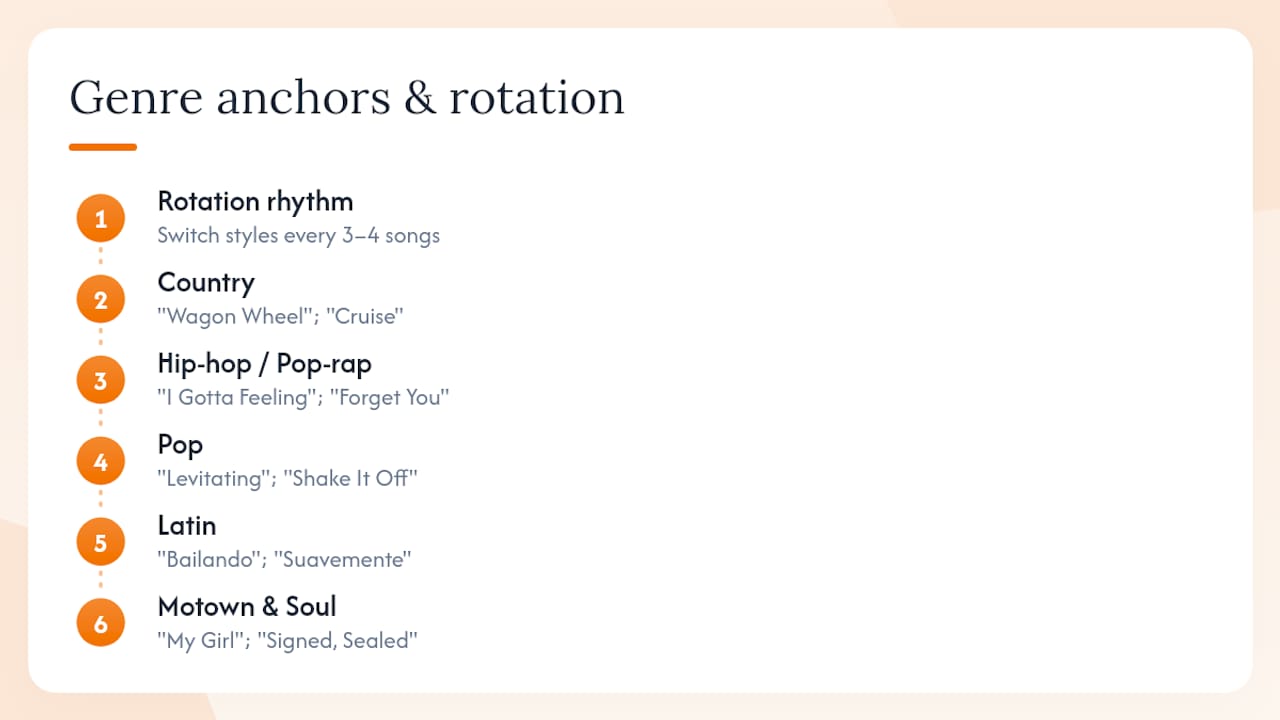
Mixing genres isn’t just about inclusivity; it’s a tactical move that resets the floor’s energy and keeps a single style from wearing thin over a four or five hour reception.
Respecting cultural and religious preferences in your song choices
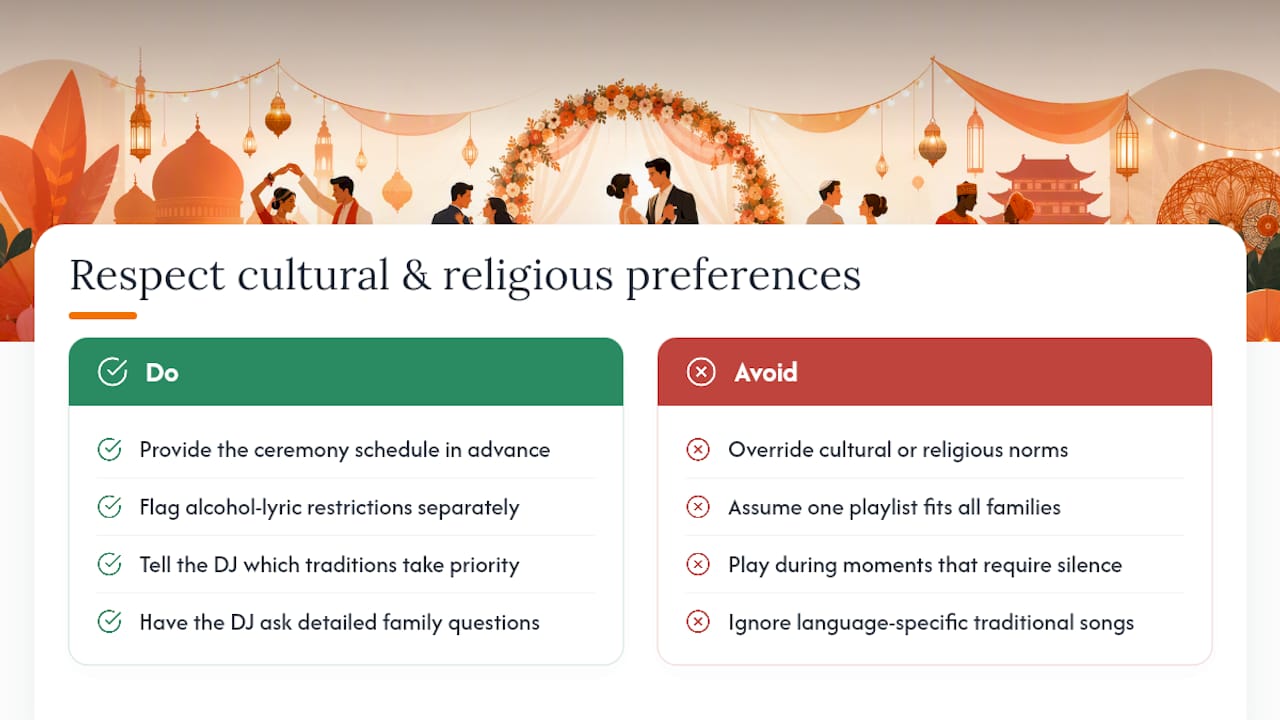
Weddings carry different musical expectations depending on cultural and religious background, and a clean, family-friendly playlist needs to flex around those norms rather than override them.
Some religious ceremonies restrict instrumental music or dancing during specific portions of the event, which means your DJ needs the ceremony schedule well in advance to avoid playing during a moment that calls for silence. Certain cultural traditions also call for specific songs at defined points, like a processional in a particular language or a traditional folk dance during the reception, and these deserve the same must-play priority as your first dance.
Alcohol-related lyrics, even in otherwise clean songs, can be a concern at receptions where the couple’s families don’t drink or where cultural norms discourage references to it. If that applies to your wedding, flag it separately from your general do-not-play list, since a song about celebration and dancing might still mention champagne or shots in a line you’d otherwise miss.
Multigenerational and multicultural guest lists, a specialty area for Dj-phoenix, benefit from a DJ who asks detailed questions ahead of time rather than assuming a single template fits every family. If your families come from different backgrounds, tell your DJ which traditions take priority during which parts of the night, and build the modern dance-floor set around those anchor points rather than the other way around.
A working DJ’s pre-wedding checklist
Six things separate a smooth reception from a stressful one: a finished must-play list, a specific do-not-play list, cueing notes for special dances, a rehearsal run-through of timing with your DJ, confirmed clean edits for any borderline songs, and a direct line of communication with your DJ in the final week. Skip any one of these and you’re leaving the night’s biggest moments to chance.
— Reza
Book DJ Phoenix for a reception that never misses a beat
Dj-phoenix builds every wedding set around exactly the approach this guide describes: curated, clean playlists tuned for multicultural and multigenerational guest lists, with emcee timing, lighting, and sound handled by one team instead of three separate vendors. That means your must-play list, your do-not-play list, and your special-dance cues all live with one person who reads the room live rather than following a fixed script.
The Gold, Silver, and Bronze wedding packages cover everything from playlist curation to professional sound and emcee services, so you’re not piecing together a DJ, an MC, and a lighting rig from three different bookings. Reza and the team have handled multicultural celebrations for clients including Mercedes-Benz and FW Sports, bringing that same attention to reading a crowd to your reception floor. If you’re ready to lock in your date, request a consultation and review the wedding packages to find the fit for your guest list and venue.
Sources
- Wedding music playlist: complete guide for every moment (2026) – Joy
- Top 100 most requested wedding songs 2026 — BandCalendar
- Your 2026 wedding playlist starts here: 15 songs every DJ is playing right now | Woman Getting Married
- The ultimate wedding DJ playlist for 2026: songs that fill every dance floor — Digital DJ Pool
FAQ
What are some clean songs for a dance party?
“Uptown Funk,” “Dancing Queen,” “Shake It Off,” “Levitating,” and “Can’t Stop the Feeling!” are all clean in their original studio releases and work at nearly any age-mixed event.
What are the top 10 wedding dance songs?
Rankings vary slightly by year, but “I Wanna Dance With Somebody,” “Uptown Funk,” “Sweet Caroline,” “Dancing Queen,” “September,” “Don’t Stop Believin’,” “Shake It Off,” “Y.M.C.A.,” “Celebration,” and “I Gotta Feeling” appear consistently across 2026 wedding song rankings.
Who dances first at a wedding, the mother and son or the father and daughter?
There’s no fixed rule; most receptions run the father daughter and mother son dances back to back, with order chosen based on family preference or timing convenience rather than tradition.
What song reliably gets everyone on the dance floor at a wedding?
“Uptown Funk” and “I Wanna Dance With Somebody” are two of the most consistent floor-fillers across generations, largely because of their strong recognisable hooks and clean, universally familiar lyrics.
How do I get a clean version of a popular song for my wedding?
Ask your DJ to source it through a professional music pool rather than a consumer streaming app, and confirm the specific edit before the event since “clean” tags on public platforms aren’t always reliable.