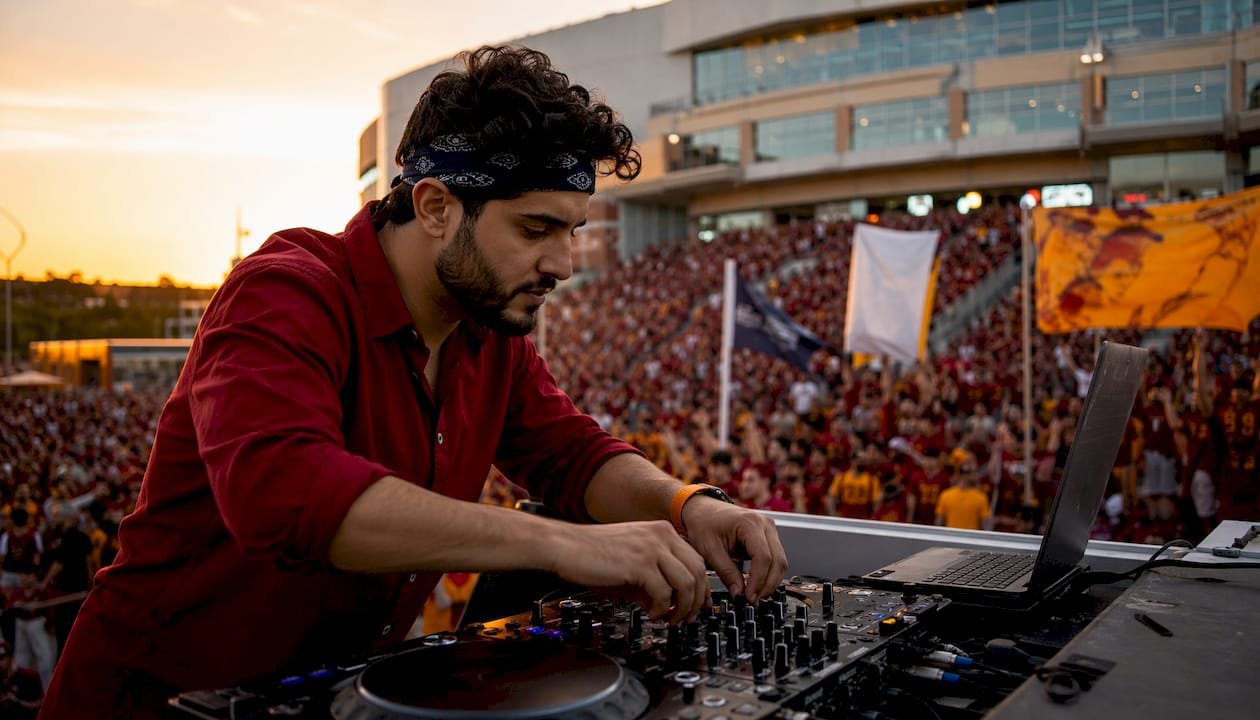
A professional DJ can reliably create repeatable crowd hype at sports events — but only when three conditions are met: cues are locked to the game clock, participation is designed as a staged ladder from passive to active, and the DJ operates as a genuine extension of the venue’s production team. Without all three, you get music playing at a sporting event, not a crowd that is truly alive.
The trust signals that separate a production-calibre DJ from a generalist are specific: a documented run-sheet tied to game operations, a demonstrable spotter workflow, and a client portfolio that includes stadium or arena work. Dj-phoenix has performed for clients including Mercedes-Benz and FW Sports, and publishes a sports event DJ checklist that coordinators can use as a vetting benchmark.
- Game-clock cue discipline: every activation window is finite — a timeout, a whistle stop, a halftime break. Miss it and the moment is gone.
- Participation ladder: crowd engagement techniques work best when designed as a progression from passive listening to coordinated chanting, not as a binary on/off switch.
- Integrated comms: the DJ must receive live “stop” and “go” cues from game ops and broadcast, not guess from the sidelines.
Table of Contents
- What must be confirmed before the event: your DJ planning checklist
- How to program music by sport: hockey, basketball, football, soccer, and baseball
- How to activate the crowd: the participation ladder in practice
- Technical and venue logistics every planner must confirm
- Inclusive and multicultural programming for Canadian audiences
- Booking timeline and main cost drivers
- How to vet and hire the right sports-event DJ
- Key takeaways
- What a production-level sports DJ actually demands
- Dj-phoenix: sports-event DJ services for Canadian planners
- Useful sources for production teams and planners
What must be confirmed before the event: your DJ planning checklist
A pre-event checklist is not a formality — it is the document that prevents on-site failures. Assign an owner and a deadline to every item below, then attach the completed sheet to your venue’s production binder.
Run-sheet and cue list:
- Run-sheet synced to the game clock, with named cue windows (ingress, warm-up, timeout, big play, halftime, egress)
- Exact handoff protocol between the DJ and the announcer for each cue window
- Playlist folders built by category and pre-approved by the league or venue
Staffing and roles:
- Spotter or field communicator confirmed and briefed
- Broadcast liaison identified
- Stage manager or production contact named with direct comms line
- Backup operator assigned for technical emergencies
Logistics:
- Load-in schedule and soundcheck windows confirmed with venue FOH
- Power specs and audio feed requirements verified against the DJ’s equipment rider
- Redundant playback device tested and loaded with the approved standby playlist
- Permit or league music approvals obtained and filed
- SOCAN/Re:Sound venue licence confirmed active for the event date
Pro Tip: Attach the completed checklist to the venue’s production binder at least 72 hours before the event, not on the day. Late submissions are the single most common source of last-minute cue conflicts.
How to program music by sport: hockey, basketball, football, soccer, and baseball
Every sport has a distinct pacing structure and a finite set of cue windows. Programming that works for a basketball timeout will feel wrong at a soccer match. Sports DJs describe the craft as scoring a film: each scene has a function, and the music must serve it precisely.
Hockey: Fast transitions and short roar moments define the game. Build a warm-up playlist folder for pre-game, then separate folders for in-game chant loops (15–30 seconds), big-play stings, and timeout beds. Avoid full songs mid-play; short drum fills and crowd chant stems are the workhorses here.
Basketball: Frequent stoppages make this the most DJ-friendly sport. Quick samples, call-and-response prompts, and countdown fills all land cleanly. Label folders: ingress, timeout bed, big play sting, halftime show.
Football: Longer pauses between plays allow for impactful anthems on big moments. Reserve the heaviest tracks for touchdowns and use lighter instrumental beds during drives. A pre-snap energy folder of 8–12 second fills is worth building.
Soccer: Long stretches of uninterrupted play mean the DJ’s primary windows are set pieces, halftime, and ingress/egress. Group chants work best here because they sustain without requiring a cue. Build a chant loop folder and a halftime activation set.
Baseball: The longer game rhythm rewards micro-activations. Use pitching changes and between-inning breaks for short crowd prompts. Folder labels: between innings, walk-up stems, rally moment.
Pro Tip: Use short stems, drum fills, and chant loops rather than full songs for tight game windows. Practitioners recommend preparing squeaky-clean edits and confirming league approval for any licensed material before the event.
How to activate the crowd: the participation ladder in practice
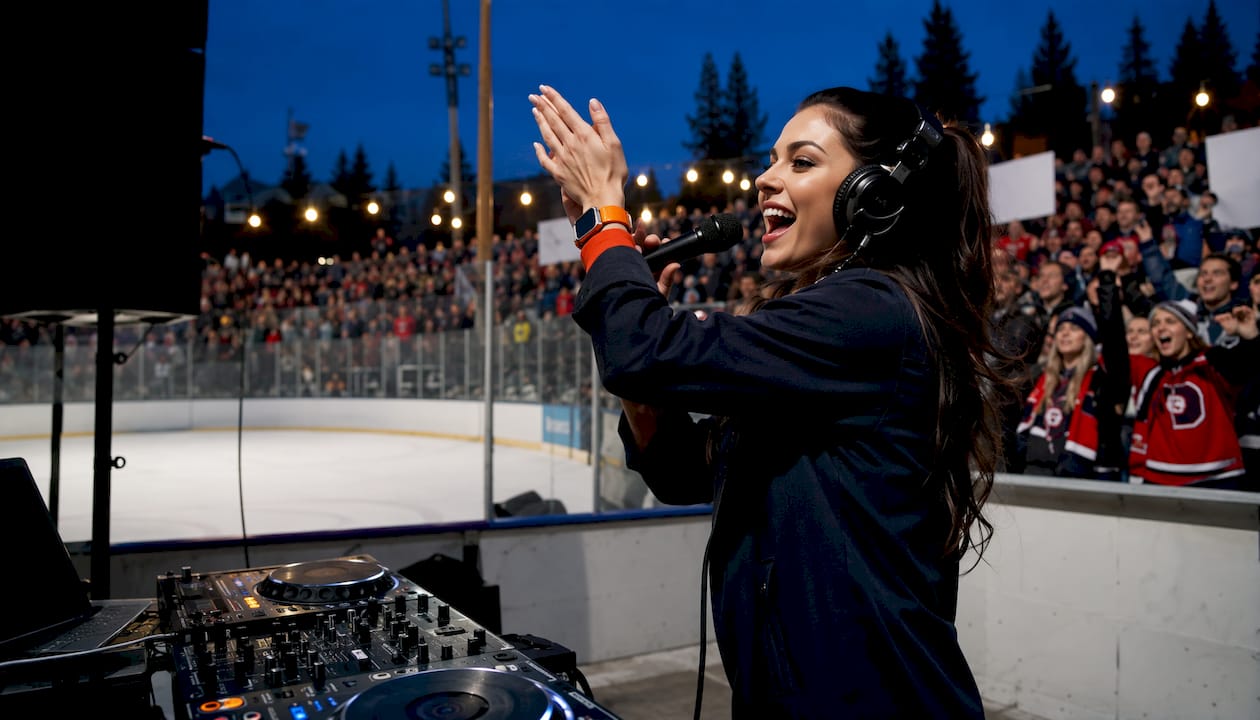
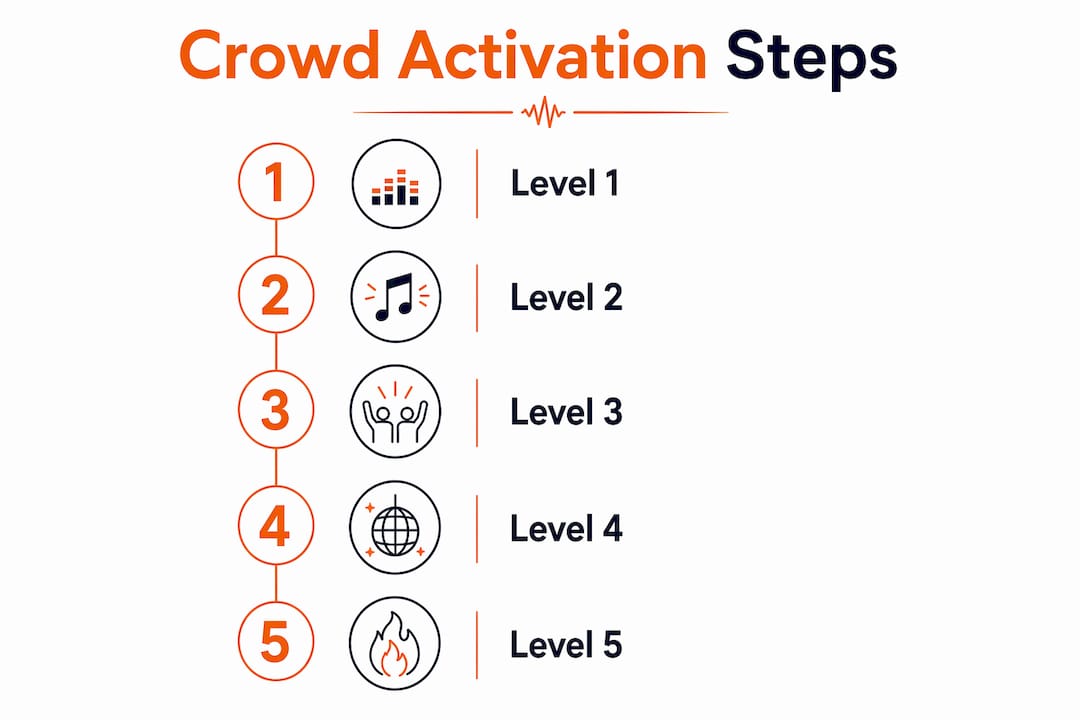
Designing participation as a ladder rather than a single on/off prompt is the most reliable method for building crowd energy across a diverse audience. Each rung reduces anxiety for newcomers while giving experienced fans a path to higher engagement.
- Level 1 — Passive: music bed plays; the crowd absorbs the atmosphere without being asked to act.
- Level 2 — Low-friction action: a clap prompt or a scoreboard emoji wall invites a simple, anonymous response.
- Level 3 — Call-and-response: the DJ or announcer calls a phrase; the crowd repeats it. Short, clear, and repeatable.
- Level 4 — Coordinated chant or wave: the highest rung, reserved for peak moments like a home goal or a big defensive stop.
Scene dynamics and collective body language — posture shifts, synchronised movement, rising noise — are the real-time signals a skilled DJ reads to decide whether to escalate or hold. A crowd leaning forward and moving together is ready for Level 3 or 4; a crowd still settling into seats needs Level 1 first.
Specific DJ techniques that support each level: countdown fills for Level 2, short call-and-response stems for Level 3, LED and lighting sync for Level 4, and social-media hashtag pushes displayed on the scoreboard throughout.
Pro Tip: Brief security and floor staff on every planned activation moment before the event. Provide a quiet stop command so staff can de-escalate if energy exceeds safe thresholds.
Technical and venue logistics every planner must confirm
Timing accuracy depends on redundant audio playback and direct comms lines to game ops and broadcast. A single point of failure in either chain will break the cue discipline the entire programme depends on.
| Requirement | Minimum specification |
|---|---|
| Primary audio feed | Balanced XLR into venue FOH; gain-staged to house spec |
| Mixer I/O | Minimum 4-channel with dedicated cue output |
| Backup playback | Separate device loaded with approved standby playlist |
| Intercom/IFB | Dedicated spotter channel; broadcast IFB if integrated |
| Wireless mic | Frequency-coordinated with venue RF plan |
| Latency allowance | Under 10 ms end-to-end for cue accuracy |
| Power | Dedicated power circuit; UPS recommended |
Comms workflow: the spotter relays game-ops cues to the DJ in real time. The DJ acknowledges each cue before executing. Broadcast IFB keeps the DJ aligned with on-air timing. The venue FOH engineer holds master volume authority.
Canadian compliance notes:
- Municipal noise bylaws vary by city; confirm permitted hours for outdoor or semi-outdoor venues with the local authority before the event.
- League music restrictions (NHL, CFL, NBA Canada) require pre-approved playlists; submit at least two weeks prior.
- SOCAN and Re:Sound licences must be held by the venue, not the DJ; verify coverage is active for the specific event date.
Contingency: test the backup playback device during soundcheck, not on event day. Pre-approve a standby playlist and document the failover process in the run-sheet so any crew member can execute it.
Inclusive and multicultural programming for Canadian audiences
Cultural competence is a production requirement, not an optional add-on. Canada’s sports audiences are among the most culturally diverse in the world, and a playlist that ignores that reality will lose a significant portion of the crowd before the first timeout.
Request these items from your DJ during the pre-event brief:
- A written cultural brief listing the primary communities represented in the expected audience
- Top-requested tracks from host families or event organisers, with respectful edits for traditional music
- Visual or bilingual cues for call-and-response moments so newcomers can follow along
- A short pre-event montage blending representative genres to prime the crowd and signal a multilingual, multi-genre celebration
Practical tactics on the day: short bilingual prompts on scoreboard graphics, scheduled multicultural dance or chant moments at planned windows rather than ad-hoc surprises, and discrete staff moderators positioned to welcome and coach first-time participants. The multicultural event DJ brief Dj-phoenix provides for Canadian planners covers each of these items in detail.
Pro Tip: Schedule the multicultural activation moment, do not leave it to improvisation. A planned window at halftime or a major break lands with far more artistry than a spontaneous insert that disrupts the game-clock rhythm.
Booking timeline and main cost drivers
Cost is shaped by scope, production complexity, date, travel, and licensing. Book production-level DJs 3–9 months ahead, depending on the season and the prestige of the date.
Main cost elements:
- Base performance fee (varies by market, event scale, and DJ pedigree)
- Spotter or assistant fee
- Production and technical rider costs
- Travel and accommodation for out-of-market events
- Licensing and clearance fees for custom edits
- Overtime rates for extended game delays
Booking timeline:
- Immediate hold for marquee or peak-sport dates
- Signed contract and deposit 3–6 months before the event
- Technical walk-through and league approvals 2–4 weeks prior
- Final run-sheet delivered 72 hours before the event
Price accelerants include short lead times, peak-sport dates (playoff season, Grey Cup weekend), special broadcast integration, and bespoke multicultural mash-ups requiring significant pre-production. The party packages Dj-phoenix offers outline bundled production options that can simplify cost planning for corporate and private event clients.
How to vet and hire the right sports-event DJ
Hire for demonstrated cue-driven sports experience, integrated comms ability, and cultural competence. A DJ who cannot produce evidence of all three is not production-ready for a live sports environment.
Questions to ask:
- Can you provide a sample game-day run-sheet from a previous event?
- Who fills the spotter role, and how do they communicate cues to you in real time?
- How do you handle league or venue music restrictions and licensing requirements?
- Can you provide references from stadium, arena, or corporate sports-hospitality clients?
- What is your failover process if your primary playback device fails mid-event?
Red flags:
- No clear spotter or comms strategy
- No documented backup playback or contingency plan
- Reluctance to provide cleared edits or pre-approved playlists
- No prior work in venues of comparable size or production complexity
Post-interview test: request a 5-minute mock run-sheet describing cues for a hypothetical big play, a timeout, and a halftime segment. A production-calibre DJ will produce this without hesitation; it is a standard deliverable in their workflow.
Key takeaways
A professional sports-event DJ delivers repeatable crowd hype by combining cue-driven programming, a staged participation ladder, and redundant comms integration with venue and game operations.
| Point | Details |
|---|---|
| Cue-driven design is non-negotiable | Every activation must be locked to the game clock; missed windows cannot be recovered. |
| Use the participation ladder | Design crowd engagement from passive (music bed) to active (coordinated chant) across four levels. |
| Confirm technical redundancy | Backup playback, a dedicated spotter channel, and a tested failover process must be in place before soundcheck. |
| Inclusive programming is a production requirement | Request a cultural brief and scheduled multicultural activation moments for Canadian audiences. |
| Dj-phoenix delivers this calibre of service | With a documented checklist, spotter workflow, and clients including Mercedes-Benz and FW Sports, Dj-phoenix is a verified option for upscale sports and corporate events in Canada. |
What a production-level sports DJ actually demands
Most planners underestimate how much of a sports DJ’s value is invisible on the night. The crowd hears a great track at exactly the right moment and assumes it was instinct. It was not. It was a run-sheet built three weeks earlier, a spotter relaying a cue from the game-ops table, and a backup device already loaded and tested during soundcheck.
The participation ladder concept is genuinely underused in Canadian sports entertainment. Planners brief a DJ on genre and tempo, then wonder why the crowd never fully ignites. The answer is almost always structural: no one designed the onboarding path from passive listener to active participant. A crowd that has never been given a Level 2 prompt — a simple clap or a scoreboard cue — will not spontaneously reach Level 4 on its own.
Cultural competence deserves the same rigour. Canada’s sports audiences are not monolithic, and a playlist built around a single cultural reference point will alienate a meaningful share of the room. The brief should be as specific as the run-sheet.
Dj-phoenix: sports-event DJ services for Canadian planners
Dj-phoenix brings production-level sports-event artistry to upscale private, corporate, and multicultural wedding celebrations across Canada. Where a generalist DJ brings a playlist, Dj-phoenix brings a full production package: a cue-driven run-sheet, a confirmed spotter workflow, a cultural brief process, and the pedigree of having delivered for clients of the calibre of Mercedes-Benz and FW Sports.
For event organisers and corporate planners, the DJ services for corporate events page outlines the full scope of what is available, from sports-hospitality activations to multicultural programming. The DJ performance gallery provides visual proof of past event scale so you can assess fit before a single conversation. Peak-season dates in Canada fill 3–6 months out; contact Dj-phoenix now to confirm availability for your event.
Useful sources for production teams and planners
The following sources informed this article and offer deeper reading for coordinators, technical teams, and event planners.
- From cues to engagement: survey and architecture for computer vision-based audience analysis — Academic framework for measuring live-event engagement through scene dynamics and body language; useful for production teams building real-time activation workflows.
- Between script and shout: designing audience participation that actually works — Practitioner guide to the participation ladder; the primary reference for crowd activation design in this article.
- Game On! DJ rocks jock jams — DJ Times feature on sports-event DJing; covers folder organisation, edit preparation, and the film-scoring analogy for game-day programming.
- Audience engagement techniques in oral presentations — Peer-reviewed research on turning passive audiences into active participants; theoretical foundation for the participation ladder applied in this article.
- 25 in-person event engagement ideas — Practical activation ideas scaled by event size; useful for pre-event and halftime activation planning.
- Dj-phoenix sports event DJ checklist — Downloadable planning checklist and run-sheet template for coordinators; covers timing, staffing, and redundancy.
- Dj-phoenix equipment explainer for coordinators — Technical spec sheet describing I/O, IFB requirements, and redundancy recommendations for venue and broadcast integration.
- Why DJ cultural competence matters at events — Dj-phoenix guidance on culturally sensitive programming and brief templates for multicultural Canadian events.