The most reliable way to fill a wedding dance floor is to open with cross-generational singalongs and rotate genres every three to four songs. Cue tracks like “Uptown Funk,” “I Wanna Dance with Somebody,” or “Mr. Brightside” right after the formal dances end, while energy and attention are already on the room. Layer in “Dancing Queen” and “September” once the core group commits, then build outward from there.
TL;DR:
- Cross-generational singalongs like “Uptown Funk” and “Dancing Queen” are essential to quickly fill the dance floor, as recognition and familiarity are key.
- Peak-energy songs should be played in bursts of 20 to 40 minutes with genre rotations every three to four songs to sustain momentum and guest engagement.
- Timing the playlist to avoid placing high-energy tracks immediately before formal events or structured moments prevents energy depletion and awkward transitions.
- Live adjustment and room reading are vital; a professional DJ adapts in real time and filters requests to maintain flow and avoid playlist fatigue.
- Songs typically work because they have recognizable choruses, tempos between 100 and 135 BPM, and broad cultural saturation across multiple guest generations.
Table of Contents
- What makes wedding dance floor fillers actually work
- How to build a 60–90 minute peak set that keeps the floor full
- Song picks for every reception moment
- Genre and era rotation: the mechanics behind a full floor
- DJ Phoenix’s crowd-reading and request-handling playbook
- Coordinating floor fillers around the rest of your reception
- Why curated playlists beat auto-generated ones
- How Dj-phoenix turns a playlist into a full dance floor
- Sources
- FAQ
What makes wedding dance floor fillers actually work
A true floor filler earns its place through recognition, not novelty. Guests need to know the chorus within four bars, or they hesitate, and hesitation is what empties a dance floor before it ever fills. That is why the songs that dominate wedding sets, decade after decade, share three traits: a singalong hook, a tempo between 100 and 135 BPM, and enough cultural saturation that a table of grandparents and a table of groomsmen recognizes the same three words.
Here is a curated shortlist of 25 songs organized by the reaction they’re built to trigger, drawn from the patterns Digital DJ Pool’s wedding playlist analysis identifies as consistently top-tier.
Cross-generational singalongs (the non-negotiables):
- “Mr. Brightside” by The Killers. Every generation from 25 to 65 knows this chorus, which makes it a near-universal reset button.
- “Uptown Funk” by Mark Ronson ft. Bruno Mars. Funk horns and a call-and-response hook that works even for reluctant dancers.
- “I Wanna Dance with Somebody” by Whitney Houston. A pure joy anthem with one of the most recognizable choruses in pop history.
- “Dancing Queen” by ABBA. Built for group singing, and it rarely fails to pull the entire room in.
- “September” by Earth, Wind & Fire. A horn-driven groove that reliably closes the generation gap between guests in their 20s and their 70s.
- “Sweet Caroline” by Neil Diamond. The “so good, so good, so good” call and response almost runs itself.
- “I Gotta Feeling” by The Black Eyed Peas. Still one of the most requested reception anthems on curated wedding party playlists.
High-energy dance tracks (peak-set fuel):
- “Don’t Stop ‘Til You Get Enough” by Michael Jackson. A steady 118 BPM groove that keeps momentum without overwhelming.
- “Levitating” by Dua Lipa. Modern disco-pop that bridges older funk influences with a younger crowd.
- “Blinding Lights” by The Weeknd. Synth-driven and instantly recognizable to guests under 40.
- “Get Lucky” by Daft Punk ft. Pharrell Williams. Smooth, funky, and rarely a dance-floor mistake.
- “Shut Up and Dance” by Walk the Moon. High tempo with an easy, shoutable hook.
- “24K Magic” by Bruno Mars. Another funk-forward crowd-pleaser that pairs naturally with “Uptown Funk.”
- “Can’t Stop the Feeling!” by Justin Timberlake. Pure, uncomplicated joy at a brisk, danceable tempo.
- “Party Rock Anthem” by LMFAO. A guaranteed floor-mover, especially for guests who grew up on 2010s pop.
Throwbacks and classics (the emotional bridge):
- “Tainted Love” by Soft Cell. A staple of enduring dance anthems that Rolling Stone’s dance canon credits for its lasting reach across generations.
- “I Will Survive” by Gloria Gaynor. An anthem of defiance that older and younger guests both belt out.
- “Y.M.C.A.” by Village People. Built-in choreography does half the work of getting people moving.
- “Never Gonna Give You Up” by Rick Astley. Nostalgic, upbeat, and unexpectedly beloved by younger guests through internet culture.
- “Billie Jean” by Michael Jackson. A tight groove with a bassline that pulls people in before the vocal even starts.
- “Livin’ on a Prayer” by Bon Jovi. One of the most reliable rock singalongs at any reception.
- “Shout” by The Isley Brothers. The tempo shifts alone make it a guaranteed crowd mover.
- “Signed, Sealed, Delivered I’m Yours” by Stevie Wonder. Warm, upbeat, and works well as a mid-set connector.
- “Celebration” by Kool & The Gang. Practically wedding-branded at this point, and still effective.
- “Girls Just Want to Have Fun” by Cyndi Lauper. A high-energy closer to any 80s block.
How to build a 60–90 minute peak set that keeps the floor full
Sequencing matters more than song selection. A brilliant playlist played in the wrong order still empties a floor, because momentum is built through rotation, not just song quality.
- Open with singalongs (first 15–20 minutes, 100–115 BPM). Start right after the formal dances with a song like “I Wanna Dance with Somebody” or “September.” This is the window where guests decide whether the dance floor is worth joining.
- Shift into peak energy (minutes 20–60, 120–135 BPM). This is where “Uptown Funk,” “Levitating,” and “Don’t Stop ‘Til You Get Enough” earn their keep. Digital DJ Pool’s playlist research recommends this range specifically for high-energy blocks, since it sits fast enough to sustain movement without exhausting less confident dancers.
- Rotate genres every 3–4 songs. Move from pop to funk/soul to 80s rock to hip-hop and back. Each shift pulls in a slightly different guest segment while the core dancers stay locked in.
- Drop a singalong every 15–20 minutes. Reinsert an anthem like “Dancing Queen” or “Sweet Caroline” mid-peak to re-energize anyone who drifted to the bar.
- Close with three high-recognition songs (final 10–20 minutes, 100–125 BPM). End on “I Will Survive,” “Celebration,” or “Mr. Brightside” so the night ends on a shared, emotional high rather than fading out.
Pro Tip: Never stack two singalongs back to back. Guests need one high-tempo dance track between anthems, or the set starts to feel like a karaoke night instead of a party.
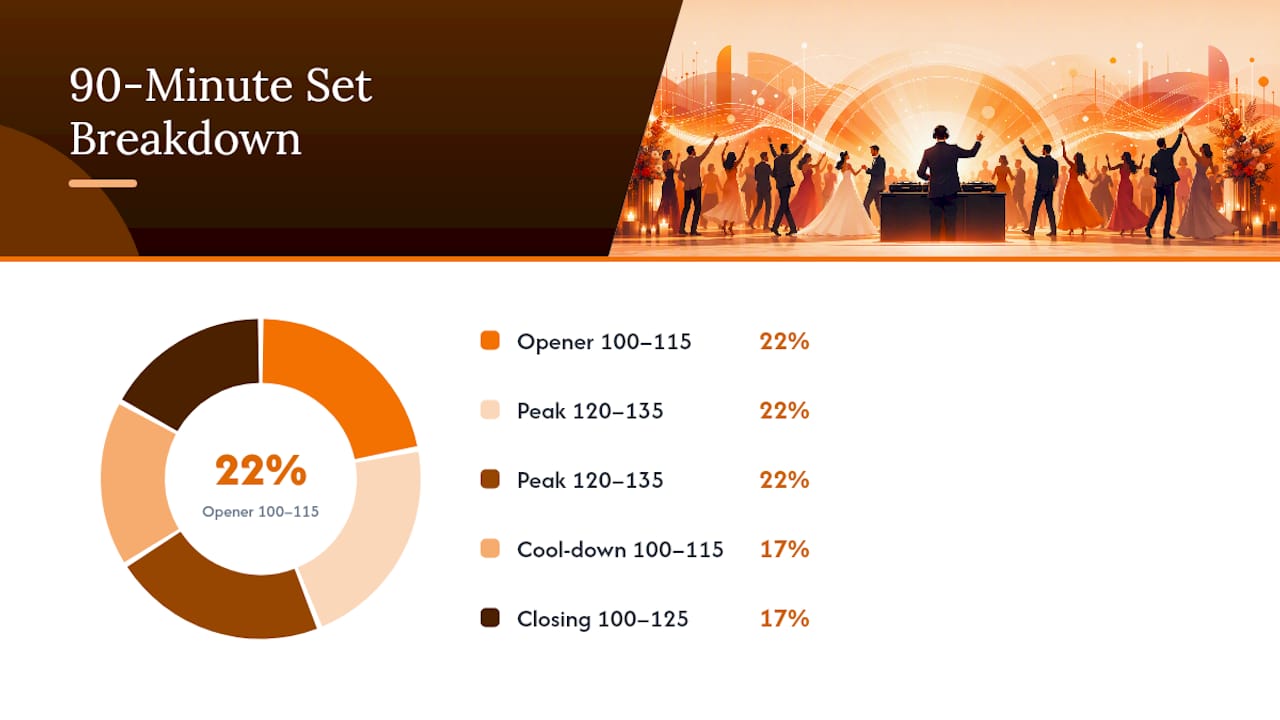
A sample 90-minute structure looks like this: minutes 0 to 20 as the opener wave, minutes 20 to 40 as the first peak cycle, minutes 40 to 60 as a second peak cycle with a genre shift into hip-hop or funk, minutes 60 to 75 as a brief cool-down with one or two mid-tempo singalongs, and minutes 75 to 90 as the closing run. This structure lines up with how Digital DJ Pool’s research on wedding sets frames a 90-minute peak block: broken into cycles, monitored constantly, and adjusted the moment the floor thins.
Song picks for every reception moment
Different moments in the night call for different songs, and matching mood to timing is what separates a set that flows from one that feels random.
Openers (right after formal dances, to draw the core group in):
- “I Wanna Dance with Somebody” by Whitney Houston
- “September” by Earth, Wind & Fire
- “Can’t Stop the Feeling!” by Justin Timberlake
If you’re still finalizing entrance music before the reception even starts, the same logic applies to grand entrance songs: pick something the room already knows.
Peak-energy blocks (30–60 minutes of sustained momentum):
- “Uptown Funk” by Mark Ronson ft. Bruno Mars
- “Levitating” by Dua Lipa
- “Get Lucky” by Daft Punk ft. Pharrell Williams
- “Party Rock Anthem” by LMFAO
Late-night bangers (closers everyone sings along to):
- “Mr. Brightside” by The Killers
- “I Will Survive” by Gloria Gaynor
- “Celebration” by Kool & The Gang
- “Livin’ on a Prayer” by Bon Jovi
Slow or transition songs (short cool-down moments to regroup the crowd):
- A three-to-four-song stretch of mid-tempo R&B or soul, like Stevie Wonder’s “Signed, Sealed, Delivered I’m Yours,” gives guests a breather between peak blocks without emptying the floor entirely. Keep this stretch under ten minutes, or the energy you built starts to leak away.
Genre and era rotation: the mechanics behind a full floor
BPM guides function, not vibe. Openers sit around 100 to 115 BPM to ease guests in without demanding much physical commitment. Peak blocks climb to 120 to 135 BPM, the range Digital DJ Pool’s analysis flags as the sweet spot for high-energy sustained dancing. Closers settle back to 100 to 125 BPM, fast enough to stay festive but slow enough to let an emotional singalong land.
Rotation works because no single generation dominates a wedding guest list. A classic four-song rotation template runs: pop anthem, funk or soul track, 80s or 90s throwback, hip-hop or modern pop, then repeat with different specific songs in each slot. This is the same principle behind DJs cycling genres every three to four songs to capture different guest segments while holding on to the dancers already committed.
A practical example: “Uptown Funk” (funk/pop) into “Billie Jean” (80s) into “Blinding Lights” (modern pop) into “Shout” (soul), then loop back into a new pop selection. Repeat the pattern with fresh songs roughly every 20 minutes, and reserve your two or three strongest anthems, like “Dancing Queen” or “September,” for moments when the floor visibly needs a jolt.
DJ Phoenix’s crowd-reading and request-handling playbook
Reading a room is a skill built on constant small adjustments, not a fixed playlist executed on autopilot. Experienced DJs watch the floor every three to four songs and ask a simple question: is the core group still moving, or has energy started to drain toward the bar? If it’s draining, that’s the cue to shift genre or tempo immediately, not to wait out the current song.
Request handling follows a similar discipline. Guests will ask for songs that flatter their own taste, not the room’s. A DJ’s job is to filter those requests against what’s actually working, since too many obscure or mismatched picks can undo twenty minutes of carefully built momentum. This is one of the clearest arguments for hiring an experienced wedding DJ rather than relying on a static pre-made playlist: a human operator adjusts in real time, a playlist app does not.
If you’re briefing a DJ yourself, a few checklist items make the difference between a vague conversation and a usable plan:
- A must-play list of 8 to 10 songs guests are certain to know.
- A never-play list of 3 to 5 songs to explicitly avoid, whether for taste or timing reasons.
- A preferred peak BPM range (120 to 135 works for most crowds).
- Three genres to prioritize during rotation, based on your specific guest list.
- A clear request policy communicated to guests in advance.
- One venue constraint, such as floor size or a sound curfew, stated up front.
This is essentially the same framework detailed in a guide to choosing the right wedding DJ, and it works because it turns a fuzzy expectation into something a professional can execute against.
Coordinating floor fillers around the rest of your reception
Dance floor fillers don’t exist in isolation. They have to work around a schedule that already includes speeches, dinner service, the bouquet toss, and often a garter toss or cultural rituals specific to your families.
The rule of thumb: never place a floor filler immediately before a scheduled event that requires guest attention. If speeches are 20 minutes away, ease off the peak-energy tracks and shift into background-friendly music instead, so the transition back to formal moments doesn’t feel jarring. Once speeches wrap, that’s actually a prime opening moment. Guests are already gathered and attentive, so cueing “Uptown Funk” or “I Wanna Dance with Somebody” right after the final toast capitalizes on a room that’s already paying attention.
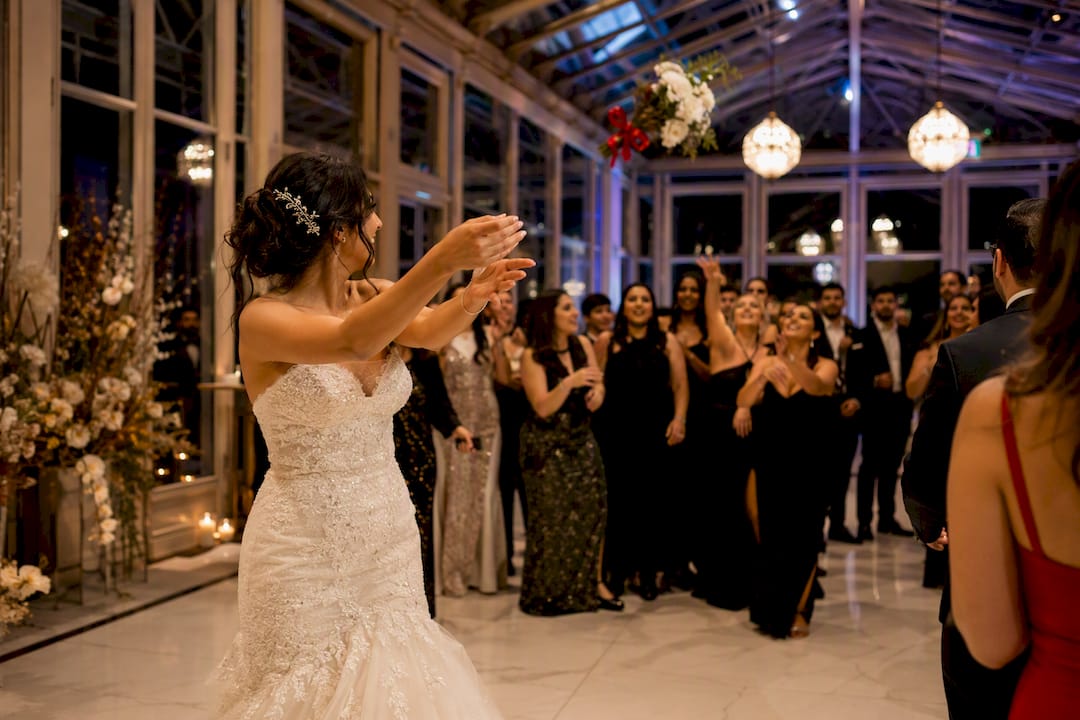
The bouquet and garter toss work best treated as their own mini-peak moment. Build anticipation with an upbeat but not maximum-energy track, run the toss itself, then immediately drop into a high-energy song like “September” or “Don’t Stop ‘Til You Get Enough” to carry that spike in attention straight back onto the dance floor. The goal is to never let the room’s energy fully reset between structured moments and open dancing.
Why curated playlists beat auto-generated ones
Algorithmic playlists optimize for individual listening habits, not for a room full of strangers who need to feel invited onto a floor at the same moment. That’s the gap most couples don’t see until the reception is already underway and the dance floor stays half-empty through a technically “good” playlist.
Sequencing is a craft, not a shuffle setting. The order songs play in, the moment a genre shifts, the decision to hold back “Mr. Brightside” until exactly the right window, that’s judgment built from reading actual rooms, not a recommendation engine. Prioritize crowd-proof singalongs over your personal favourite deep cuts, use the templates above as your starting structure, and brief whoever’s running your music with the same checklist a professional would insist on.
— Reza
How Dj-phoenix turns a playlist into a full dance floor
A great song list only works if someone reads the room and adjusts it live, and that’s the exact gap between a playlist app and a professional DJ. A great song list only works if someone reads the room and adjusts it live, with hands-on crowd-reading, open-format transitions between genres, and services that keep speeches, toasts, and dance blocks flowing without dead air.
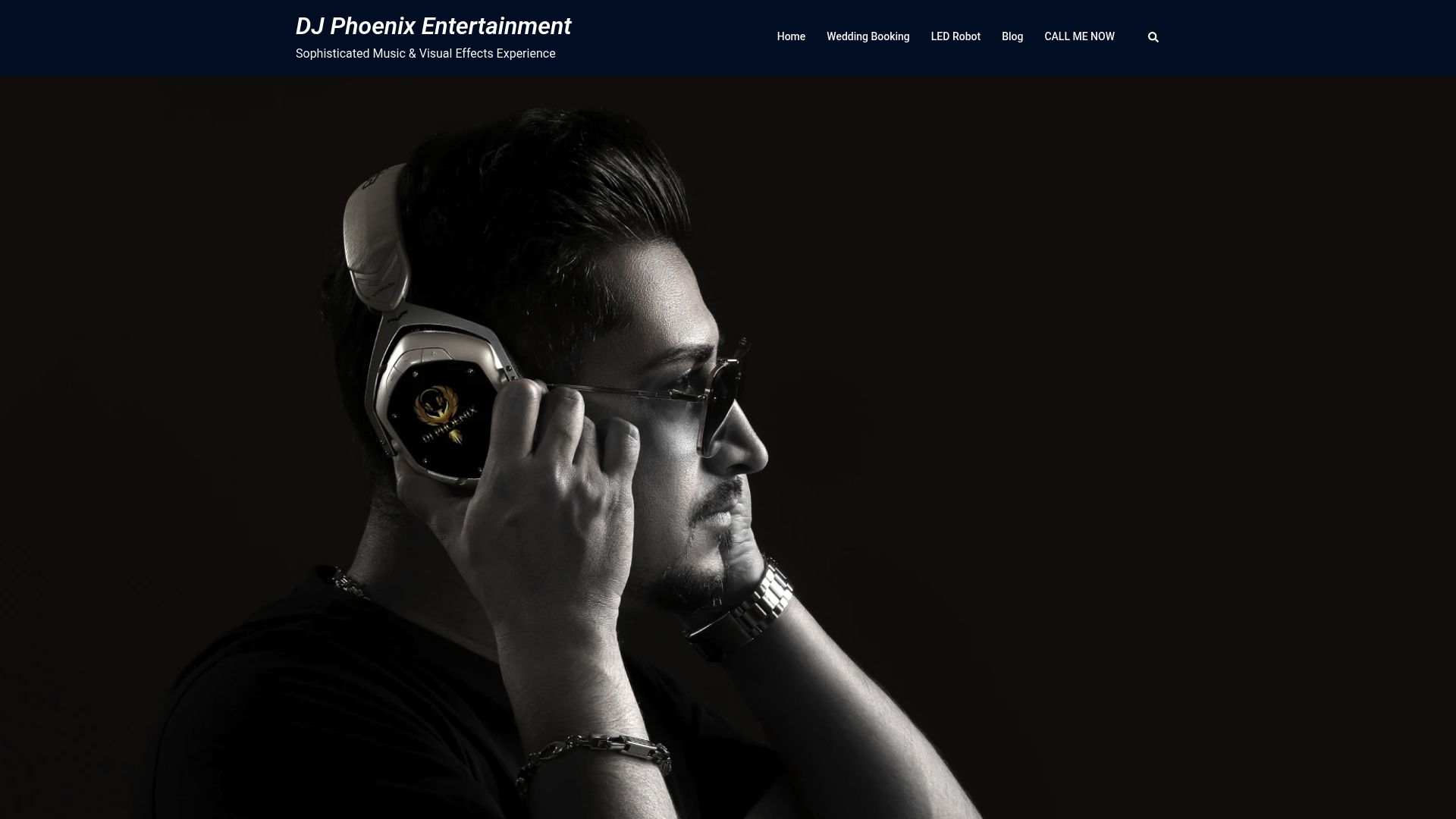
Every set is built around the same logic covered here: cross-generational singalongs, tight three-to-four-song rotations, and real-time adjustments instead of a fixed running order. For multicultural celebrations, that curation extends further, blending traditions the way a Persian wedding playlist or broader multicultural wedding music guide requires. If you’d rather see the approach in action before booking, browse the DJ performance gallery for real event footage, then reach out to check availability for your date.
Sources
- The Ultimate Wedding DJ Playlist for 2026: Songs That Fill Every Dance Floor — Digital DJ Pool
- 200 greatest dance songs of all time — Rolling Stone
FAQ
What are some good floor filling songs for a wedding dance?
Songs like “Mr. Brightside,” “Uptown Funk,” “September,” and “Dancing Queen” work reliably because they combine strong singalong hooks with cross-generational recognition.
Who dances first: mother and son, or father and daughter?
There’s no fixed rule; most receptions run the father-daughter dance first, followed by mother-son, though many couples swap the order or run them together depending on family preference.
What are some of the best floor fillers of all time?
Enduring anthems like “I Will Survive,” “Dancing Queen,” and “Celebration” appear repeatedly on dance-song lists because they’ve stayed relevant across multiple generations of dancers.
What song brings everyone to the dance floor at a wedding?
“Uptown Funk” and “Mr. Brightside” are two of the most consistent floor-clearers into floor-fillers, thanks to instantly recognizable hooks that require no prior familiarity with the artist.