
Lock one SMART entertainment goal before you book a single vendor. That single discipline separates championship events that generate genuine cultural moments from those that simply fill time between competition segments. Once the goal is written, your next move is to secure a DJ and entertainment partner with verified stadium experience and multicultural programming competence — DJ Phoenix Entertainment is one such partner, with a track record spanning corporate prestige clients and multicultural celebrations alike.
Immediate action checklist:
- Confirm event scale and expected attendance to set the correct planning timeline appropriate for the size of your event
- Set a firm budget with an appropriate contingency line before approaching vendors
- Reserve venue and key production windows (load-in, soundcheck, stage footprint) in writing
- Identify licensing and permit requirements for your municipality early
Table of Contents
- What does your championship entertainment checklist look like?
- When should you start planning by event scale?
- How do you set a SMART entertainment goal with real KPIs?
- How do you choose the right DJ for a championship event?
- What production specs does a championship event actually require?
- How do you design multicultural programming for a championship audience?
- What does championship-scale entertainment cost in Canada?
- What happens when your entertainment plan breaks down?
- How do you coordinate entertainment with your full event schedule?
- What keeps your audience engaged during entertainment segments?
- How do you measure entertainment success after the event?
- What licences and permits do you need for entertainment in Canada?
- Key takeaways
- The real lesson championship events teach you about entertainment
- Dj-phoenix brings championship-calibre entertainment to your event
What does your championship entertainment checklist look like?
Successful championship event entertainment planning runs on milestones, not momentum. Use this framework as your working playbook.
- Define one SMART entertainment goal and three supporting KPIs
- Set total entertainment budget with an appropriate contingency line
- Confirm venue availability and production access windows
- Obtain municipal permits and SOCAN/Re:Sound music licensing
- Shortlist and vet DJ/entertainment vendors (references, rider, insurance)
- Finalise production supplier and sign technical addendum
- Confirm VIP hospitality flow and guest-experience touchpoints
- Distribute run-of-show to all stakeholders
- Conduct soundcheck and full technical rehearsal
- Deploy post-event survey within 48 hours
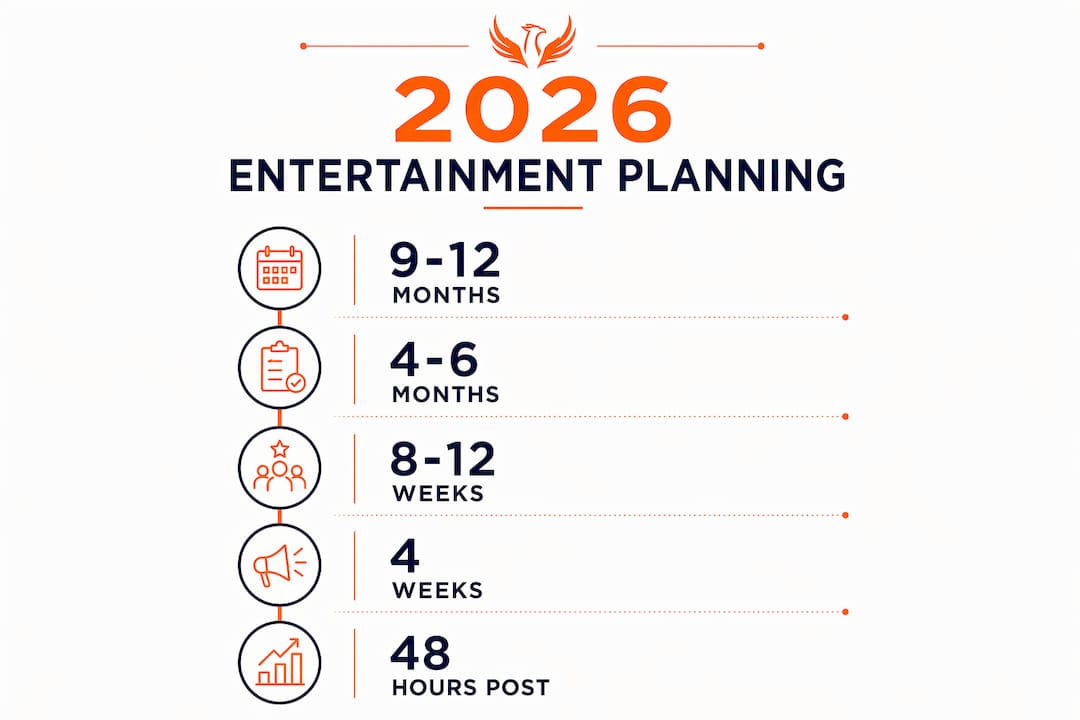
| Milestone | 9–12 months | 4–6 months | 8–12 weeks | 4 weeks | 48 hrs post-event |
|---|---|---|---|---|---|
| SMART goal set | ✓ | ||||
| Venue locked | ✓ | ||||
| DJ/talent deposit | ✓ | ✓ | |||
| Permits & licensing | ✓ | ✓ | |||
| Production supplier | ✓ | ||||
| Run-of-show draft | ✓ | ||||
| Vendor confirmations | ✓ | ✓ | |||
| Post-event survey | ✓ |
Pro Tip: Nominate a single entertainment lead — internal or vendor-side — who owns the run-of-show document and all vendor confirmations. Diffused ownership is the most common cause of day-of failures.
When should you start planning by event scale?
Planning timelines vary sharply by attendance, and the consequences of starting late compound quickly at championship scale.
- 500+ attendees: Begin 9–12 months out. Stadium-capable DJs, large PA rigs, and city permits for outdoor or multi-venue activations are finite resources in Canadian markets.
- 100–499 attendees: A 4–6 month window is workable, provided venue and production are locked in the first two weeks.
- Under 100 guests: Six to eight weeks is the minimum — but only if the venue is already confirmed and the entertainment brief is clear from day one.
| Scale | Planning start | Venue locking | DJ deposit | Production supplier | City permits |
|---|---|---|---|---|---|
| Large-scale stadium/fan-fest events | Planning should start well in advance to secure necessary resources and permits | ||||
| Mid-size hall events | Planning should allow sufficient time for vendor and venue arrangements | ||||
| Small VIP/intimate gatherings | Planning timeline should suit the confirmed venue and clear entertainment brief |
Work backwards from your event date and assign a named owner to each milestone. A sports event DJ checklist can help map these windows to specific vendor tasks.
How do you set a SMART entertainment goal with real KPIs?
Write the goal before you open a single vendor proposal. The SMART framework — Specific, Measurable, Achievable, Relevant, Time-bound — forces clarity that every subsequent decision can reference.
Example SMART goals:
- Fan engagement: “Achieve a guest satisfaction score of 8.5/10 or higher on the post-event survey, collected within 48 hours of the closing set.”
- VIP retention: “Retain 90% of VIP guests in the hospitality suite through the final performance segment.”
- Social reach: “Generate 500 organic social posts using the event hashtag during the entertainment programme.”
KPI checklist:
- Attendance engagement rate (percentage of guests on the floor or in active zones during peak sets)
- Net Promoter Score or guest satisfaction score from a post-event survey
- Social impressions and hashtag volume during entertainment segments
- Lead capture volume at sponsor activations tied to entertainment moments
Measure attendance engagement with real-time crowd sensors or venue capacity reports. Deploy your audience engagement survey within 48 hours for the strongest recall and response rates.
How do you choose the right DJ for a championship event?
The calibre of your entertainment partner determines whether the event achieves its SMART goal or simply fills the schedule. Prioritise these criteria:
- Championship/stadium experience: Ask for a verified run-of-show from a comparable event, not just a highlight reel.
- Multicultural competence: The DJ must demonstrate fluency across the cultural demographics of your audience — not token playlist additions. Review their cultural competence approach directly.
- Production rider: A professional vendor provides a detailed technical rider specifying PA requirements, stage footprint, power draw, and load-in windows.
- Bilingual MC capability: For multicultural and VIP audiences, bilingual hosting elevates the experience and signals genuine cultural respect.
- Insurance and SLA: Require a certificate of liability insurance and a written service-level agreement with cancellation, overtime, and force-majeure clauses.
Questions to ask during vetting:
- Can you provide a sample run-of-show from a stadium or championship-scale event?
- What is your soundcheck requirement and minimum load-in window?
- Who is your backup if you are unable to perform?
- What are your overtime and travel/accommodation terms?
- Can you supply three references from comparable events?
Red flags: non-itemised quotes, no technical rider, inability to name a backup performer, and any reluctance to provide proof of insurance or sign an SLA.
Reference request template: “Please provide the name and contact of your event lead from [comparable event], a copy of your technical rider, your certificate of liability insurance, and one audio or video clip demonstrating crowd-read across a multicultural setlist.”
What production specs does a championship event actually require?
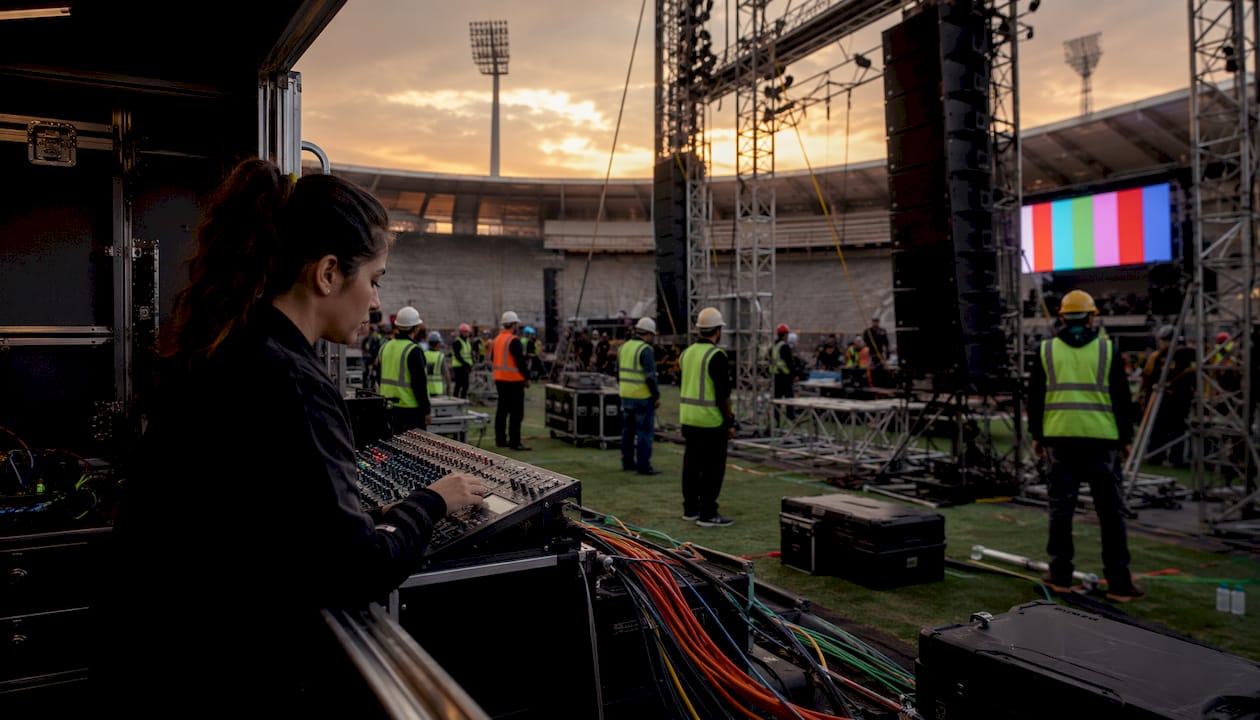
Stadium-grade production is not simply a larger PA. It involves precise coordination of power, staging, and timing that venue footprint constraints can make genuinely complex.
| Venue type | Audience size | PA recommendation | Lighting rig | Stage footprint |
|---|---|---|---|---|
| Indoor ballroom | Under 100 guests | Line-array cluster, 10–15 kW | Wash + moving heads | 6 m × 4 m minimum |
| Mid-size hall/arena | 100–499 attendees | Flown line-array | Full truss rig | 10 m × 6 m |
| Stadium/fan-fest | 500+ attendees | Distributed delay towers + main hang | LED wall + full truss | 15 m × 10 m+ |
Load-in and soundcheck checklist:
- Confirm delivery window in writing with venue operations
- Map cable routing to avoid crossing playing surfaces or emergency exits
- Specify deck protection materials for any field or court surface
- Identify union or time restrictions that affect setup and strike
- Schedule a full soundcheck at least 90 minutes before doors open
The 2026 FIFA World Cup final’s 11-minute halftime window at MetLife Stadium illustrated how unforgiving championship timelines are: every production element must be pre-positioned and rehearsed off-field before the performance window opens.
Pro Tip: Require a venue-signed production addendum that specifies the permitted stage footprint, approved surface-protection materials, exact load-in and load-out windows, and financial penalties for overruns. Verbal agreements dissolve under championship-day pressure.
How do you design multicultural programming for a championship audience?
Authentic multicultural programming is architecture, not a playlist shuffle. Local cultural flavour is what transforms a global spectacle into a moment the host city actually claims as its own.
Structure your programme in three layers:
- High-energy fan-fest blocks: Broad-appeal anthems and regional hits that build collective energy across demographic lines
- Culture-specific showcase segments: Dedicated 10–15 minute sets that honour the dominant cultural communities in your audience, with a bilingual MC to contextualise each transition
- Intimate VIP sets: Bespoke playlists that reflect the specific cultural backgrounds of your VIP guests, curated in advance through direct consultation
Transitions between cultural segments require as much craft as the sets themselves. A skilled DJ reads the room’s energy and uses tempo, key, and language shifts to signal a new cultural moment without losing the crowd’s momentum. For multicultural event programming, the sequencing brief should be as detailed as the setlist itself.
Pro Tip: Test multicultural setlists in advance with a representative listening session — even a 30-minute call with two or three community members from your key demographics will surface track choices that land authentically versus those that read as performative.
What does championship-scale entertainment cost in Canada?
Budget shapes vary by event scale, but the allocation logic is consistent. Set your total entertainment budget early, because venue, production, and talent are the three highest-cost line items and they interact. Budget allocation among categories should be planned carefully to ensure coverage of key expenses.
Stadium-capable DJ fees in Canada vary by market, event scale, and production scope; publicly listed pricing is not standard practice among elite providers. Common add-ons include overtime rates (typically billed per hour beyond the contracted set), travel and accommodation for out-of-market engagements, and production uplift for events requiring the DJ to supply PA and lighting rather than integrate with a house system.
Budget control checklist:
- Require itemised quotes from every vendor — a single-line “event fee” is a red flag
- Carry the 10–15% contingency as a separate line, never folded into talent or production
- Monitor actual-versus-budget weekly during the final eight weeks using a master vendor spreadsheet that tracks deliverables, payment schedules, and cancellation terms
What happens when your entertainment plan breaks down?
Contingency planning is not pessimism — it is the professional standard. Confirmed backup options for every critical supplier are a baseline expectation at championship scale.
Maintain at least two backup entertainment options at the point of contracting your primary DJ. For outdoor events, identify an indoor fallback venue or a covered stage alternative before the event date, not the morning of. Weather contingency plans should be written into the venue contract, specifying the trigger conditions and decision timeline for activating the backup.
For equipment failures, require your entertainment partner to carry redundant gear: a backup laptop or controller, spare cables, and a secondary audio path. A professional technical rider will specify this. The run-of-show should also name the person authorised to make real-time programme changes if a segment must be cut or extended.
How do you coordinate entertainment with your full event schedule?
Entertainment does not run in isolation. It must be choreographed against catering service windows, award ceremonies, sponsor activations, broadcast schedules, and VIP movement.
Distribute the run-of-show to every stakeholder — venue operations, catering, security, broadcast, and your entertainment lead — no later than one week before the event. Build explicit buffer windows of five to ten minutes between programme segments to absorb the inevitable delays. Assign a single point of contact for real-time communication on event day, with a direct line to the DJ and production team.
Breaks and transitions are programming opportunities, not dead air. A skilled DJ uses a transition set to shift the audience’s energy intentionally — from high-intensity competition coverage to a relaxed hospitality moment, or from a cultural showcase into a broad-appeal closing set.
What keeps your audience engaged during entertainment segments?
Passive audiences do not generate the social content, NPS scores, or sponsor ROI that justify championship-scale entertainment budgets. Design for participation.
Structured crowd interaction — call-and-response moments, bilingual dedications, and live song requests curated through a moderated digital platform — gives guests agency without surrendering programme control. Lighting design that responds to musical peaks and cultural transitions reinforces the emotional arc of each segment. For VIP audiences, personalised touches such as a custom intro track or a culturally specific first-dance equivalent signal that the programme was built for them specifically.
How do you measure entertainment success after the event?
Deploy your guest satisfaction survey within 48 hours — response rates and recall quality drop sharply after that window. Keep it to five to seven questions covering overall experience, entertainment quality, cultural representation, and likelihood to recommend.
Cross-reference survey data against your pre-set KPIs: engagement rate, NPS, social impressions, and VIP retention. Schedule a formal performance review with your entertainment partner within two weeks, using the run-of-show as the benchmark document. Note which segments overperformed and which required real-time adjustment — that debrief becomes the foundation of your next event brief.
What licences and permits do you need for entertainment in Canada?
Music licensing is mandatory for any public performance in Canada. SOCAN administers performing rights for musical works; Re:Sound covers neighbouring rights for sound recordings. Both licences are typically required for events where recorded music is played publicly, and fees are calculated based on event type, attendance, and ticket price. Your venue may hold blanket licences that cover your event — confirm this in writing before assuming coverage.
Municipal noise ordinances govern outdoor events and late-night programming. Permit requirements vary by city: Toronto, Montreal, Ottawa, Vancouver, and Calgary each have distinct processes for temporary event permits, amplified sound permits, and public assembly approvals. Apply a minimum of 8–12 weeks before your event date for any outdoor or large-scale indoor production.
Liability insurance for entertainment at championship events is a legal and contractual requirement. Require your DJ and production vendors to carry commercial general liability coverage and to name your organisation as an additional insured on their policy.
This article provides general information about Canadian entertainment licensing and permits. Confirm current requirements with SOCAN, Re:Sound, and your municipal authority for your specific event.
Key takeaways
Championship event entertainment planning delivers its best results when a SMART goal drives every vendor decision, stadium-capable talent is secured early, and a 10–15% contingency protects every production line.
| Point | Details |
|---|---|
| Set a SMART goal first | Define one measurable entertainment objective before approaching any vendor — it anchors every subsequent decision. |
| Book stadium-capable talent early | Large championship events require 9–12 months of lead time; elite DJs with multicultural competence book out quickly. |
| Insist on rider and insurance | A professional technical rider and certificate of liability insurance are non-negotiable trust signals at championship scale. |
| Budget a contingency line | Carry 10–15% of the total entertainment budget as a separate contingency — never fold it into talent or production fees. |
| Dj-phoenix for multicultural events | Dj-phoenix brings stadium-grade production, multicultural playlist artistry, and bilingual MC capability to championship and upscale celebrations across Canada. |
The real lesson championship events teach you about entertainment
There is a tendency among upscale hosts to treat entertainment as the last line item — the thing you finalise after the venue, the catering, and the broadcast deal are settled. That instinct is understandable, and it is also the single most reliable path to a forgettable event.
What stadium-scale productions demonstrate, from the Big Ten Championship Fan Fest in Indianapolis to the 2026 World Cup final at MetLife Stadium, is that entertainment is the hospitality product. It is the element guests carry home, the content that circulates on social platforms for days afterward, and the experience that determines whether a sponsor considers the activation a success. The local cultural flavour woven into a programme is what makes a global event feel like it belongs to the city hosting it.
The practical lesson from working at this scale: plan for the venue’s constraints before you plan the programme. Short on-field windows, strict load-in timelines, and surface-protection obligations will reshape your entertainment brief faster than any creative ambition. Request a sample run-of-show and a signed production addendum during contracting — not as a formality, but as the clearest signal that your partner has actually done this before.
Dj-phoenix brings championship-calibre entertainment to your event
Dj-phoenix delivers stadium-capable DJ sets, multicultural playlist curation, bilingual MC hosting, and full production rider support for championship events, upscale corporate celebrations, and multicultural weddings across Canada. With prestigious clients including Mercedes-Benz and FW Sports in the portfolio, the pedigree speaks directly to the calibre of experience you are commissioning.
Every engagement begins with a detailed brief, a written run-of-show, and a production addendum tailored to your venue’s specific constraints. You can review live performance footage and crowd-response clips in the DJ performance gallery before committing to a proposal. For hosts planning championship-scale or multicultural events, the event organiser service page outlines the full scope of production partnership available. Request your proposal and production addendum today at dj-phoenix.com.