For a single-day event, a small ceremony PA runs about $300 to $750, a mid-size reception or corporate setup lands between $750 and $3,000, and a full concert-grade line array for 1,000 or more guests climbs to $3,500 to $12,000 or higher. Those figures typically include the speakers, mixer, cables, and stands. Delivery, setup, and a technician are often priced separately, and they can add anywhere from a couple hundred dollars to over a thousand, depending on the complexity of your event.
That range is wide because “sound system rental” covers everything from a single Bluetooth speaker at a backyard barbecue to a festival-grade array with delay towers and dedicated monitor engineers. The industry term for this whole category is PA (public address) system rental, and most vendors quote it as either a flat package price or an itemized list of components.
Before requesting quotes, confirm these five things with any vendor:
- Whether the quoted price includes delivery, setup, and teardown, or if those are extra
- Whether a technician is included, optional, or mandatory for your event type
- The exact speaker count, subwoofer count, and mixer channel capacity in the package
- What happens with overtime if your event runs long
- Whether a damage deposit is required and how it’s refunded
Pro Tip: Venue access quietly wrecks more budgets than equipment does. A loading dock two floors down, no nearby power circuit, or a cocktail hour on a rooftop with no elevator can push labour costs up significantly, since crews need more time and sometimes extra gear like cable ramps or a generator. Mention your venue’s access details in your very first quote request.
Table of Contents
- Sound system rental cost by package size and rental duration
- What’s included in a sound rental package, and what’s billed separately
- Why sound system rental costs vary so much between quotes
- Do you need a sound technician, and what do they cost?
- Extra charges that show up after the initial quote
- How many speakers do you actually need?
- Is it cheaper to rent or buy your own sound system?
- When to book your sound rental, and what deposits to expect
- Sample package templates you can use in your next quote request
- What DJ Phoenix tells clients before quoting a sound rental
- Book your sound system with a provider who already knows the details that matter
- Quick planning checklist before you book
- Frequently asked questions
- Sources
Sound system rental cost by package size and rental duration
Pricing scales with three things: how many people need to hear clearly, how complex the event program is (a DJ playlist is simpler than a live band with six microphones), and how long you need the gear on site. A vendor guide from Primal Sounds puts single-event rentals at roughly $500 for a small PA up to $5,000 or more for large line arrays serving 1,000-plus guests, with technician day rates commonly adding $300 to $800.
Smaller regional operators sometimes price a notch lower. The Vera Project lists small PA packages at $300 to $500 per day, standard packages at $500 to $750, and full PA setups at $1,000 to $1,250 or more. A California-focused guide from Eden USA breaks costs down by event type instead of package size: DJ or party setups run $450 to $1,200, live band or medium events run $1,200 to $3,500, and large outdoor or festival systems run $3,500 to $12,000 or more.
| Package size | Typical components | Typical price band (per day) |
|---|---|---|
| Small PA | Two powered speakers, basic mixer, one or two mics, stands and cables | $300 to $750 |
| Medium PA | Four speakers, one or two subwoofers, mixer with more channels, three to four mics, stands | $750 to $3,000 |
| Large PA | Line array speakers, multiple subwoofers, digital mixer, monitor wedges, full mic kit | $3,500 to $12,000 |
| Festival-grade system | Multiple line array hangs, delay towers, dedicated FOH and monitor consoles | $3,500 to $12,000+ |
Renting for multiple consecutive days rarely doubles or triples the single-day rate. Most companies discount the second and third day since the gear is already on site, but they will bill separately for any hours beyond the agreed load-in-to-load-out window. Urban markets with dense event calendars sometimes carry a premium on weekends, especially during wedding season from May through October, while rural markets may have fewer vendors but lower baseline rates.
- Confirm whether your quote covers a set number of hours or a full calendar day
- Ask what the overtime rate is per hour before you sign anything
- Weekend and holiday dates often carry a 10% to 20% premium in busy markets
Pro Tip: Booking your date 60 to 90 days out often locks in the current rate before any seasonal price adjustment. Bundling your sound rental with a DJ or MC service, rather than hiring separately, frequently shaves cost off both because the vendor is already on site and doesn’t need a second load-in.
What’s included in a sound rental package, and what’s billed separately
Most quoted packages bundle the core hardware: powered speakers, a subwoofer or two for anything with bass-heavy music, a mixer, stands, XLR and speaker cables, and a basic microphone kit. Delivery, setup, and teardown are frequently rolled into the package price for standard local jobs, though some vendors bill them as a separate line item, especially for out-of-town events.
What’s commonly bundled:
- Powered speakers and subwoofers matched to your guest count
- A mixer with enough channels for your microphones and music source
- Speaker stands, basic cabling, and power strips
- One to three wireless or wired handheld microphones
- Local delivery, setup, and teardown for standard venues
What’s usually sold separately:
- Long cable runs beyond a standard 50 to 100 foot range
- Multi-zone coverage, such as a ceremony area plus a separate reception space
- Advanced audio processing or dedicated monitor mixes for performers
- Rigging for hanging speakers from a truss or ceiling point
- Permits, venue-mandated union labour, or insurance certificates
The industry heuristic behind item-level pricing, according to LendControl’s guide to AV rental pricing, is that many vendors price each piece of gear at roughly 3% to 5% of its replacement cost per day. That’s why a single powered speaker might rent for $75 to $150 a day while a wireless handheld microphone runs $35 to $75. Get every inclusion in writing, ideally itemized, rather than trusting a verbal “it’s all included” from a salesperson. Ask specifically whether teardown time counts against your rental window or whether it’s billed as overtime.
Why sound system rental costs vary so much between quotes
Two events with the same guest count can land $2,000 apart in price, and the gap almost always traces back to a handful of specific variables. Guest headcount and required coverage area drive speaker count and power needs first. A 150-person indoor reception needs far less horsepower than a 150-person outdoor ceremony fighting wind and open air, since sound disperses more in the open and speakers need to work harder to reach the back row.
Venue type matters just as much as headcount. Ceiling height, whether the room is carpeted or has hard reflective surfaces, and whether the event is indoors or outdoors all change what equipment a vendor recommends. A live band with a drum kit and six vocal mics needs a completely different mixing setup than a DJ running off a laptop, which is why program type (speech, DJ set, live band) shows up as a major line item in most quotes.
- Guest headcount and coverage area, which determine speaker count and placement
- Indoor versus outdoor and ceiling height, which affect how sound travels
- Program type, since a live band needs more channels and monitoring than a DJ
- Power availability, since older venues sometimes lack enough circuits for pro audio gear
- Site access and load-in complexity, including stairs, elevators, and loading dock distance
- Labour time for setup, soundcheck, and strike, plus any overtime if the event runs long
- Equipment quality and whether backup gear is included in case of failure
Labour is often the hidden multiplier here. A simple DJ setup might take 45 minutes to set up and 20 to tear down. A live band with monitors, multiple vocal mics, and a soundcheck can eat two to three hours before doors even open, and that time gets billed. Practitioner insight from The Catalyst Companies notes that difficult site access, like a long push from a loading dock or a lack of nearby power circuits, is one of the most under-budgeted cost drivers in the entire industry, and it can double the final invoice when crews need extra time or a generator.
Pro Tip: Send your vendor a floor plan or even just a phone photo of the load-in path and nearest power outlet before they quote you. Vendors who quote blind almost always build in a contingency buffer, and that buffer disappears once they know exactly what they’re walking into.
Do you need a sound technician, and what do they cost?
A trained technician is essential once your event involves more than two or three microphones, any live instruments, or a mixing board with more than a handful of channels to manage in real time. A self-contained PA kit with a single DJ controller or a laptop running a preset playlist is usually fine without a dedicated operator, since the DJ or presenter can manage volume themselves.
Technician rates typically run $25 to $50 per hour for straightforward gigs, according to the Vera Project, while more complex jobs commonly command flat day rates of $300 to $800, per Primal Sounds.
Billing models vary by vendor and by job complexity. Some companies charge a simple hourly rate for short, low-complexity events, while others switch to a flat day rate once the show involves a full band, multiple mic zones, or a run-of-show that spans several hours. Always confirm which model applies before you book, since a job quoted hourly can balloon fast if your event runs long.
- Setup-only technician: arrives, configures the system, tests it, and leaves before the event starts
- Run-of-show operator: stays on site to adjust levels as the event unfolds, common for weddings and corporate programs
- Front-of-house (FOH) engineer: mixes the overall sound for the audience during live performances
- Monitor technician: manages the separate mix that performers hear on stage, needed only for bands with in-ear or wedge monitors
If your event includes a live band alongside a DJ set, as is common at multicultural weddings, plan for a technician who can manage the handoff between the two smoothly. That’s a detail worth raising directly with your sports event DJ equipment provider or entertainment company early in planning, since last-minute technician add-ons cost more than booking one from the start.
Extra charges that show up after the initial quote
The number on a vendor’s homepage rarely matches the number on your final invoice, and the gap is almost always one of a handful of predictable extras. Delivery distance fees kick in once your venue sits outside a vendor’s standard service radius, and they scale with mileage. Stair fees or long-push fees apply when a crew has to hand-carry gear up flights of stairs or across a long distance from the truck to the venue, since that eats labour time that a loading dock or elevator would save.
- Delivery distance fees for venues outside the standard service area
- Stair or long-push fees when there’s no elevator or nearby loading access
- Late-night or after-hours labour rates, often after 10 or 11 p.m.
- Refundable damage deposits, commonly around $150 for smaller packages
- Permits or venue-mandated union labour at certain hotels and convention centres
- Power distribution equipment or generator rental when circuits are insufficient
Taxes and service fees are frequently shown as separate line items rather than baked into the headline price, which is standard practice but easy to miss when comparing two quotes side by side. Always ask for an all-in total that includes tax, delivery, technician time, and any deposit, rather than comparing base package prices alone. A useful line to send any vendor: “Can you send me a final all-in total, including delivery, technician time, tax, and any refundable deposit, so I can compare it against other quotes?” That single question tends to surface every hidden fee in one reply.
How many speakers do you actually need?
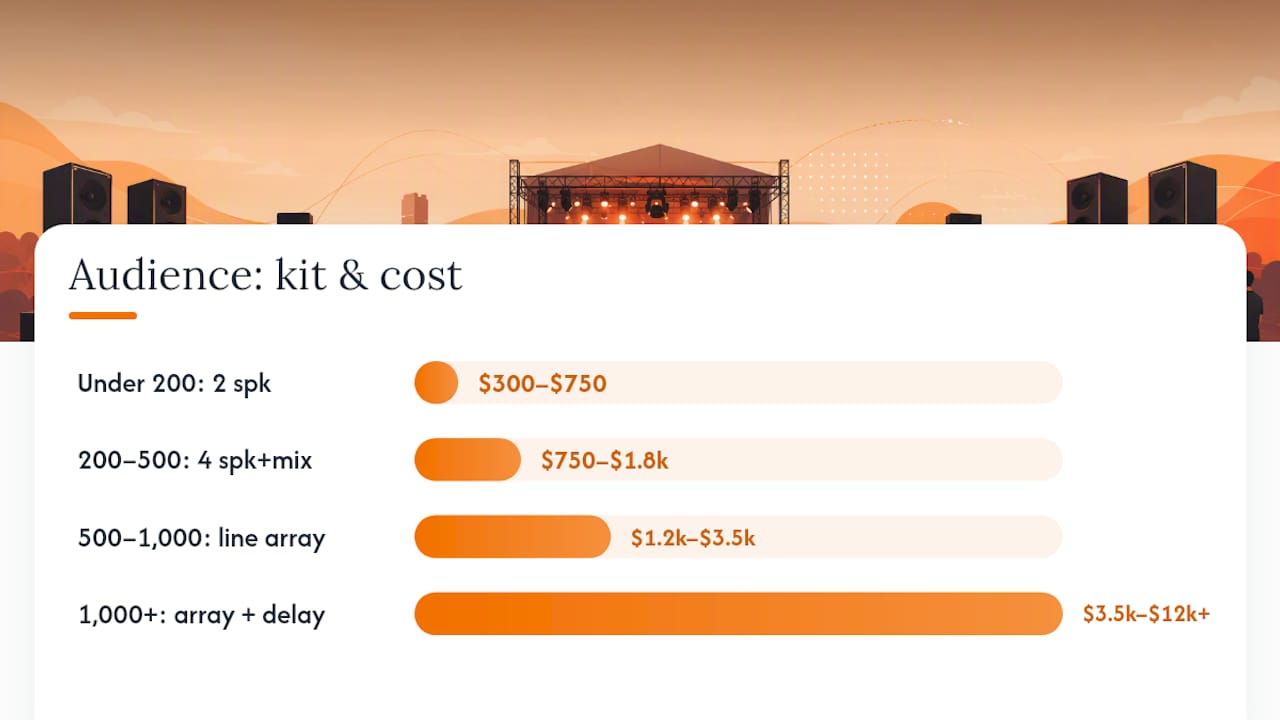
Speaker count scales with audience size in fairly predictable steps, and getting this wrong in either direction costs you: too few speakers and the back of the room can’t hear, too many and you’ve overpaid for headroom you didn’t need. For an indoor event under 200 guests, two powered speakers on stands with one subwoofer usually covers the room comfortably. Between 200 and 500 guests, plan for four speakers, one or two subwoofers, and a mixer with enough channels for a DJ, microphones, and any playback source.
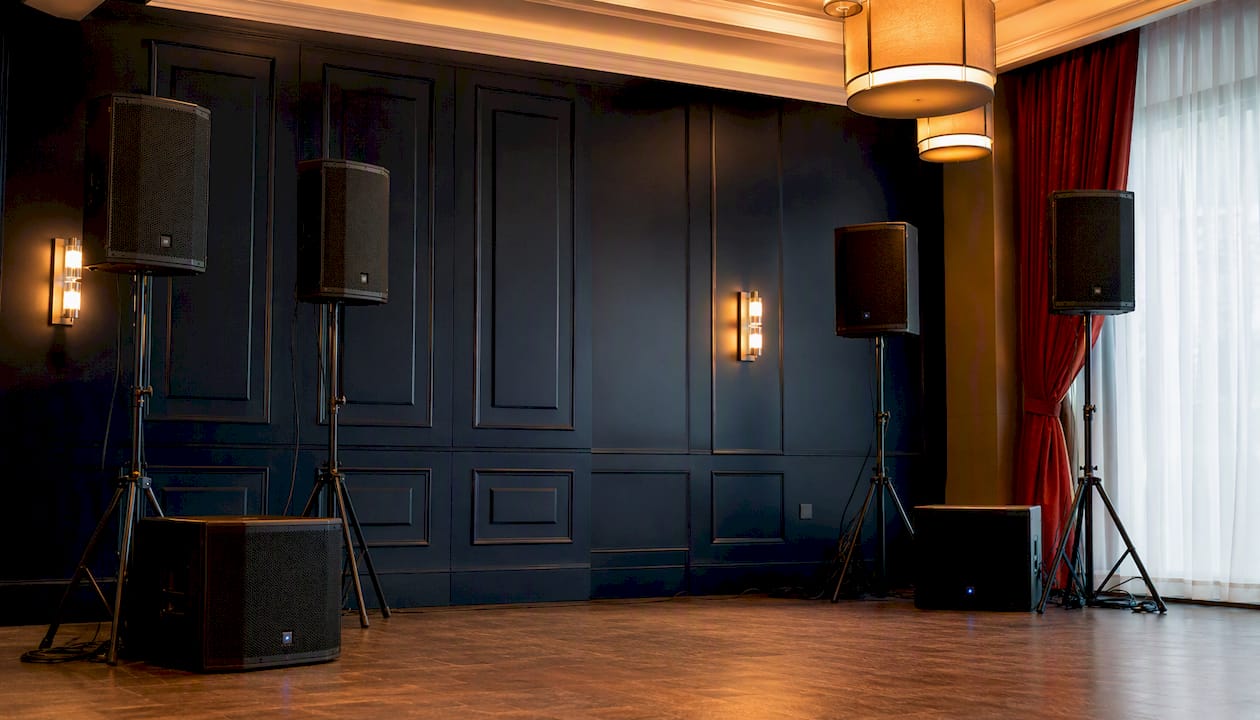
Once you cross 500 guests, a single pair of speakers can’t throw sound evenly across the room without serious volume at the front and mud at the back. That’s when vendors start recommending a line array system, which stacks smaller speaker elements to control how sound spreads. For crowds over 1,000, especially outdoors, delay towers or front fills become necessary. These are additional speaker clusters placed farther back in the crowd, synced with a slight delay so sound arrives at the same time everywhere rather than echoing off itself.
| Audience size | Recommended minimal kit | Typical price band |
|---|---|---|
| Under 200 | Two speakers, one subwoofer, basic mixer | $300 to $750 |
| 200 to 500 | Four speakers, one to two subwoofers, mixer, wireless mics | $750 to $1,800 |
| 500 to 1,000 | Line array elements, multiple subwoofers, digital mixer | $1,200 to $3,500 |
| 1,000+ | Line array with delay towers or front fills, dedicated FOH console | $3,500 to $12,000+ |
Outdoor events generally need more power than indoor ones for the same headcount, since there are no walls to help contain and reflect sound. A single-zone setup, where one sound source covers the whole space, works fine for most weddings and parties under 500 guests in a single room. Multiple zones become necessary once you have a ceremony space and a separate reception space, or an outdoor venue large enough that guests spread across distinct areas. Planners working stadium-scale events should look closely at PA systems built for outdoor stadiums, where coverage and delay planning look nothing like a standard banquet hall setup.
Is it cheaper to rent or buy your own sound system?
Renting wins for the overwhelming majority of individuals and even most event planners, because sound equipment depreciates fast and sits idle most of the year. The math vendors themselves use is instructive: per LendControl’s pricing methodology, rental businesses often price gear at roughly 3% to 5% of its replacement cost per day. That means a $2,000 speaker system might rent for $60 to $100 a day, and you’d need to rent it more than 20 to 30 times before you’d have spent what it costs to buy outright, not counting storage, maintenance, or the risk of something breaking between uses.
Buying starts to make sense only if you’re running events frequently, think weekly or biweekly, with fairly consistent audience sizes and venue types. A wedding DJ or a house of worship running services every week is a very different calculation than a couple planning one wedding or a company hosting an annual holiday party. For a single event or a handful of events a year with varying guest counts and venues, renting keeps you flexible: a 150-person backyard party and an 800-person ballroom gala need completely different gear, and owning for one leaves you underequipped for the other.
- Buying tends to pay off only above roughly 25 to 30 uses per piece of equipment
- Renting keeps you flexible across wildly different event sizes and venue types
- Ownership adds storage, maintenance, and depreciation costs renting avoids entirely
Pro Tip: Add up how many total event days you’d realistically need sound equipment over the next three years. If that number is under 15 to 20 days, renting is almost certainly the cheaper path once you factor in storage and the risk of gear failing without a backup unit on hand.
When to book your sound rental, and what deposits to expect
Booking timelines follow a predictable pattern tied to event type. Weddings, especially during peak season from late spring through early fall, should be locked in four to six months ahead, both to secure your preferred date and to avoid rush pricing that some vendors apply within 30 days of an event. Corporate events can often be booked with less lead time, six to eight weeks in many cases, since companies tend to have more flexible scheduling. Private parties and smaller gatherings can sometimes be arranged with just two to three weeks’ notice, though weekend dates in busy months fill up fast regardless of event type.
Cancellation policies typically scale with how close to the event date you cancel: full refunds are common outside 60 days, partial refunds between 30 and 60 days, and little to no refund inside 30 days, since the vendor has likely turned away other bookings for that date. Rescheduling is often easier to negotiate than an outright cancellation, particularly if you give the vendor several weeks’ notice.
- Book weddings four to six months out; corporate events six to eight weeks; private parties two to three weeks minimum
- Expect a 25% to 50% deposit at booking, with the balance due before the event
- Ask specifically what happens if you need to reschedule versus cancel outright
Before signing anything, ask your vendor to confirm the full scope in writing: exact equipment list, technician hours, delivery window, and the all-in total including tax and any deposit. Venues themselves sometimes have their own audio restrictions or preferred vendor lists, so it’s worth checking your venue’s requirements before locking in a rental company.
Sample package templates you can use in your next quote request
Copying a structured request into your first email to a vendor gets you a far more accurate quote than simply asking “how much for sound?” Below are four templates built around common event types, with realistic price ranges based on typical market rates.
Ceremony speak-only package: Two speakers, one wireless lavalier or handheld mic, basic mixer, stands, delivery and setup included. Typical price: $300 to $600. Good for wedding ceremonies, small speeches, or short award presentations under 150 guests.
Wedding reception DJ package: Four speakers, one to two subwoofers, DJ mixer or controller interface, two wireless mics for toasts, uplighting sometimes bundled, delivery, setup, and a DJ or technician included. Typical price: $750 to $2,000. This is the range most couples land in for a 100 to 250 guest reception.
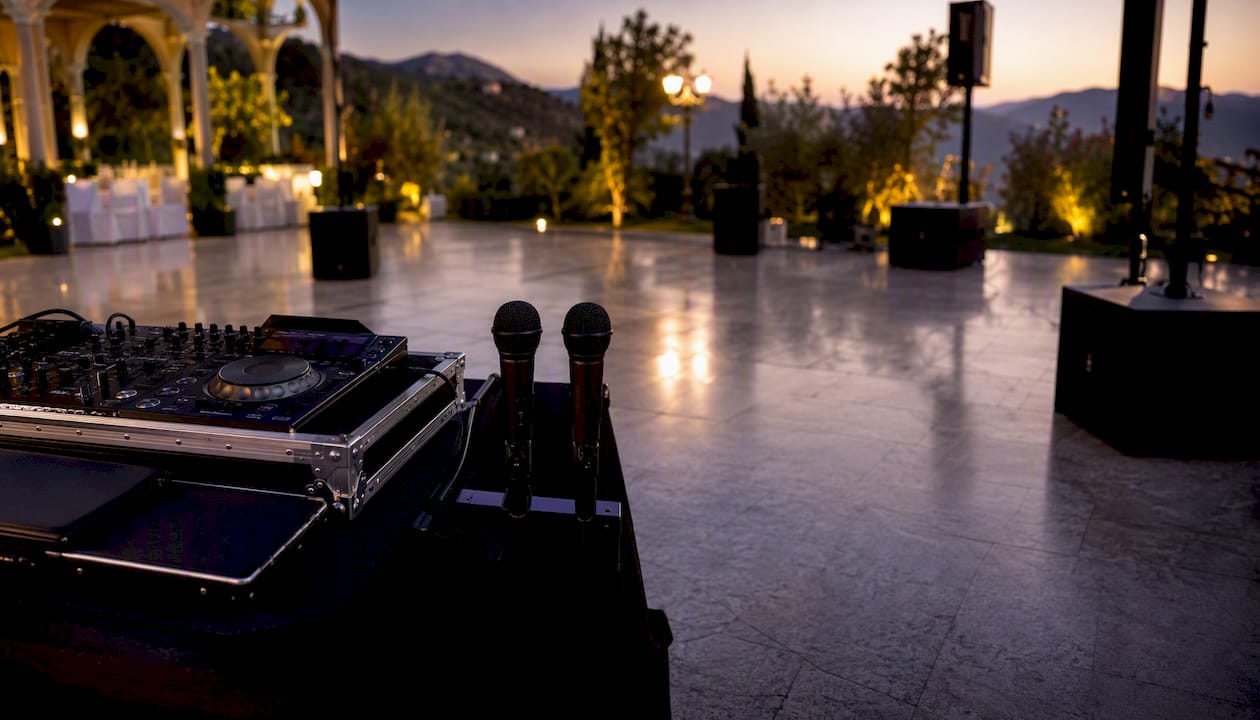
Live band mid-size package: Line array or high-output speakers, multiple subwoofers, digital mixer with 16 or more channels, stage monitors, full mic kit for vocals and instruments, dedicated FOH engineer. Typical price: $1,800 to $3,500. A partner guide on band PA hiring breaks down exactly what a full band setup requires, which is useful reading if you’re booking live musicians for the first time.
Outdoor festival or large corporate package: Multiple line array hangs, delay towers or front fills, redundant backup gear, dedicated FOH and monitor consoles, full crew for load-in and strike. Typical price: $3,500 to $12,000 or more.
| Package name | Core components | Typical price band | Question to include in your RFQ |
|---|---|---|---|
| Ceremony speak-only | 2 speakers, 1 mic, basic mixer | $300 to $600 | “Is delivery and pickup included at this price?” |
| Wedding reception DJ | powered speakers, subwoofers, mixer, microphones | $750 to $2,000 | “Is a technician or DJ operator included?” |
| Live band mid-size | Line array, digital mixer, monitors, full mic kit | $1,800 to $3,500 | “How many hours of setup and soundcheck are covered?” |
| Outdoor festival/large corporate | Multiple arrays, delay towers, backup gear | $3,500 to $12,000+ | “What’s the overtime rate if the event runs long?” |
Pro Tip: When you get quotes back, ask each vendor to itemize the total rather than just handing you a package number. Package pricing often runs 10% to 15% below the sum of renting each item separately, but you can only confirm that discount is real by seeing the itemized breakdown side by side. For smaller gatherings, a private party entertainment checklist can help you match the right package tier to your actual guest count before you even start requesting quotes.
What DJ Phoenix tells clients before quoting a sound rental
The single biggest factor in getting an accurate quote fast isn’t the vendor, it’s the information the client brings to that first conversation. Vague requests like “we need sound for about 100 people” force any provider, including us, to build in a contingency buffer for the unknowns, and that buffer shows up in the price. Precise details eliminate the guesswork entirely, and they usually bring the quote down, not up.
When preparing a quote, we typically ask for a venue map or at least a description of the room, the location of the nearest power source, the coverage zones you need addressed (a ceremony area and a separate reception space are two zones, not one), and a run-of-show outline covering speeches, first dance, and any live performance elements. Clients who show up with this information in hand get a firmer number on the first pass, rather than a range that needs revising after a site visit.
There’s also a judgment call we make on every booking: when a self-serve kit is genuinely fine versus when we insist on a staffed solution. A corporate meeting with a single presenter and a lapel mic rarely needs a dedicated operator standing by all day. A wedding reception with toasts, a first dance, a live band handoff, and 200 guests almost always benefits from having someone managing levels in real time, because the moments that matter most, like a father’s speech or a surprise performance, are exactly the moments where unmanaged audio tends to fail.
Book your sound system with a provider who already knows the details that matter
DJ Phoenix Entertainment builds sound rental directly into the same packages covered throughout this guide, so you’re not stitching together a separate equipment vendor and a separate DJ or MC. Every package maps to the sizes above: a ceremony speak-only setup, a full reception system with DJ services, or a larger configuration for corporate and multicultural events with mixed programming.
Every booking includes the core equipment, delivery, setup, and teardown, with a technician included as standard rather than billed as a surprise add-on, since we’ve seen firsthand how often that line item catches clients off guard. DJ Phoenix has handled sound and entertainment for clients including Mercedes-Benz and FW Sports, which means the same attention to detail applied to a corporate brand activation gets applied to a backyard reception. If your event mixes cultural traditions, multiple languages, or a live band handoff with DJ sets, that range of experience keeps the transitions smooth rather than awkward.
Start by requesting a quote through the DJ Phoenix Entertainment homepage, where you can outline your guest count, venue, and event date. If you’re planning a corporate function specifically, the corporate events page walks through packaged options built for that setting.
Quick planning checklist before you book
Renting the right sound system comes down to matching your guest count and venue to a package tier, then confirming every add-on fee in writing before you sign.
| Point | Details |
|---|---|
| Set your budget range early | Expect $300 to $750 for small events, $750 to $3,000 for mid-size, and $3,500 to $12,000+ for large or festival-scale events. |
| Confirm technician billing model | Ask whether the vendor charges hourly ($25 to $50) or a flat day rate ($300 to $800) for staffed events. |
| Get an itemized quote, not just a package number | Itemized lists reveal delivery, setup, tech time, and deposits that a flat number can hide. |
| Book early for peak-season dates | Lock in weddings four to six months out and corporate events six to eight weeks out to avoid rush pricing. |
| Consider a bundled provider for smoother execution | DJ Phoenix Entertainment folds equipment, delivery, setup, and technician time into one package rather than separate vendor bookings. |
Frequently asked questions
What’s a realistic sound system rental cost for a wedding?
Most wedding receptions with 100 to 250 guests land between $750 and $2,000 for a full DJ sound package, including speakers, subwoofers, wireless mics for toasts, and setup. Ceremony-only sound tends to run $300 to $600 separately if it’s not bundled with the reception package.
Does sound system rental cost include a technician?
Sometimes, but not always. Many packages price the equipment and technician separately, with hourly rates around $25 to $50 for simpler jobs and flat day rates of $300 to $800 for complex live-sound events. Always confirm this before comparing quotes.
Why do some quotes seem so much higher than others for the same event?
Venue access, power availability, and program complexity explain most of the gap. A venue with stairs, no nearby power circuit, or multiple coverage zones drives up labour time, which drives up the final price even when the equipment list looks similar on paper.
Is it worth buying a PA system instead of renting for a one-time event?
For a single event or a handful per year, renting is almost always cheaper.
How far in advance should I book sound equipment for my event?
Book weddings four to six months ahead, corporate events six to eight weeks ahead, and private parties at least two to three weeks ahead, especially for weekend dates during busy seasons.
This article provides general budgeting information and is not a substitute for a formal quote from a licensed rental provider. Confirm current pricing, availability, and contract terms directly with your chosen vendor.
Sources
- Sound system rental cost guide — Primal Sounds
- How to price AV rentals for maximum profit — LendControl
- Vera Project — equipment rentals
- How much does it cost to rent a sound system in California? — Eden USA