Background music affects productivity at any hosted event because it directly shapes arousal and pleasure, the two emotional dials that govern how guests move, talk, and linger. Raise tempo and volume, and guests eat faster, mingle in tighter bursts, and head for the door sooner. Slow the tempo, soften the volume, and the same room lingers over dinner, deepens conversation, and stays engaged longer at the bar. This is not guesswork. A 2024 restaurant field experiment confirmed that tempo alone predicts how quickly guests depart, and decades of hospitality research back it up.
For a planner, couple, or host, that means productivity at an event is really about output: more mingling, better timing on speeches, a fuller dance floor, or a smoother exit at the end of the night. Here are the levers Dj-phoenix uses to engineer those outcomes on site:
- Tempo sets pace. Push to higher tempos to energize a dance floor; drop to lower tempos to extend conversation at dinner.
- Volume controls intimacy. Keep dining under roughly 70 dB so guests can talk without shouting.
- Genre and mood signal permission. A jazz trio invites lingering; a horn-driven anthem invites movement.
- Transitions protect flow. Abrupt genre jumps stall a room; gradual ramps and short musical bridges keep guests moving with the night instead of against it.
Quick stat: In a 2022 restaurant study, guests exposed to classical arrangements reported measurably higher pleasure and more positive dining behaviour than those under jazz, in that specific sample. Genre congruence with the room’s register matters as much as the notes themselves.
Key takeaways
Background music governs guest behaviour through tempo, volume, and genre, and briefing a DJ on these levers with measurable goals is what turns a good playlist into a controlled event outcome.
| Point | Details |
|---|---|
| Slow tempo extends stays | Use 80 to 100 BPM and 65 to 70 dB during dinner to keep guests seated and talking longer. |
| Fast tempo speeds turnover | Push past 120 BPM for cocktail hours or buffet lines when you need guests moving efficiently. |
| Transitions protect flow | Bridge phases with a mid-tempo track or brief instrumental fade instead of an abrupt genre jump. |
| Measure before you assume | Track dwell time and dance floor fill speed across two comparable events to test one lever at a time. |
| Brief your DJ explicitly | Require phase playlists, a cue sheet, and a volume plan before signing, not vague genre preferences. |
| Dj-phoenix builds this in | Reza and Dj-phoenix deliver phase-mapped playlists and on-site mixing as standard practice, not an add-on. |
Table of Contents
- How music changes guest behaviour, according to the research
- What musical levers can DJs and planners actually control?
- How should a playlist evolve across event phases?
- What technical controls keep the room sounding right?
- How do you measure whether the music strategy is working?
- What should you require when hiring a DJ?
- A practitioner’s view on reading the room in real time
- How Dj-phoenix builds this playbook into every event
- Sources
How music changes guest behaviour, according to the research
Music works on guests through two psychological channels: arousal (how stimulated someone feels) and pleasure (how good that stimulation feels). Fast tempo raises arousal quickly. Slow tempo lowers it. Whether that arousal translates into pleasure or discomfort depends on whether the tempo matches what guests expect from the room, which is why a wedding reception and a nightclub call for entirely different soundtracks even when the guest list overlaps.
The clearest evidence comes from restaurant field experiments, and it maps directly onto weddings, galas, and cocktail hours. The 2024 field study found that fast-tempo music shortened guest stays while slow tempo extended them, measured in actual minutes at the table, not survey responses. A related experiment on tempo and tipping reported that slower tempo increased dining time, while faster tempo boosted table turnover and, in some cases, tip size. That second finding matters for corporate events on a tight schedule: energizing music during a working lunch can move guests through a buffet line faster without anyone feeling rushed.
Meta-analytic work on retail and hospitality settings adds another layer: background music reliably shifts spending, perceived atmosphere, and emotional tone, and tempo moderates those effects in crowded rooms. Fast music can even offset the discomfort of a packed dance floor by keeping energy and purchase behaviour high despite the crowding, a useful fact for any host worried a full room will feel claustrophobic rather than electric.
Three practical takeaways follow directly from this research:
- Use fast tempo when you need turnover, such as a cocktail hour before a ceremony start time.
- Use slow tempo when you want guests to linger, such as a plated dinner or a networking reception.
- Match genre to room register, since congruence between music and venue matters more than whether guests personally love the song.
What musical levers can DJs and planners actually control?
Tempo is the single most operationally simple lever. It changes behaviour fast and it is easy to specify in a brief. Volume, genre, and lyrics are secondary levers that fine-tune the effect once tempo has set the baseline energy.
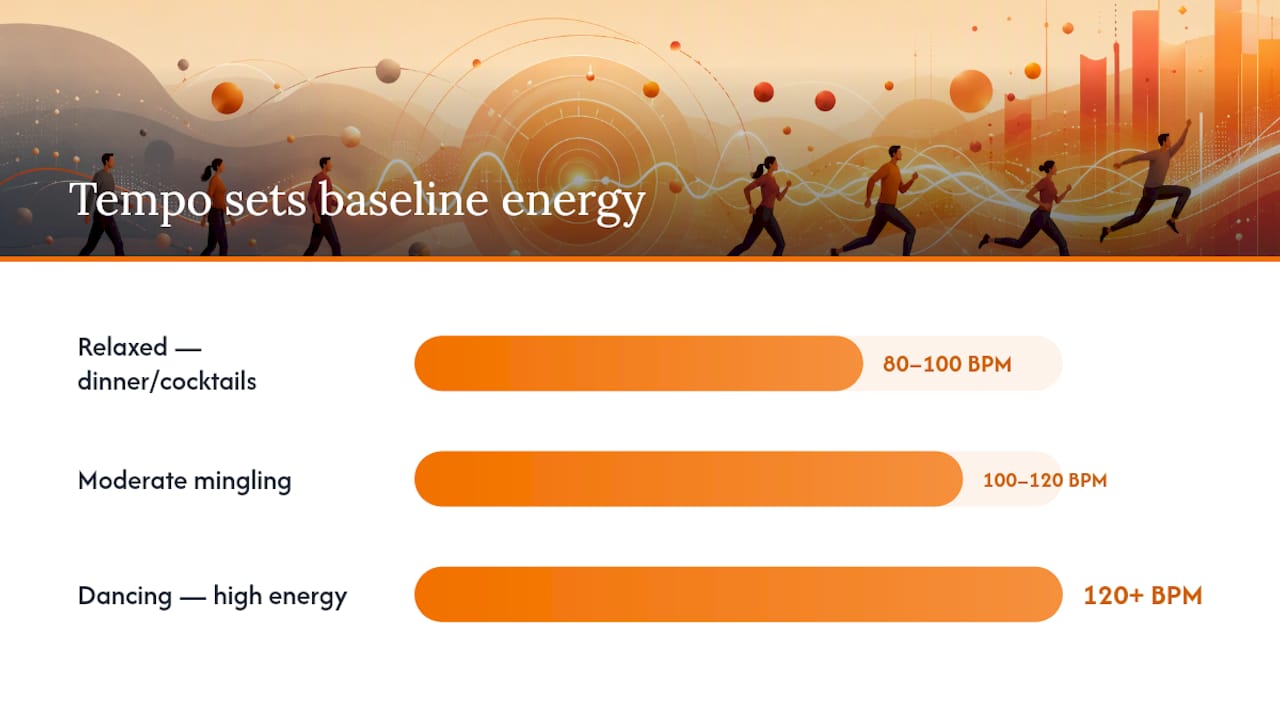
Tempo (BPM). Aim for 80 to 100 BPM for relaxed phases like dinner or early cocktails, 100 to 120 BPM for moderate mingling energy, and 120-plus for dancing. Operational anchors like these give a DJ concrete targets instead of vague mood descriptions.
Volume (dB). Dining and deep conversation need roughly 65 to 70 dB. Cocktail networking can run slightly hotter, around 70 to 75 dB, without drowning out speech. Dance floor peaks can climb past 90 dB because the goal there is physical energy, not conversation.
Genre and instrumentation. Instrumental or lyric-light tracks reduce cognitive load, letting guests hold a conversation while music plays underneath. Vocal-heavy tracks compete for attention, which is exactly what you want once the dance floor opens and conversation is no longer the priority.
Lyrical content and transitions. Lyrics pull focus. During dinner or speeches, they are a liability. During a set-closer, they are the whole point.
- Small BPM shifts of 5 to 10 beats per minute nudge energy without guests noticing the change consciously.
- Abrupt genre jumps, like cutting from a string quartet straight into EDM, stop conversation cold and read as jarring rather than exciting.
- For multicultural guest lists, Reza’s approach at Dj-phoenix blends regional instrumentation gradually rather than segregating cultural sets, which keeps the room unified instead of splitting into cliques.
Pro Tip: Test a tempo change on your DJ before the event by asking for a two-minute “energy ramp” demo from 90 to 118 BPM. If the transition feels smooth to you sitting still, it will feel seamless to guests moving through a room.
How should a playlist evolve across event phases?
Event music works best as a continuous arc rather than a stack of unrelated songs, an approach practitioner guides describe as building a “journey” that mirrors the night’s emotional shape. Guests remember songs as emotional bookmarks tied to key moments, so mapping energy to the schedule matters more than any individual track choice.
Build the ramp gradually. Jumping from dinner’s 80 BPM straight to a 125 BPM dance opener without a bridge track will empty the floor before it fills. A short instrumental fade about 30 seconds before a toast gives the room a clear, wordless cue that attention is shifting, which is far more effective than an MC shouting over the mix.
- Cue the transition into speeches with a fade to near-silent instrumental, not a hard cut.
- Bridge dinner to dancing with one mid-tempo track around 105 to 110 BPM before hitting full energy.
- Reserve true silence, even two or three seconds, for moments you want guests to feel land, like a grand entrance.
What technical controls keep the room sounding right?
Guest behaviour depends on hearing music the way it was designed to be heard, and that is a mixing and placement problem as much as a song-selection one. A DJ who nails the BPM chart on paper can still lose the room if the sound system creates dead zones or blasts the head table.
Target ranges worth memorizing: 65 to 70 dB for dining conversation, 70 to 75 dB for cocktail networking, and 85 dB or higher for dance floor peaks, measured with a basic sound meter app rather than guesswork. Speaker placement should aim for even coverage across the room, with satellite speakers over dining areas at lower volume rather than one loud stack blasting the nearest tables while the back of the room gets nothing.
A pre-event soundcheck should walk the entire room, not just the DJ booth, checking corners, bar areas, and anywhere the head table sits. During speeches, ducking the music bed and applying a gentle low-pass filter keeps ambient sound present without competing with the microphone.
Pro Tip: If a toast is running long and the room gets restless, a DJ can subtly raise the low-end warmth in the mix without raising volume. It keeps the room feeling alive without pulling attention away from the speaker.
- Walk the room before doors open, checking every seating zone, not just near the booth.
- Assign one staff member as the DJ’s spotter for speeches and cue changes.
- Keep a backup wireless mic charged and tested, since dead audio during a toast is the fastest way to lose a room’s attention.
How do you measure whether the music strategy is working?
Guest behaviour leaves a trail. Average dwell time at tables, drink orders per hour, how quickly the dance floor fills after the first song, and how long guests stay past the scheduled end time all tell you whether your musical choices landed.
Run a simple test:
- Pick one lever to isolate, such as tempo during cocktail hour.
- Apply it consistently across a defined window, like the first 45 minutes of two comparable events.
- Track one or two KPIs discreetly, such as bar orders per 15 minutes or time until the dance floor reaches half capacity.
- Compare results and adjust the next event’s brief accordingly.
- Track dwell time at key stations (bar, dinner tables, dance floor) using simple staff headcounts every 15 minutes.
- Note the exact minute the dance floor crosses half capacity after the first dance track plays.
- Skip formal recording devices; a staff member with a clipboard and a phone timer collects everything you need without raising privacy concerns.
If a test shows the opposite of what you wanted, the fix is usually fast: drop tempo by 10 BPM, pull volume back 3 to 5 dB, or swap one vocal-heavy track for an instrumental. Small adjustments, checked against real guest movement, beat rebuilding a whole playlist mid-event.
What should you require when hiring a DJ?
A strong brief separates a DJ who executes a strategy from one who just plays a mixed bag of requests. Before signing anything, ask for phase-by-phase playlists tied to your actual event schedule, a cue list for speeches and formal moments, a stated volume plan by phase, and a full equipment list including backup gear.
- Ask how the DJ handles a dead dance floor mid-set. A strong answer describes reading the room and adjusting tempo, not just switching genres at random.
- Ask for a soundcheck window on the contract. No soundcheck offered is a red flag.
- Ask about multilingual or multi-tradition repertoire if your guest list spans cultures. Reza’s work at Dj-phoenix specializes in blending multicultural traditions into one coherent set rather than isolated cultural blocks.
- Watch for insistence on a fixed, unchangeable playlist. Rooms behave unpredictably, and a DJ who cannot adapt in real time will lose the crowd when the plan meets reality.
- Confirm a contingency plan exists for equipment failure or an unresponsive room, not just a plan for when everything goes right.
Dj-phoenix builds every event around this exact brief structure, supplying phase playlists, cue sheets, and a documented volume plan before the first guest arrives, backed by experience serving clients like Mercedes-Benz and FW Sports where sound quality and timing precision were non-negotiable.
A practitioner’s view on reading the room in real time
Curating music for multicultural celebrations for years has taught me that no chart of BPM ranges survives contact with an actual room unchanged. Every crowd arrives with its own energy, and the job is reading that energy within the first fifteen minutes and adjusting the plan rather than forcing the plan onto the guests.
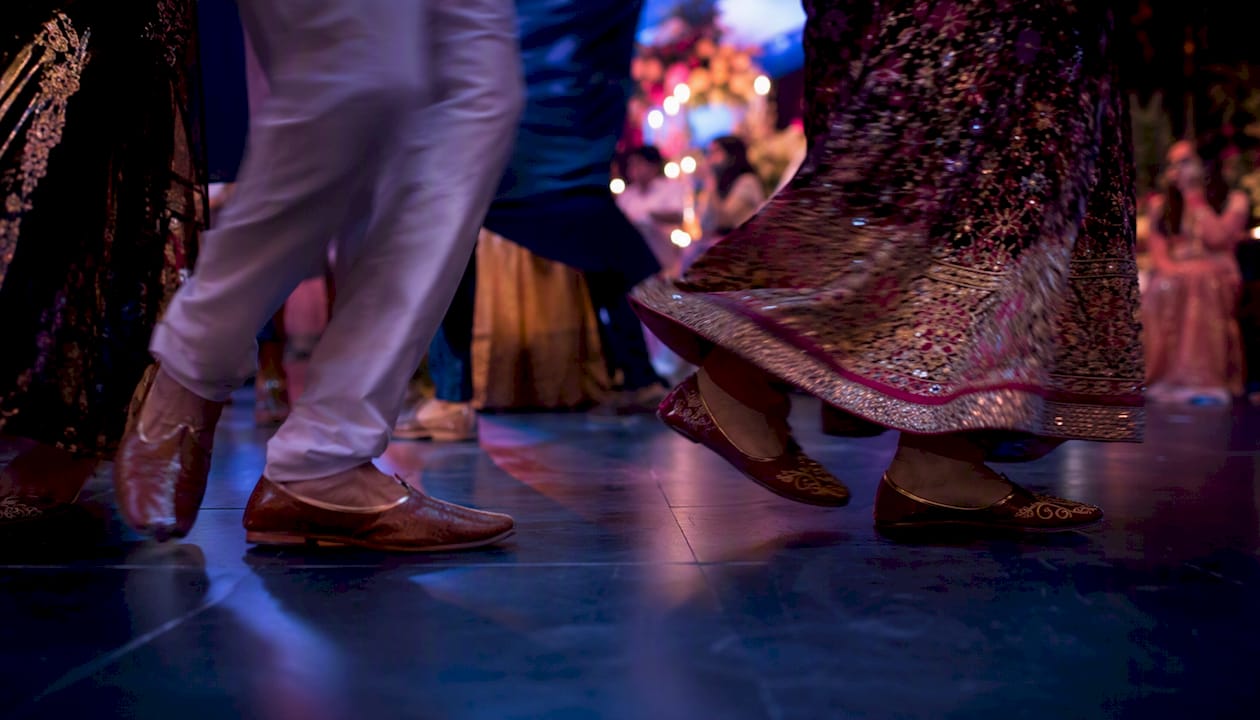
Three rules of thumb guide every set I build. First, build energy gradually. A dance floor that peaks too early empties by 10 p.m. and never refills. Second, keep lyric density low during dining. Guests want to hear each other, not compete with a chorus. Third, set measurable goals before the event and brief your DJ against them explicitly. “Keep people dancing” is not a brief.
Crowd reading is why a professional is worth the investment over a preset playlist app. A human can hear when a room’s energy dips and correct within one song. A fixed setlist cannot.
How Dj-phoenix builds this playbook into every event
Every lever covered here, tempo ramps, dB targets, phase transitions, cultural blending, is standard practice for Dj-phoenix on every booking, not an upsell. Dj-phoenix designs phase-by-phase playlists mapped to your actual schedule, handles on-site mixing to protect speech clarity and dining conversation, and provides MC support for cue timing during toasts and transitions.
For weddings and multicultural celebrations, Reza’s repertoire spans traditions and languages without splitting a reception into disconnected cultural blocks, a capability built directly from serving diverse guest lists across Toronto, Montreal, and Ottawa. Corporate planners get the same phase-mapped approach applied to networking flow and timed programming; see the corporate event DJ services page for what a typical brief looks like.
Ask for a phase playlist plus cue sheet as your first deliverable when you request a consultation with Dj-phoenix. It costs nothing to review and shows exactly how your event’s sound will evolve from arrival to send-off before you commit to a date.
Sources
- 2024 restaurant field experiment (PMC)
- Meta-analytic review of music effects in retail settings (Journal of Retailing and Consumer Services, 2017)
- Background music and dining emotions/behaviour (MDPI, 2022)