“Good evening, everyone. I’m honoured to be your emcee tonight, and it’s my pleasure to welcome you to the wedding celebration of [Couple’s Names].” That single line, adjusted with real names, can carry you through the opening seconds of a wedding reception. This guide gives you a full wedding emcee script for every major moment, from welcome to first dance to the last song of the night, so you can adapt rather than improvise cold.
TL;DR:
- Most wedding reception scripts follow a standard sequence, but adaptions should be made for room energy, guest engagement, and event flow.
- Confirm timing details and cues with vendors at least a week in advance, and keep a run sheet for 20-minute check-ins during the event.
- Introductions of the bridal party and newlyweds should follow a logical order, with brief, rehearsed pronunciation checks for all names beforehand.
- Key moments like speeches, first dances, and cake cutting require clear, concise prompts and smooth transitions to keep guests engaged.
- A professional emcee can reduce stress by handling timing, coordination, and room reading, especially if the host feels overwhelmed or inexperienced.
Table of Contents
- What is a wedding emcee script, exactly?
- How do you handle housekeeping announcements?
- What is the right order for introducing the bridal party?
- How should you introduce the newlyweds?
- What do you say for the first dance and parent dances?
- How do you introduce speeches and manage long-winded toasts?
- How do you announce dinner and keep things moving?
- What do you say for cake cutting and other traditions?
- How do you open the dance floor and keep momentum?
- Emcee performance and improvisation: pro tips from a wedding DJ
- What should you confirm with the DJ and other vendors beforehand?
- Copyable one-liners for every moment
- An emcee’s honest note on scripts versus instinct
- Would hiring a professional emcee take the pressure off?
- Sources
- FAQ
What is a wedding emcee script, exactly?
A wedding emcee script is the master document that sequences everything a host says at a reception, moment by moment, from the welcome through housekeeping, introductions, speeches, and the dance floor. Most sample scripts follow the same backbone: welcome, housekeeping, bridal party introductions, dinner, toasts, dances, cake cutting, and floor-opening, in roughly that order, according to templates published by wedding vendors.
Formal opening:
“Ladies and gentlemen, please welcome the bridal party as we begin this evening’s celebration for [Couple]. My name is [Your Name], and I’ll be guiding you through tonight’s festivities.”
Casual opening:
“Hey everyone! Grab a seat if you’ve got one, because we are kicking off the party for [Couple] right now. I’m [Your Name], your host for the evening, and I could not be more excited.”
Before you say a word, run through this quick checklist:
- Fade the background music down (or cue the DJ to do it) before you raise the microphone.
- Match your energy to the room. A backyard barbecue reception and a ballroom gala call for different volume and pace.
- Confirm pronunciation of every name in your script, out loud, with a family member if possible.
- Do a mic check at least 20 minutes before guests arrive.
Experienced coordinators consistently advise treating any downloadable script template as a starting draft, not a word-for-word transcript. Adjust the phrasing until it sounds like you.
How do you handle housekeeping announcements?
Guests need four or five pieces of practical information, and none of them need more than one sentence. Keep each announcement under 20 seconds, since practitioner guidance on reception pacing consistently points to brevity as the thing that keeps a room engaged rather than checked out.
- “Restrooms are located [location] if you need them before dinner gets underway.”
- “The bar is open all evening. Please give our bartenders a hand.”
- “If you’re checking a coat, the coat check is [location].”
- “Wifi password is on your table card, and we’d love to see your photos. Tag [hashtag] if you snap something great.”
Skip any item that doesn’t apply. If there’s no coat check or hashtag, cut the line entirely rather than forcing filler into the script.
What is the right order for introducing the bridal party?
Most receptions follow a consistent sequence: grandparents first, then parents of the couple, then the wedding party, and finally the newlyweds. Introducing people out of order is one of the fastest ways to create an awkward pause while everyone waits to figure out who’s walking next.
- Grandparents of both partners, escorted or announced first.
- Parents of the couple, often to a shorter musical cue than the party.
- Bridesmaids and groomsmen, in pairs, by name.
- The maid of honour and best man, typically last before the couple.
- The newlyweds themselves, saved for the biggest musical and energy build.
Full roll call: “Please welcome [Bridesmaid], escorted by [Groomsman]!” repeated for each pair, then “And now, your maid of honour, [Name], and best man, [Name]!”
Abbreviated version: “Let’s give a big welcome to the entire wedding party!” works when the couple wants a faster-moving reception or a smaller group standing at the door.
If you’re unsure how to pronounce a name, ask the person directly before the ceremony. Guessing in front of 150 guests is the one mistake that’s hard to walk back.
How should you introduce the newlyweds?
This is the loudest, highest-energy moment of the introductions, and it deserves a clear cue to your DJ so the music and the mic land together.
- Formal entrance: “Ladies and gentlemen, for the first time as husband and wife, please welcome Mr. and Mrs. [Last Name]!”
- Playful entrance: “They said ‘I do,’ and now they’re ready to party. Make some noise for [Names]!”
- Cue the photographer before you speak so the entrance is captured, not missed while cameras are still adjusting.
- Hand off to the DJ with a short line like, “Take it away,” so the transition into music feels intentional rather than abrupt. Getting the timing of entrance music right, so the couple walks in on the beat rather than after it, is worth confirming with your DJ during setup.
What do you say for the first dance and parent dances?
Each dance needs a clean introduction and, just as importantly, a clean exit line so the room doesn’t sit in silence wondering what happens next.
- “Please join me in welcoming [Couple] to the floor for their first dance as husband and wife.”
- “Now let’s turn our attention to [Bride] and her father, [Name], for a dance that means the world to both of them.”
- “[Groom] and his mother, [Name], would like to share this next dance.”
- To close it out: “Let’s give them one more round of applause,” followed immediately by a cue to the DJ to shift the music back to the room’s background level.
How do you introduce speeches and manage long-winded toasts?
Speeches are where an emcee earns their keep, because the room’s patience depends entirely on how tightly you run this segment.
- “It’s now my pleasure to invite [Name], [relationship to couple], to say a few words.”
- After each toast: “Let’s raise a glass to that. Cheers to [Couple]!”
- If a speech is running long, a discreet hand signal to the speaker, agreed on beforehand, works better than interrupting mid-sentence.
- If you must step in: “Let’s give [Name] one more round of applause as we move toward dinner.”
Pro Tip: Ask every speaker, in advance, how long they plan to talk. A speaker who commits to “under three minutes” almost always self-polices better than one who’s simply told to “keep it short.”
How do you announce dinner and keep things moving?
Plated service: “Dinner will be served shortly. Please remain at your tables, and our servers will be right with you.”
Buffet service: “Dinner is ready! We’ll be calling tables up by number, starting with table one.”
- For special meals: “If you ordered a vegetarian or gluten-free plate, please let your server know, or head to the [location] station.”
- After dinner winds down, a light transition works well: “While plates are being cleared, let’s keep the celebration going with a few words from the wedding party.”
What do you say for cake cutting and other traditions?
“It’s time for [Couple] to cut their first cake together. Everyone, gather round.” That’s the whole announcement. It doesn’t need embellishment.
- Coordinate with the photographer beforehand so cameras are positioned before the cake is cut, not after.
- If the couple is skipping the bouquet or garter toss, don’t mention them at all. Naming a tradition and then explaining why it’s being skipped only draws attention to an absence nobody would have noticed.
- Fold this into the timeline quickly. Cake cutting rarely needs more than two minutes of mic time total.
How do you open the dance floor and keep momentum?
Low-key opener: “The floor is open. Come on up whenever you’re ready.”
Standard opener: “This is the moment we’ve all been waiting for. Let’s get the dance floor moving!”
High-energy opener: “If you’ve got even an ounce of energy left, now’s the time. Everybody up!”
- Interactive calls, like asking everyone with a specific connection to the couple to join the floor, tend to break the ice faster than a generic invitation.
- Hand the mic back to the DJ cleanly: “I’ll let the music take over from here,” rather than trailing off.
Emcee performance and improvisation: pro tips from a wedding DJ
A script gets you through the structure. Reading the room is what actually makes the night work, and it’s the part no template can fully write for you. Watch three signals constantly: how full the dance floor is, how loud the room’s conversation is, and whether guests are looking at their phones or at each other. Each tells you whether to raise energy, dial it back, or simply get out of the way.
Hold the microphone about two inches from your mouth, angled slightly off-centre to avoid popping consonants. If you lose your place, a simple filler like “Alright, moving right along” buys you a beat to find your notes without dead air. On the vendor side, a quick in-ear or hand signal with the DJ, worked out before the event, solves ninety per cent of timing surprises before guests ever notice one. Our complete guide to emcee duties covers the improvisation side in more depth.
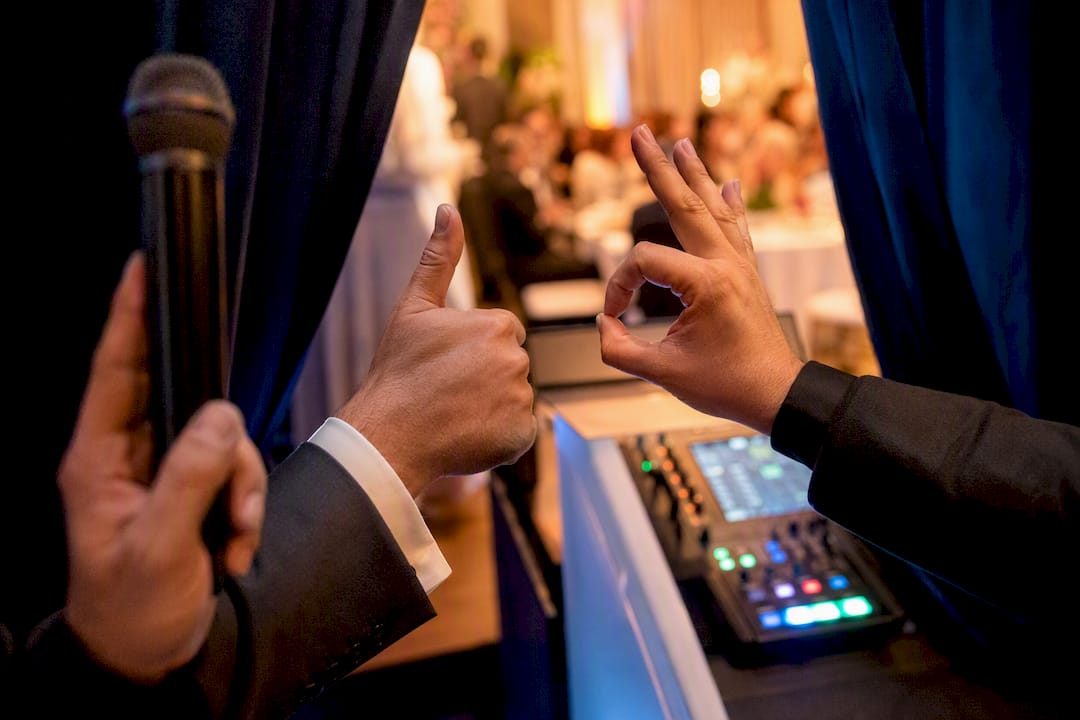
Pro Tip: Practise your toughest transition, usually the one right after speeches, out loud at least twice before the wedding day. That’s the moment most hosts stumble because they’re reading a room that’s just gone quiet and emotional.
What should you confirm with the DJ and other vendors beforehand?
- Confirm exact timing for entrances, meal service, and speeches with your DJ and caterer at least a week out.
- Agree on hand signals for “wrap it up,” “hold the mic,” and “we’re running behind.”
- Keep a printed or phone-based run sheet and check it against the clock every 20 to 30 minutes during the reception.
- Review our wedding DJ timeline best practices with your vendor team before the big day.
Copyable one-liners for every moment
Keep this shortlist on your phone or printed card as backup:
- Welcome: “Welcome, everyone, to the celebration of [Couple]!”
- Housekeeping: “Restrooms are [location], bar’s open all night.”
- Bridal party: “Please welcome our wedding party to the floor!”
- Entrance: “For the first time as husband and wife, [Names]!”
- First dance: “Let’s watch [Couple] share their first dance.”
- Toasts: “Please raise a glass. Cheers to [Couple]!”
- Cake: “Time to cut the cake. Everyone, gather round!”
- Floor-opening: “The dance floor is officially open!”
Shorten any line further if the couple prefers a low-key tone, and swap in nicknames where the family actually uses them.
An emcee’s honest note on scripts versus instinct
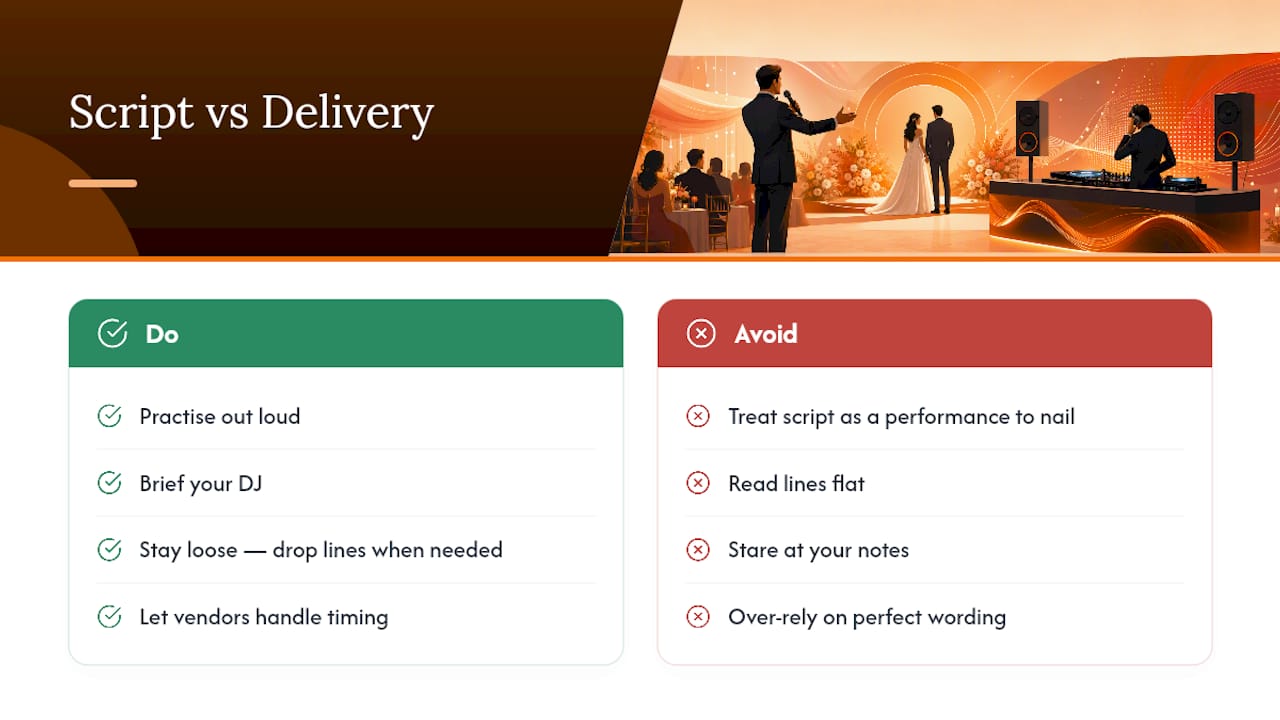
Most first-time hosts overestimate how much the script matters and underestimate how much delivery does. A perfectly worded line, read flat, lands worse than a rougher line delivered with genuine warmth. The couples I’ve watched succeed as their own emcees weren’t the ones with the tightest paragraphs. They were the ones who practised out loud, briefed their DJ properly, and stayed loose enough to drop a line when the room clearly wanted less talking and more music.
Where people go wrong is treating the script as a performance to nail rather than a safety net to lean on. Say the words like you mean them, watch the couple’s faces instead of your notes, and let the vendors around you handle the timing so you can focus on sounding like yourself.
— Reza
Would hiring a professional emcee take the pressure off?
If reading these scripts still feels like a lot to carry solo on someone’s wedding day, that instinct is worth trusting. A professional emcee builds the run sheet, holds the mic, coordinates every cue with your caterer and photographer, and reads the room in real time so nobody in the family has to juggle a script and a toast at the same time. Before booking anyone for this role, ask about their reception experience, their backup equipment plan, and how they handle a speech that runs long.

Browse the DJ performance gallery to see how a professional emcee handles a live room, or get in touch through Dj-phoenix to check availability for your date.
Sources
- A Free Template for a Wedding DJ or MC Script — Elisabeth Kramer
- Emceeing a wedding: script and guide for a perfect reception | ShunBridal
FAQ
What should an emcee say at a wedding?
An emcee should stick to short, clear lines for each moment: a warm welcome, quick housekeeping notes, confident introductions, and clean transitions between speeches, dances, and dinner. Keep every announcement under 20 seconds so the pacing stays natural.
What is a good script for an emcee at a wedding reception?
A good reception script moves through welcome, housekeeping, bridal party introductions, dinner, toasts, first dance and parent dances, cake cutting, and floor-opening, with one or two lines per moment. Sample templates follow this same sequence because it matches how most receptions actually flow.
What is a good script for an emcee?
Outside weddings, the same principle applies: short, direct lines that introduce each segment, credit the right people, and hand control back to the next speaker or performer without dead air.
What do officiants say during weddings?
Officiants handle the ceremony itself, including vows, ring exchanges, and the pronouncement of marriage, which is a separate role from the reception emcee. An emcee’s script begins once the ceremony ends and the reception celebration starts.