The most authentic same-sex wedding soundtrack comes from three deliberate moves: choosing songs with gender-neutral lyrics, favouring tracks by openly LGBTQ+ artists, or editing pronouns outright. Any of the three works. What follows is a full set of curated lists by moment, a briefing checklist for your DJ or band, and timing math (a 50-song public playlist runs roughly three hours) so you can plan with confidence. I have spent years reading rooms full of every kind of couple, and the principle never changes: representation in the music matters as much as the dancing.
TL;DR:
- Choosing gender-neutral songs or editing pronouns ensures the music reflects the couple’s identity without alienating guests or compromising authenticity.
- Curating playlist segments for each wedding moment with appropriate energy levels helps keep the flow natural, from solemn ceremony tracks to energetic dance-floor hits.
- Planning a 50-song playlist of roughly three hours covers most reception needs, with clear priority and do-not-play lists simplifying vendor communication.
- An experienced DJ should handle lyric edits quickly, incorporate multicultural tracks seamlessly, and consult with the couple via a written run sheet to ensure inclusivity.
- Selecting songs by LGBTQ+ artists or those that explicitly address identity and self-acceptance continues to shape the trend toward more expressive, meaningful same-sex wedding music.
Table of Contents
- Curated same sex wedding music lists for every moment
- How do you choose songs for a same-sex wedding?
- How long should your wedding playlist be?
- Practical tips from a wedding DJ on building an inclusive set
- Inclusivity in wedding music goes beyond pronouns
- What music trends are shaping same-sex weddings right now?
- Are there legal or cultural considerations for same-sex wedding music?
- A DJ’s honest take on why this matters
- Book an inclusive DJ for your same-sex wedding
- Where to listen for more inspiration
- Sources
- FAQ
Curated same sex wedding music lists for every moment
A same-sex wedding playlist works best when it is broken into moments, not treated as one giant shuffle. Each segment of the day asks something different of the music, from quiet reverence at the altar to full chaos on the dance floor.
First dance. Brides’ roundup of gender-neutral first-dance songs makes a strong case for mainstream love songs that were never written with a specific gender in mind, letting couples skip the pronoun problem entirely rather than searching for a niche alternative. Strong picks include:
- “A Thousand Years” by Christina Perri, for its steady, unhurried build.
- “Latch (Acoustic)” by Sam Smith, a staple on the Hitched LGBTQ first dance playlist for its gentle, gender-neutral devotion.
- “Yellow” by Coldplay, simple and singable at any tempo a couple wants.
- “Falling Slowly” from Once, favoured for its unadorned, plain-spoken affection.
- “Landslide” by Fleetwood Mac, a lyric that reads as universal rather than romantic-partner-specific.
- “I Won’t Give Up” by Jason Mraz, often chosen for its commitment-forward message.
Ceremony music. Processional and recessional moments benefit from instrumental or minimally lyrical tracks, which sidestep gendered language altogether. Consider “Canon in D” for a classic entrance, “A Sky Full of Stars” (instrumental version) for something with more emotional lift, or “River Flows in You” by Yiruma for a quiet, contemplative signing moment. Our ceremony music roles guide breaks down exactly which vendor typically handles which of these moments.
Reception floor-fillers. Once the formalities end, the room wants energy that everyone can sing along to regardless of age or background. “Dancing Queen” by ABBA, “I Wanna Dance with Somebody” by Whitney Houston, “Uptown Funk” by Mark Ronson featuring Bruno Mars, and “Born This Way” by Lady Gaga all land safely across generations. Our reception song selection guide covers how to sequence these for maximum floor time.
Parent dances and entrances. These moments carry more emotional weight and more pronoun risk than any other part of the day. Songs like “My Wish” by Rascal Flatts or “Humble and Kind” by Tim McGraw tend to work because they speak to guidance and gratitude rather than romance, but any song with gendered lines (“her,” “son,” “daughter”) can usually be re-recorded or edited by a DJ ahead of time.
How do you choose songs for a same-sex wedding?
Start with the lyrics, then work outward to arrangement and feel. Three approaches cover almost every situation:
- Choose gender-neutral songs outright — the fastest path, and where Brides’ list of roughly 65 options is genuinely useful.
- Edit the lyrics — a DJ can swap “she” for “he,” or remove a pronoun entirely, in a digital file with modest notice.
- Commission or request a cover — some bands will re-record a verse specifically for your names or pronouns, though this needs more lead time.
Tempo matters more than couples expect. First-dance songs generally sit between 60 and 90 beats per minute, slow enough to sway without feeling static. Reception songs need to build in energy across the set, not spike immediately. Always check a song’s actual length before locking it in; some album versions run past five minutes, which is a long time to hold a room’s attention during a first dance.
Match the tone to the couple, not the trend; for fresh inspiration, see these wedding proposal ideas that wow. A playful couple might pair “Sunday Morning” by Maroon 5 for entrance with something loud for the reception, while a more reserved couple might keep the whole day acoustic. When you brief a vendor, ask directly: “Can you edit the pronouns on this track?” “Can you extend or shorten the song to fit our walk length?” “Do you have a preferred key if this is performed live?” Our guide to choosing the right DJ walks through these exact questions in more depth.
Pro Tip: If a vendor hesitates or seems unsure how to answer the pronoun-editing question, that is your red flag. A DJ or band experienced with same-sex weddings should have a clear, quick answer, not a shrug.
How long should your wedding playlist be?
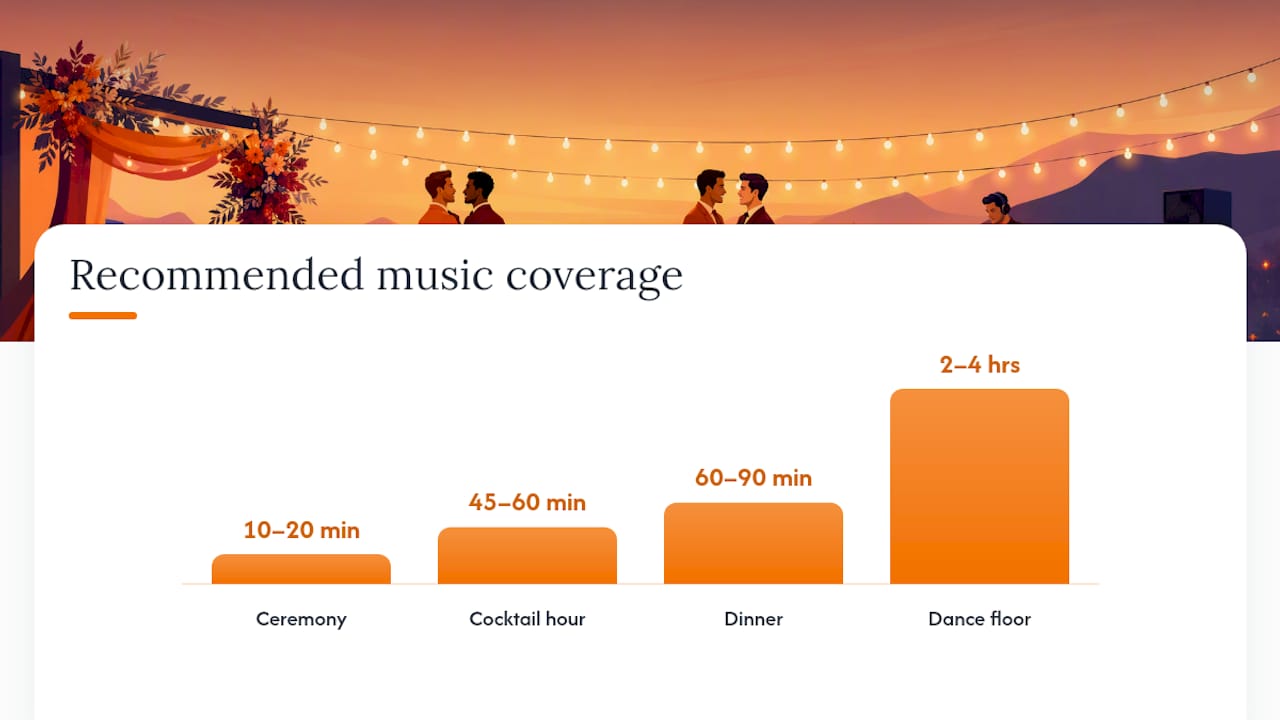
Plan music in blocks, not as one long list. Ceremony music generally needs 10 to 20 minutes of coverage across processional, signing, and recessional. Cocktail hour runs 45 to 60 minutes and can lean on background instrumentals or lounge covers. Dinner needs roughly 60 to 90 minutes of conversational-volume music, and the dance floor itself typically runs two to four hours depending on your reception length.
Public playlists offer a shortcut for estimating coverage. The Hitched LGBTQ first dance playlist lists 50 songs at roughly three hours total, which means a similarly sized list comfortably covers a full reception dance segment without repeats.
- Label your song choices by priority: must-play (five to ten tracks), preferred (10 to 20), backup (30 or more), and do not play.
- Give your DJ the must-play list first; everything else is negotiable in the moment.
- Streaming files can be edited or cued with days of notice, but a live band needs chord charts and lyric edits two to four weeks ahead to rehearse properly.
A short must-play list, paired with a clear do-not-play list, is the single fastest way to keep your DJ from guessing.
Practical tips from a wedding DJ on building an inclusive set
Reading a room means balancing what feels true to the couple against what actually fills a dance floor, and the two are rarely in conflict when the groundwork is done early. A professional DJ should ask for a sample playlist, an annotated run sheet marking key moments, and both priority lists well before the event, not the week of.
- Bring multicultural or multilingual tracks into the mix deliberately if they reflect either partner’s background; a DJ experienced with multicultural events knows how to blend these without breaking the flow.
- For lyric edits, decide early whether you want a DJ (faster turnaround, digital edits) or a live band (richer sound, but needs weeks of lead time for arrangement changes).
- Give one point of contact for song changes to avoid three different people sending the DJ conflicting requests two days before the wedding.
Pro Tip: Ask your DJ for a written run sheet, not just a verbal confirmation. Names, pronunciations, and pronoun edits get lost in casual conversation far more often than in a document both sides can check.
Inclusivity in wedding music goes beyond pronouns
Pronoun swaps solve the most obvious problem, but a genuinely inclusive soundtrack considers more than grammar. Bisexual, transgender, and non-binary couples often find that even “gender-neutral” mainstream songs carry assumptions about coupledom, monogamy, or family structure that do not reflect their relationship. The fix is not always a lyric edit. Sometimes it is simply choosing songs by artists who write from that lived experience, rather than adapting a straight love song to fit.
Kiss My Tulle’s roundup groups its recommendations by identity, gay, lesbian, or open to any couple, precisely because one universal list rarely serves everyone equally well. A lesbian couple’s list might lean on artists like Tegan and Sara or Hayley Kiyoko, while a gay couple might gravitate toward Troye Sivan or Frank Ocean, not because the songs are strictly gendered but because the artist’s own visibility adds meaning the lyrics alone cannot.
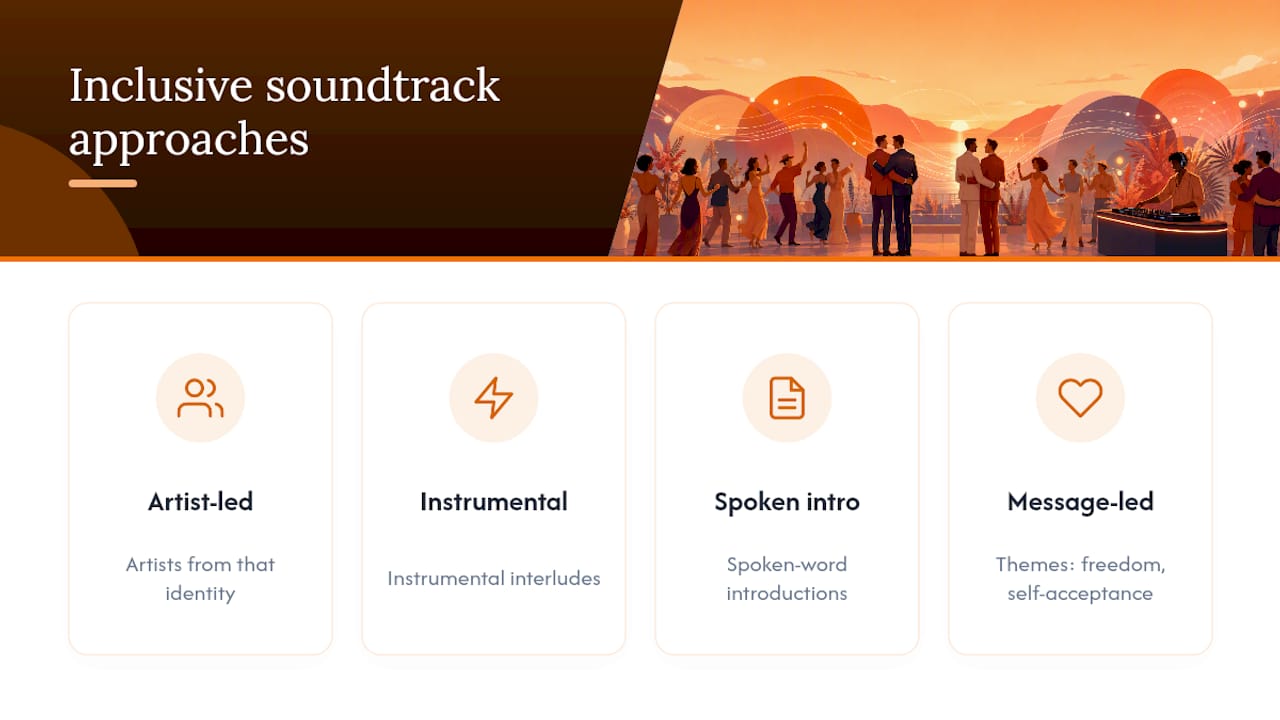
Non-binary and transgender couples face an added layer: many songs default to binary pairings even after pronouns are removed. In these cases, instrumental interludes, spoken-word intros, or a song chosen purely for its message (freedom, becoming, self-acceptance) often resonates more than trying to force a conventional love song into a new shape. Talk this through with whoever curates your set, whether that is a DJ, a band, or you doing it yourself, so the music reflects the actual relationship on the day, not a retrofitted version of a traditional one.
What music trends are shaping same-sex weddings right now?
Pop remains the dominant genre at same-sex receptions, largely because so much of mainstream pop in the last decade has been written or performed by openly queer artists, giving couples plenty of authentic options without hunting through obscure catalogues. Troye Sivan, Kim Petras, MUNA, and Years & Years all show up regularly on inclusive wedding roundups for exactly this reason.
Acoustic and indie folk covers have grown as a first-dance category, partly because slowed-down versions of pop hits (the acoustic take on Sam Smith’s “Latch” is a clear example) strip a song down to something intimate enough for a first dance while keeping its queer provenance intact.
There is also a visible shift toward openly celebratory anthems, not just love songs. “Born This Way,” “Rise Up,” and similar tracks have moved from Pride-event staples to regular reception requests, reflecting couples who want their wedding to say something about identity, not only romance. Wedding bands have noticed too: FixTheMusic’s coverage of same-sex first-dance songs notes that staples like “At Last” and “Stand by Me” remain heavily covered in live repertoires, proof that some classics stay relevant precisely because they never needed gendered lyrics to work.
Multilingual and multicultural blending is another steady trend, especially for couples merging two cultural backgrounds into one celebration, which asks more of a DJ’s transition skills than a single-genre set ever would.
Are there legal or cultural considerations for same-sex wedding music?
Music licensing rules apply identically to same-sex and opposite-sex weddings; there is no separate legal category for song selection based on the couple. The considerations that do matter are practical and venue-specific: a religious or historic venue may restrict amplified music or certain lyrical content regardless of the couple’s identity, so confirm those rules with the venue directly rather than assuming.
Cultural considerations carry more weight than legal ones. Couples blending faith traditions, family expectations, or cultural backgrounds sometimes face pressure to include songs or dances that don’t reflect who they actually are as a couple. There is no obligation to include a traditional parent dance, a specific religious hymn, or a culturally “expected” song simply because it is customary. The music should represent the two people getting married, and a good vendor will support that choice rather than push back on it. If family members raise concerns, it often helps to frame the conversation around meaning rather than obligation: which songs actually tell your story, not which songs are traditionally expected at a wedding.
A DJ’s honest take on why this matters
Representation in wedding music isn’t a checklist item. It’s the difference between a couple hearing “their song” during the first dance and hearing a song that was written for someone else’s relationship and quietly edited to fit. I’ve seen both, and the gap in emotional impact is obvious to everyone in the room, not just the couple.
My practical advice: before you talk to any vendor, write two short lists. Ten must-play songs, five do-not-play songs. That alone resolves most of the back-and-forth that eats up planning time. And don’t feel bound by tradition just because a song, a dance, or a moment is “supposed” to happen. Meaning beats convention every time.
— Reza
Book an inclusive DJ for your same-sex wedding
A skilled wedding DJ builds same-sex wedding soundtracks around the couple, not around a generic template pulled from a standard reception package. This can include pronoun-aware lyric editing handled digitally, playlist curation blending queer-artist tracks with mainstream favourites, and multilingual or multicultural programming when a couple’s backgrounds call for it.
A consultation may include a sample playlist built around your must-play and do-not-play lists, an annotated run sheet covering ceremony through last dance, and guidance on which songs need a lyric edit versus a straight swap. Browse the DJ performance gallery to see how past sets have come together, then request a consultation through Dj-phoenix to start building your own must-play list with a DJ who has done this before.
Where to listen for more inspiration
- The Best LGBTQ First Dance Songs (Hitched, Spotify): 50 songs, roughly three hours, built specifically around gender-neutral first-dance tracks.
- 65 gender-neutral first-dance songs (Brides): a long-form roundup with selection rationale for each pick.
- Love songs by LGBTQ+ artists (Equally Wed): fifteen tracks chosen for explicit queer-artist representation.
Sources
- The Best LGBTQ First Dance Songs – playlist by Hitched (Spotify)
- 65 gender-neutral first-dance songs for LGBTQ+ weddings (Brides)
FAQ
What are some popular LGBTQ+ love songs for weddings?
Frequently chosen tracks include “Latch (Acoustic)” by Sam Smith, songs by MUNA and Troye Sivan, and classics like “At Last,” which live bands cover often enough to make it a safe, well-rehearsed choice.
What are some good WLW (women who love women) songs for a wedding?
Artists like Tegan and Sara and Hayley Kiyoko appear often on lesbian-specific wedding roundups, alongside gender-neutral standards like “Landslide” by Fleetwood Mac that avoid pronoun issues entirely.
How many songs do I need for a wedding reception?
A dance floor running two to four hours varies in the number of songs needed depending on their length; a 50-song playlist, similar to the Hitched LGBTQ list, covers roughly three hours.
Can a DJ edit song lyrics for pronouns?
Yes. Most professional DJs can edit digital files for pronoun changes with modest notice, though live bands need two to four weeks to rehearse a rewritten arrangement properly.
Do I need to include a parent dance at a same-sex wedding?
No. There’s no legal or cultural obligation to include a traditional parent dance; couples are free to swap it, skip it, or replace the song with something that better reflects their actual family relationships.