Build a Greek wedding playlist around two layers: traditional line-dance songs like kalamatiano and syrto, then laïká and modern remixes for the peak of the party. Anchor the reception with kalamatiano, syrto, sirtaki, tsamikos, zeibekiko, tsifteteli, and nisiatika, in that rough order of energy. What follows is a ready-to-play shortlist, the rhythm logic behind each dance, and the sequencing tricks that separate a memorable Greek reception from one where the floor empties by 10 PM.
TL;DR:
- The playlist should start with family and traditional line dances like kalamatiano and syrto, each lasting around four to six minutes, to build momentum gradually.
- Sirtaki, a hybrid dance with a slow-to-fast pace, is best reserved for a full-room moment that unites guests across backgrounds.
- Modern remixes and laïká tracks are crucial for peak energy, especially in a dense ten to fifteen-minute dance block, to maintain guest engagement.
- Proper sequencing involves beginning with traditional songs, transitioning into open dancefloor moments, then reaching high-energy peak tracks before winding down with romantic or slower songs.
- DJs must understand specific dance rhythms and leader roles, using percussion cues and live drumming when possible, to ensure the line dance flows smoothly and authentically.
Table of Contents
- Greek wedding dance songs organised by moment
- Greek wedding dances and their rhythms, explained simply
- How to sequence a Greek wedding party playlist
- Running the line dance: what DJs and planners need to know
- How Dj-phoenix brings this playlist to life
- A closing note on kefi
- Sources
- FAQ
Greek wedding dance songs organised by moment
A Greek reception rarely plays songs at random. Each dance has a role, and each role has a moment in the evening it suits best. Below is a working shortlist organised by dance type, with a note on where each track earns its place.
Kalamatiano & syrto — the backbone of any Greek wedding party playlist, danced in a long connected line.
- “Samiotissa” (traditional) — best for the family line dance right after the ceremony toast.
- “Mikra Milia” (traditional) — best for warming up the whole bridal party before the crowd joins in.
- “Ώρα Καλή” / “Ora Kali” (traditional) — best for honouring the koumbaro and koumbara early in the line.
Sirtaki & hasapiko — the slow-to-fast hybrid dance most non-Greek guests recognize instantly, often from film soundtracks.
- “Zorba’s Dance (Sirtaki)” by Mikis Theodorakis — best for a big-group moment where you want every guest, Greek or not, on the floor at once.
- “Never on Sunday” by Melina Merkouri — best for a nostalgic bridge between dinner and dancing.
Tsamikos & zeibekiko — showcase and solo moments, not group filler.
- “Tsamiko tou Giorgou” (traditional) — best for a showcase moment featuring the groom or father of the bride.
- “Misirlou” (traditional, various recordings) — best for a zeibekiko-style solo, often reserved for the groom or a respected elder.
Tsifteteli & dancefloor pop — where the tempo turns modern and hips take over from feet.
- “Dyo Zoes” by Antonis Remos — best for the transition into free-form dancing later in the night.
- “Ola Kala” by Panos Kiamos — best for peak party energy once the older guests have taken a seat.
Nisiatika and slow wedding songs — island rhythms and quieter moments.
- “Ntenizeli” (traditional nisiatiko) — best for a lighter island-style break between high-energy sets.
- “S’agapo” by Notis Sfakianakis — best for a romantic slow song aimed at the newlyweds mid-reception.
Modern remix options worth keeping in your back pocket: laïká remixes by Greek club DJs and crossover tracks that blend bouzouki lines with a four-on-the-floor beat. These keep guests under 30 on the floor without losing the folk character older relatives expect. Level Tunes’ roundup of the best Greek wedding songs makes the same point: the strongest receptions mix eras rather than committing entirely to one.
Rhythm note: kalamatiano runs on a distinct seven beat cycle, while syrto typically sits in a 4 or 8 beat pattern. That difference matters more than tempo alone when you are matching a track to a dance.
For readers building a broader multicultural set, our guide to a Persian wedding playlist shows the same layering logic applied to a different tradition.
Greek wedding dances and their rhythms, explained simply
You don’t need to read music to pick the right track. You need to know what each dance asks of a song.
Kalamatiano moves in a seven beat cycle, the most common rhythm at Greek weddings and the default line dance for family and friends. Syrto is its close cousin, usually built on a 4 or 8 beat pattern, and the two are often danced back to back without anyone noticing the switch.
Sirtaki is not, strictly speaking, an old folk dance. It’s a hybrid created for the film “Zorba the Greek,” blending hasapiko and hasaposerviko into a slow build that accelerates as the song progresses. Use it for the one moment in the night when you want every single guest, regardless of background, holding hands in a circle.
Tsamikos is a showcase dance with a proud, march-like step, often given to the groom or an older male relative to lead. Zeibekiko is the opposite: an improvised solo, traditionally danced alone, with the dancer moving to feeling rather than a fixed pattern.
Quick selection cues for a non-musician briefing a band or DJ:
- Fast tempo, strong percussion accent = kalamatiano or syrto for group lines.
- Slow build with a dramatic swell = sirtaki for a full-room moment.
- Solo instrumental break, bouzouki-forward = zeibekiko for an individual spotlight.
- Steady march feel = tsamikos for a showcase pair or small group.
How to sequence a Greek wedding party playlist
Energy should build in layers, not spike randomly; consider mixing in jeux d’ambiance pour adultes alongside dance breaks to keep guests engaged and refreshed. Start with the ceremonial and family-led songs, move into open group dancing, then close with the highest-tempo laïká and remix tracks. Layering folk first and modern last is the pattern that keeps Greek receptions from losing momentum halfway through the night.
- Reception entrance: open with a traditional welcoming song. “To Tragoudi tou Gamou” is traditionally used to honour the bride and groom as the couple enters.
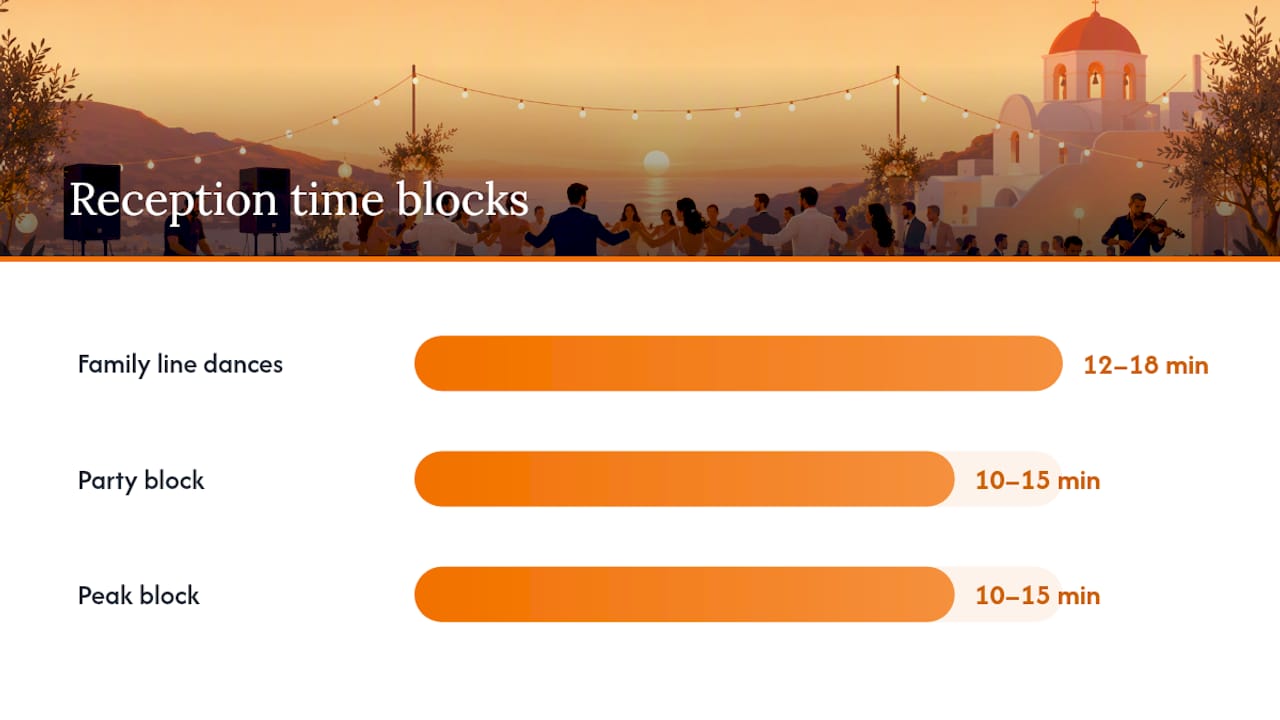
- Family-led line dances: three to four kalamatiano and syrto tracks, each running four to six minutes, enough time for the line to grow without wearing out the leaders.
- Open dancefloor transition: a sirtaki or hasapiko track that widens the invitation beyond the immediate family.
- Peak party block: ten to fifteen minutes of tsifteteli and laïká remixes, the loudest, densest stretch of the night.
- Late-night closing songs: slower nisiatika or romantic tracks to wind guests down before the send-off.
A reliable mini-set template: three line-dance songs, then a ten-minute party block, then two peak tracks before easing off. This keeps the energy predictable for both dancers and the DJ running the transitions.
Pro Tip: Keep a remix version of one folk song, like a tsifteteli-tempo take on a kalamatiano melody, loaded and ready. It lets you bridge from tradition to modern pop without losing the room’s attention.
For the after-hours stretch, our wedding after-party playlist guide covers how to keep energy alive once the formal program winds down.
Running the line dance: what DJs and planners need to know
A Greek line dance has unwritten rules, and breaking them embarrasses everyone faster than a bad song choice.
- Brief the MC before the reception starts on who leads: usually the newlyweds first, then the koumbaro or koumbara, then parents.
- Never let a guest cut to the front of the line uninvited. The leader position is an honour role, and the leader is expected to improvise steps while the rest of the line follows.
- Keep sound levels high enough for percussion accents to cut through, especially the offbeat clarinet and bouzouki hits that cue dancers to change direction.
- A live darbuka or hand drummer, even for two or three songs, adds a texture that recorded tracks can’t fully replicate, and gives the emcee something to build energy around.
Pro Tip: If you’re not sure who should lead the first kalamatiano, ask the family during the planning call, not on the dance floor. It saves an awkward pause during one of the most photographed moments of the night.
How Dj-phoenix brings this playlist to life
Some DJs only know the traditional set or have a generic wedding approach unfamiliar with Greek song structure. As a DJ who works across multicultural celebrations, from Persian to Greek to corporate crowds, Dj-phoenix reads which songs a specific family actually wants danced, rather than defaulting to a stock playlist.

That means honouring the seven-beat kalamatiano when the grandparents are watching, then sliding into laïká remixes the moment the younger cousins take over the floor, without a jarring gap in momentum. The Gold, Silver, and Bronze wedding packages each include playlist curation and emcee services built around exactly this kind of transition work, and a live drum player can be added to any package for the moments that call for it. If your wedding needs a DJ who already understands the difference between a tsamikos showcase and a zeibekiko solo, check available dates and get a quote through the wedding packages page.
A closing note on kefi
Kefi, the communal joy a Greek reception is built around, matters more than perfect footwork. Tell your DJ or band about your family’s specific traditions well before the wedding day.
— Reza
Sources
For deeper listening and rhythm context: The Knot’s Greek wedding song list, the Domna Samiou archive for regional recordings, and a curated Greek wedding playlist on Spotify for listening ahead of the big day.
- A real folk dance: kalamatiano & syrto — FolkDanceFootnotes
- To Tragoudi tou Gamou — Nourishing Souls
- Top Greek wedding songs for your NYC celebration — Tape Dia Tis Polis
FAQ
What is a famous Greek dance song?
“Zorba’s Dance,” also known as sirtaki, composed by Mikis Theodorakis, is the most widely recognized Greek dance song outside Greece. At weddings, it’s typically used as the moment that pulls the entire room, Greek and non-Greek guests alike, into one circle.
What is the traditional Greek wedding dance?
Kalamatiano is the traditional Greek wedding dance, danced in a long connected line to a seven-beat rhythm. Syrto, its close relative in a 4 or 8 beat pattern, is often danced alongside it during the same set.
What is the most popular dance song at weddings?
Within Greek receptions specifically, sirtaki and kalamatiano tracks dominate the group dancing portion, while laïká remixes take over once the tempo shifts toward peak party energy. A DJ who layers folk songs first and remixes later tends to keep the floor fuller for longer.
What are some popular Greek party songs?
Beyond the traditional line-dance staples, modern laïká hits from artists like Antonis Remos and Panos Kiamos are common at the party-peak stage of a Greek wedding. Dj-phoenix builds these into the wedding packages alongside the traditional set, so both generations get their moment on the floor.