Every wedding closes with one of two moves: an intimate private dance that turns the room quiet, or an upbeat communal finale that pulls every guest onto the floor one last time. Choose based on the mood you want guests to carry out the door: pick intimate for a focal emotional moment, communal for a high-energy send-off. Below are curated song lists by category and the exact cueing steps to hand your DJ or band.
TL;DR:
- The key to a memorable last dance is timing it to match the emotional tone, guest familiarity, and venue acoustics, whether intimate or energetic.
- Clear communication with the DJ or band about the exact song version, start point, and fade timing prevents mismatches and awkward transitions.
- For a rustic or country-themed wedding, choose songs like Wagon Wheel or Chicken Fried, and be aware of cultural traditions that influence the closing routine.
- Incorporate simple choreography or lighting cues to enhance the moment without overcomplicating, and coordinate with photographers to capture special details.
- The last dance’s emotional impact relies more on execution and crowd engagement than song choice alone, making professional timing and cueing highly valuable.
Table of Contents
- Curated last dance wedding songs by mood and moment
- How to choose and cue your last dance song
- What DJ Phoenix watches for before cueing your last dance
- Last dance versus grand exit: what’s actually different
- How to get guests involved in the last dance
- Cultural traditions that shape the last dance
- Choreography and special moments to consider
- Coordinating with your DJ or band for a smooth handoff
- Why the last song matters more than couples expect
- Let DJ Phoenix handle your last dance from playlist to cue
- Sources
- FAQ
Curated last dance wedding songs by mood and moment
The right last dance depends less on personal taste than on what you want the room to feel like at 11:45 PM. Brides’ guide to last dance songs groups picks by mood and era precisely because couples search this way. Below, five categories cover the range: romantic slow closers for couples who want a private moment, upbeat communal closers for a full-floor finish, guaranteed crowd-pleasers, country closers for southern or rustic receptions, and lyrical exit songs that state the obvious out loud.
Romantic slow closers
These work when you want the last dance to feel like it’s just the two of you, even with 150 people watching — for more romantic inspiration, see wedding proposal ideas that wow.
- “At Last” by Etta James — the title alone does the marketing; the vocal builds slowly enough that a couple can sway without rushing choreography.
- “Can’t Help Falling in Love” by Elvis Presley — under three minutes, so it never overstays the moment, and the lyric ties directly to a wedding’s whole premise.
- “Perfect” by Ed Sheeran — widely requested for first dances, but its slow build and specific lyrics about a partner also make it a strong closer.
- “Make You Feel My Love” by Adele — a vocal performance big enough to hold a room’s attention without needing volume.
- “La Vie en Rose” by Édith Piaf — a classic pick when a couple wants something outside the usual English-language wedding canon.
- “Thinking Out Loud” by Ed Sheeran — mid-tempo enough to feel danceable without pushing guests toward an upbeat finish.
- “All of Me” by John Legend — a piano-led ballad that tends to hush a room the way nothing else on this list does.
- “Songbird” by Fleetwood Mac — a quieter, less obvious choice for couples who want a last dance that isn’t already on every other wedding playlist.
Pro Tip: If you want the last dance and the first dance to feel connected without repeating a song, pick tracks by the same artist or from the same era. It reads as intentional, not accidental.
Upbeat communal closers
These are built for a full floor, not a couple’s private moment. They work because the tempo and lyric structure invite group participation rather than passive listening.
- “I Wanna Dance with Somebody” by Whitney Houston — a title that functions as an instruction; guests hear it and move.
- “Uptown Funk” by Mark Ronson ft. Bruno Mars — high tempo, widely known, and strong enough to close a night on pure energy.
- “September” by Earth, Wind & Fire — a horn section that reads as celebratory in almost any room, regardless of guest age.
- “Dancing Queen” by ABBA — decades old and still one of the most reliable floor-fillers in the wedding canon.
- “I Gotta Feeling” by The Black Eyed Peas — built around anticipation and release, which suits a closing number.
- “Feel So Close” by Calvin Harris — a newer pick that shows the same guides recommending decades-old standards also cover current dance tracks.
- “Mr. Brightside” by The Killers — a generational anthem that consistently pulls even reluctant dancers to the floor.
- “Levitating” by Dua Lipa — a contemporary option for couples who want their last dance to feel current rather than nostalgic.
Guaranteed crowd-pleasers
These songs earn a spot on nearly every wedding list because they invite singalongs and call-and-response, not just dancing.
- “Sweet Caroline” by Neil Diamond — the “bah bah bah” break is practically guaranteed audience participation, which is exactly why wedding-song guides cite it repeatedly as a communal close.
- “Don’t Stop Believin’” by Journey — a slow build into a full-throated chorus that guests shout rather than sing.
- “Livin’ on a Prayer” by Bon Jovi — another call-and-response chorus that works across age groups.
- “Shout” by The Isley Brothers — the tempo shifts (slow, then fast) make it a natural closing arc on its own.
- “I Will Survive” by Gloria Gaynor — a defiant, joyful anthem that plays especially well with a mixed-generation guest list.
- “YMCA” by Village People — a dated pick by some measures, but its built-in choreography guarantees participation from guests who otherwise sit out dancing.
Country closers
For rustic venues, barn weddings, or guest lists heavy on country fans, these picks close the night without feeling out of place against the rest of the reception’s soundtrack.
- “Chicken Fried” by Zac Brown Band — an easy, unpretentious closer that suits an outdoor or barn setting.
- “Wagon Wheel” by Old Crow Medicine Show — nearly every guest knows the chorus, which matters more than genre purity at 11:00 PM.
- “Play Something Country” by Brooks & Dunn — a literal instruction that doubles as a fun, self-aware closer.
- “I Cross My Heart” by George Strait — slower and more romantic, useful if the couple wants a country-leaning intimate close instead of a barn-dance finish.
Lyrical exit songs
Some songs work simply because the lyrics say what’s happening in the room. These double well as either a last dance or a transition into a send-off.
- “Closing Time” by Semisonic — the lyric “you don’t have to go home, but you can’t stay here” tells guests the night is over without a single word from the DJ.
- “Last Dance” by Donna Summer — the title does the heavy lifting, and Brides’ roster of picks spans exactly this range, from Donna Summer’s disco-era original to newer dance hits.
- “The Night We Met” by Lord Huron — a quieter, more reflective option for couples who want a bittersweet rather than celebratory close.
- “Time of Your Life (Good Riddance)” by Green Day — sentimental without being a slow ballad, which makes it flexible for either dance style.
How to choose and cue your last dance song
Picking the song is the easy part. Getting the timing right is what actually makes the moment land, and that means treating your last dance as a logistics problem, not just a playlist decision.
Run through this checklist before you commit:
- Decide the emotional tone first. Do you want guests crying and swaying, or shouting the chorus? That answer eliminates half the songs on any list instantly.
- Check guest familiarity. A song only 20% of the room recognizes will not generate the communal moment you’re picturing, even if it’s your personal favourite.
- Account for venue acoustics. A barn or tent with hard, open airflow swallows quieter ballads; a hotel ballroom handles both extremes fine.
- Decide if this is also your exit song. If guests are lining a sparkler tunnel right after, you may need the track’s hook to hit fast rather than build slowly.
- Confirm total time available. Some venues cut music at a hard curfew, which affects whether you can afford a four-minute ballad or need something tighter.
Once the song is locked, the cueing plan matters just as much as the pick itself:
- Tell your DJ or bandleader the exact recording version (radio edit, album cut, live version) since run times and intros differ.
- Specify where the track should start, especially if you want to skip a long instrumental intro before the vocal enters.
- Set a fade point if the last dance leads directly into an exit song, lighting change, or sparkler cue. The Knot recommends cueing the hook early for short send-offs like a sparkler tunnel, since guests only hold that formation for 30 to 60 seconds.
- Assign who calls the lighting and pyrotechnic cues so the DJ isn’t managing music, lights, and a fog machine simultaneously.
- Do a verbal run-through with your DJ or band the day of, confirming start time, fade time, and any handoff to an MC announcement.
Pro Tip: Give your DJ a written cue sheet, not just a verbal one. Weddings run behind schedule constantly, and a printed timestamp survives a chaotic timeline better than a memory of what you said during setup.
Rehearsing the walk itself, not just the song choice, prevents the most common last-dance mishap: event professionals consistently point to a mismatched cue between the music’s emotional beat and the couple’s actual movement as the easiest thing to fix in advance and the easiest thing to botch live.
What DJ Phoenix watches for before cueing your last dance
Reading a room correctly is what separates a last dance that lands from one that empties the floor early. A DJ’s job in that final stretch is less about song choice and more about timing the choice to what’s actually happening in front of them.
Before cueing anything, an experienced DJ is watching for:
- Floor density. A packed floor at 11:30 PM signals a communal closer will land; a thinning floor suggests guests are ready for the intimate version instead.
- Time of night relative to bar service. Energy typically peaks 60 to 90 minutes before last call, which is often the natural window for an upbeat finale rather than a slow ballad.
- Guest age spread. A reception split between a couple’s college friends and their grandparents needs a song both groups recognize, not one that only lands with half the room.
- Prior song response. If a specific decade or genre has already pulled strong reactions earlier in the night, that’s usually the safest lane for the closer too.
Two techniques handle the actual transition. A tempo drop (slowing the room from a fast song into the last dance) gives guests a physical signal that something’s changing before the DJ says a word. A lighting cue timed to the fade, paired with a short MC line (“this is our last song of the night, so find your person”), prepares the room emotionally in the final 15 seconds rather than surprising them when the music simply stops.
Before the reception, confirm with your DJ: the exact file version, the start timestamp, the fade timing, the lighting cue, and whether there’s a rehearsal slot to test the handoff. Two-approach frameworks like the intimate/communal split simplify this entire conversation, because once the tone is decided, the rest of the checklist fills in fast.
Last dance versus grand exit: what’s actually different
The last dance is the final song played while guests are still on the dance floor. The grand exit or send-off song is a separate, shorter piece of music that plays while the couple physically leaves the venue, often through a sparkler tunnel, confetti line, or a car waiting outside.
They can be the same song, but usually aren’t, because they serve different jobs. The last dance has room to build slowly and run its full length since guests are just dancing. An exit song has a hard physical deadline: guests are holding sparklers or standing in a line, and that formation only holds for 30 to 60 seconds before it gets awkward. Exit-specific guidance recommends cueing the song’s hook or chorus to hit almost immediately rather than waiting through a slow intro, which is the opposite instinct from picking a last dance.
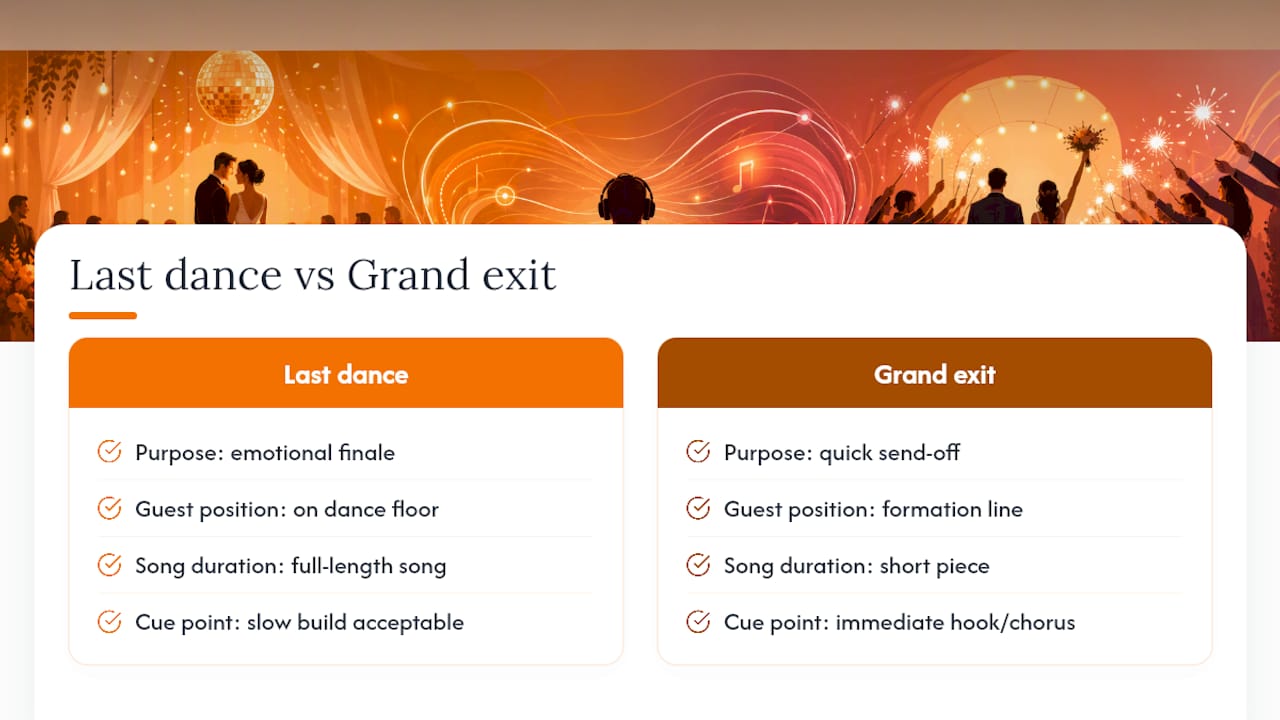
If you want both moments, plan the handoff deliberately: let the last dance close on its own natural fade with a short MC line, then start the exit track fresh with its lighting cue already timed to the hook. Treating them as one continuous song usually produces a mismatch where the emotional dance ballad is still playing while guests are already lined up outside with sparklers lit.
How to get guests involved in the last dance
The last dance works best when guests feel like participants, not spectators watching a couple sway alone. A few techniques reliably pull people in rather than letting the floor thin out early.
Ask your DJ or MC to invite everyone onto the floor for the final song specifically, rather than letting it happen without an announcement. A simple line like “grab whoever’s next to you, this is our last song” gives guests explicit permission to join, which matters more than people expect. For crowd-pleasers with a call-and-response element, like “Sweet Caroline,” the DJ can cue the crowd on the “bah bah bah” break with a raised hand or a mic prompt, which turns passive listeners into a chorus.
Some couples invite guests to form a circle around them for the first minute of the song before opening the floor to everyone, which creates a visual moment for photos before it becomes a full group dance. Others skip the choreography entirely and simply let the DJ announce an “everybody dance” moment the instant the last dance starts, skipping any formal opening seconds.
Whichever approach you pick, tell your photographer and DJ in advance so the cue and the camera are ready at the same second. A last dance that guests only notice halfway through loses the moment it was designed to create.
Cultural traditions that shape the last dance
Wedding traditions around the world treat the closing dance differently, and knowing a few variations can help couples decide how formal or communal to make their own version.
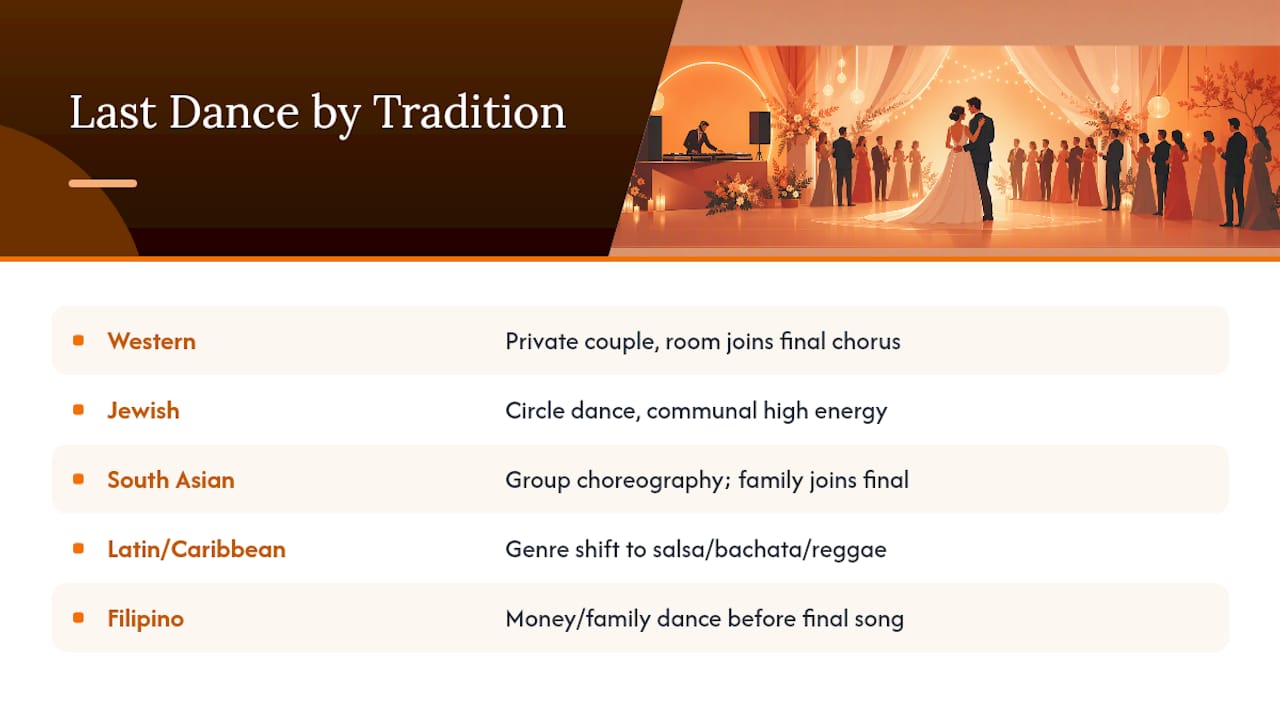
In many Western receptions, the last dance is a quiet bookend to the first dance, danced privately by the couple before the room joins in for the final chorus. Jewish weddings often build toward a high-energy circle dance like the hora earlier in the night, which means the actual last song can lean communal without needing to build energy from scratch. South Asian receptions frequently treat the closing set as an extension of earlier group choreography, with family members joining a final dance number rather than the couple dancing alone.
Latin American and Caribbean weddings sometimes close with a specific genre shift, moving into salsa, bachata, or reggae as the final stretch regardless of what played earlier, treating the last dance as a genre statement as much as a song choice. In some Filipino and other multicultural receptions, a money dance or a specific family-honouring dance happens before the true last song, adding a distinct ritual step ahead of the closing number.
None of these traditions are mandatory, but they’re worth naming during planning if either partner’s family expects a specific closing ritual. A DJ experienced with multicultural guest lists will typically ask about this directly rather than assuming a single default format applies.
Choreography and special moments to consider
The last dance doesn’t need formal choreography to feel intentional, but a few small touches turn it from a generic slow dance into a remembered moment.
Some couples learn a short, simple sequence, just 20 to 30 seconds, for the opening of the song before letting it become a normal sway. This works best with a slower romantic closer rather than a fast communal track, since a full routine to an upbeat song asks too much of a couple who isn’t training as dancers. A simpler option: choreograph just the final few seconds, ending on a dip, a spin, or a kiss timed exactly to the last note, which gives photographers a clean shot without demanding a full routine.
Lighting is often the easiest special moment to add. A single spotlight on the couple for the first verse, opening to full lighting when the chorus hits and guests join in, creates a visible shift that reinforces the communal invitation without anyone saying a word. Sparkler moments, confetti drops, or a second costume change (some couples switch into a shorter dress or change shoes for this final dance) all work as optional flourishes rather than requirements.
The one detail worth prioritizing over any choreography: telling your photographer and videographer the exact plan in advance. A special moment that isn’t captured because the camera crew didn’t know it was coming is the most common regret couples report after the fact.
Coordinating with your DJ or band for a smooth handoff
The last dance is the one moment in a wedding where a timing mistake is highly visible. Getting the handoff right comes down to a short list of confirmations made well before the reception starts.
Share the exact song and version with your DJ or band at least a week ahead, not the day of, so they can source the correct file or arrangement. Confirm whether the last dance leads directly into an exit song, a bus departure, or simply ends the night, since that changes how tightly the fade needs to be timed. If a band is performing live, confirm they know the studio arrangement well enough to hit the same emotional beats, since a live cover can run longer or shorter than the recorded version guests expect.
Build in a buffer. Wedding timelines run late constantly, and a DJ who knows the last dance might get pushed 20 minutes can adjust the rest of the night’s pacing rather than rushing the moment to stay on schedule. Finally, confirm who gives the final go-ahead signal, whether that’s the couple, the planner, or the MC, so the DJ isn’t guessing when to start the track.
Why the last song matters more than couples expect
Most couples spend weeks agonizing over their first dance and barely think about the last one until the week of the wedding. That’s backwards. Guests remember endings far more vividly than openings, and the last song is what plays in someone’s head when they think back on your wedding a year later.
The mistake I see most often isn’t a bad song choice. It’s picking a song that sounds good on paper but doesn’t match what the room actually needs by 11:30 PM. A couple who wanted an intimate ballad often gets talked into a crowd-pleaser because it “always works,” and then loses the quiet moment they actually wanted. Choose intentionally, rehearse the cue with whoever’s playing it, and confirm the exact start and fade times in writing, not just in conversation.
— Reza
Let DJ Phoenix handle your last dance from playlist to cue
Picking the perfect last dance song is only half the job. Getting the timing, transitions, and crowd energy right on the night itself is where most self-managed playlists fall apart. Experienced DJs build last-dance cueing, lighting handoffs, and crowd-reading directly into wedding bookings, drawing on experience curating playlists for multicultural guest lists and reading a room in real time rather than following a fixed script.

Wedding packages often include song curation, emcee direction for the closing announcement, and coordinated lighting so the last dance transitions cleanly into whatever comes next, whether that’s a sparkler exit or an after-party set. The Gold, Silver, and Bronze wedding packages each scale the level of service to your reception size and timeline, and every package includes the cue-sheet planning this guide walks through. If you want the closing moment of your reception handled by an experienced professional who knows how to read the crowd and time music cues, check service details and availability for your date.
Sources
- 107 Best last dance songs for your wedding
- 108 Last dance wedding songs to play at your reception
- Last dance wedding songs: How to end the night right
FAQ
What’s a good exit wedding song?
A good exit song has its hook or chorus land within the first 30 to 45 seconds, since sparkler tunnels and confetti exits typically only hold formation for 30 to 60 seconds. “Closing Time” by Semisonic and upbeat tracks like “Uptown Funk” both work well because they don’t require a slow build before the energy hits.
Who dances first at the reception, the couple, mother and son, or father and daughter?
There’s no fixed order required, though many receptions follow the couple’s first dance with parent dances (mother-son, father-daughter) shortly after, before opening the floor to guests. The last dance at the end of the night is almost always reserved for the couple alone, or the couple plus all remaining guests if it’s a communal closer.
What song is best for a final dance?
The best final dance depends on tone: a romantic slow closer like “At Last” by Etta James suits an intimate moment, while a communal pick like “Don’t Stop Believin’” suits a full-floor finish. Two main approaches exist, intimate or communal, and picking between them first makes the specific song choice much easier.
What is a good ending song for a wedding?
“Last Dance” by Donna Summer works literally as a title cue, while “Time of Your Life (Good Riddance)” by Green Day offers a more reflective, sentimental close. Favour songs guests already recognize if you want a singalong ending, since unfamiliar picks tend to underperform compared to well-known choices in that final slot.