The best Latin wedding playlist opens with a cultural Spanish-language set (think bachata and salsa), builds through bilingual crossover tracks, then peaks with high-energy reggaeton before easing into slower songs for family moments. Start with “Vivir Mi Vida,” “Suavemente,” “Danza Kuduro,” a Romeo Santos bachata, “Despacito,” “Bailando,” a Bad Bunny track, and “El Perdón.” This blend works because it honours grandparents raised on boleros and salsa while giving younger cousins the reggaeton and Latin pop they came to dance to.
TL;DR:
- A Latin wedding playlist should layer various genres, including salsa, bachata, reggaeton, and bolero, to suit different moments and generations.
- Peak dance segments rely heavily on familiar, high-energy songs like Gasolina, Danza Kuduro, and Bad Bunny tracks, which reliably fill the floor across ages.
- Transitioning smoothly between Spanish, bilingual, and English tracks is crucial, with bilingual remixes serving as effective bridges during shifts in language and energy.
- For traditional families, programming should emphasize bolero, mariachi, and salsa early in the night, reserving reggaeton and modern hits for later dance segments.
- A professional DJ who curates personalized, crowd-responsive playlists offers more authentic flow and better can adapt to real-time reactions than a static streaming playlist.
Table of Contents
- Building your Latin wedding playlist: the full picture
- A ready-to-play Latin wedding playlist by dance-floor moment
- Latin music genres for weddings, explained by mood and moment
- Micro-playlists for every key wedding moment
- Mixing Spanish and English songs without losing anyone
- Bringing live music and dance performances into the mix
- What actually works when the room is full of grandparents and cousins at once
- How Dj-phoenix builds your bilingual Latin reception from the ground up
- Where to go deeper on genres and song picks
- Sources
- FAQ
Building your Latin wedding playlist: the full picture
A “Latin wedding playlist” is really shorthand for a curated set of Spanish-language and bilingual songs programmed by tempo, cultural weight, and generational appeal rather than a single genre. Couples planning Latin-themed weddings often assume they need one flavour, salsa or bachata exclusively, when the strongest receptions layer several traditions across the night. Editorial lists from wedding publishers consistently pick predictable crowd-pleasers that work across generations rather than niche regional deep cuts, and that instinct holds up on real dance floors.
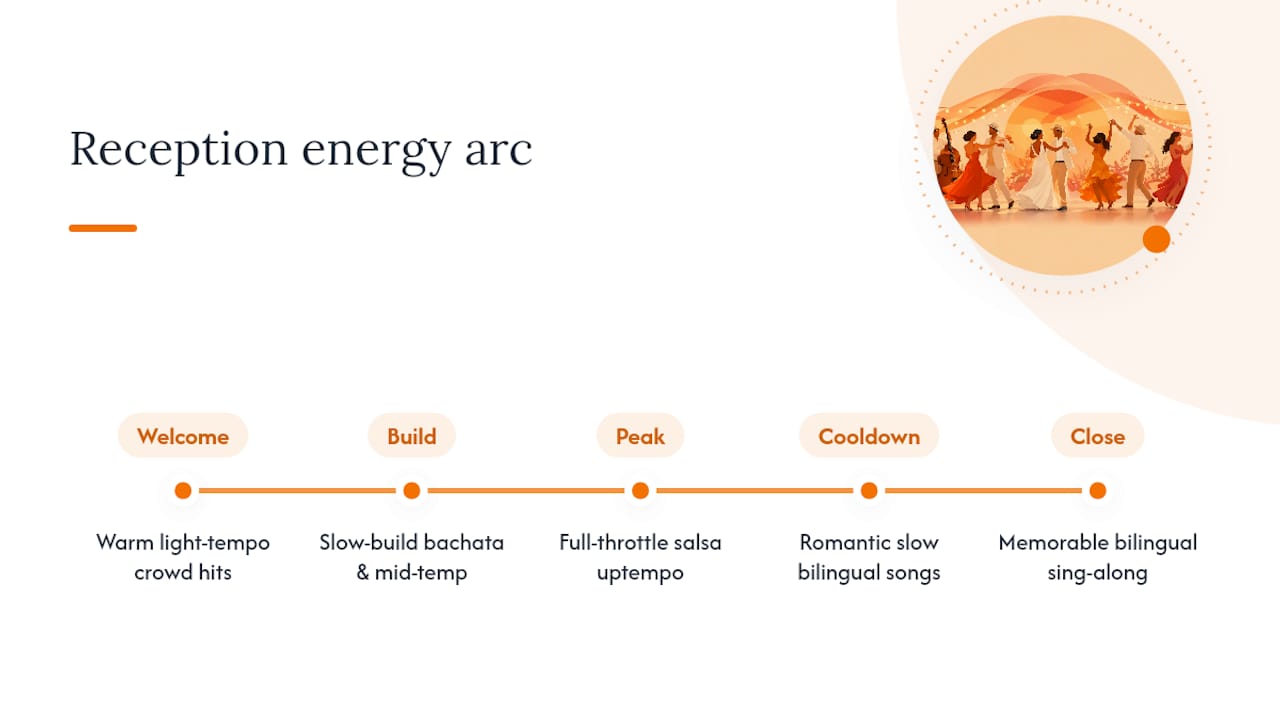
Think of the evening in five movements: a warm welcome, a slow build, a full-throttle peak, a romantic cool-down, and a memorable close. Each movement calls for a different genre or tempo, and the transitions between them matter as much as any individual song choice.
A ready-to-play Latin wedding playlist by dance-floor moment
Hand this shortlist to your DJ or drop it straight into a streaming app. It runs roughly 45 tracks, close to the 50 to 100 songs most receptions use depending on how long the dance floor stays open, according to WeDJ’s request data.
Warm-up and entrance (lower energy, cultural tone):
- “Bésame Mucho” (bolero classic) — sets a romantic, timeless mood as guests arrive
- “La Vida Es Un Carnaval” (Celia Cruz) — instantly recognizable, low pressure on the dance floor
- “Volver, Volver” (mariachi) — strong for a Mexican-heritage entrance or cocktail hour
Ramp-up (rising tempo, building familiarity):
- “El Cantante” (salsa) — mid-tempo salsa that eases newer dancers in
- “Suavemente” (Elvis Crespo, merengue) — fast enough to signal the party is starting
- “Obsession” (bachata) — bilingual crossover energy that bridges older and younger guests
Peak floor-fillers (maximum energy):
- “Danza Kuduro” — nearly universal recognition across ages
- “Gasolina” — reggaeton staple that reliably fills the floor
- A Bad Bunny track — modern anchor for younger guests
- “Vivir Mi Vida” (Marc Anthony) — salsa crowd-pleaser with a triumphant, wedding-appropriate lyric
- “Bailando” (Enrique Iglesias) — bilingual pop-salsa hybrid that keeps momentum
Sing-alongs (everyone knows the words):
- “El Perdón” — emotional, bilingual, huge singalong factor
- “Despacito” — arguably the most requested bilingual crossover of the last decade
- “La Bicicleta” — feel-good and widely recognized
Slow and romantic (cool-down, parent dances):
- A Romeo Santos or Aventura bachata ballad — romantic and generationally bridging
- “Historia de un Amor” (bolero) — timeless, ideal for a parent dance
- “Perfidia” — classic bolero warmth for a quieter moment
Closing songs:
- “La Vida Es Una Fiesta” or another group singalong — sends the night off on a high
Pro Tip: Label each track in your DJ’s set list by dance style, “bachata slow,” “salsa floor filler,” “reggaeton peak.” That single habit, common among working DJs, prevents awkward tempo collisions between songs.
Classics like “Vivir Mi Vida” and “Suavemente” sit comfortably next to modern hits like “Despacito” and Bad Bunny tracks precisely because editorial curators have already tested that combination against multigenerational crowds for years.
Latin music genres for weddings, explained by mood and moment
Each Latin genre carries its own origin, tempo, and ideal placement in a reception. Knowing the difference lets you program deliberately instead of guessing.
- Bachata: Romantic, guitar-driven, originating in the Dominican Republic. Slower BPM, close-partner dancing. Best for cool-down sets, first dances, or bridging cultural moments. UNESCO recognizes bachata’s music and dance as cultural heritage, which makes it worth a spoken acknowledgement if your ceremony leans traditional.
- Salsa: High-energy, horn-heavy, rooted in Cuban and Puerto Rican traditions filtered through New York in the 1960s and 70s. Fast footwork, ideal for ramp-up and peak sets.
- Merengue: Fast, driving, Dominican in origin. Simple enough for non-dancers to join immediately, which makes it a reliable floor-filler early in the night.
- Reggaeton: Modern, bass-forward, born in Puerto Rico in the 1990s. Highest energy on this list. Save it for the true peak, not the entrance.
- Cumbia: Rhythmic and percussive, originally Colombian. Works well for a mid-reception energy lift, especially with guests from Colombian or Mexican backgrounds.
- Bolero: Slow, lyrical, romantic classics from across Latin America. Often underused but highly effective for parent dances and quiet emotional beats.
- Mariachi: Traditional Mexican brass and string ensemble sound. Strong for ceremony entrances or a live-performance moment rather than open dancing.
- Norteño and regional Mexican: Accordion-driven storytelling songs, popular with Mexican-heritage guests, especially parents’ generation.
- Rock en Español: Guitar-driven, often nostalgic for guests who came of age in the 1990s and 2000s. A useful wildcard for a mid-set energy change.
Pro Tip: If your families skew traditional, weight the first half of the night toward bolero, mariachi, and salsa. Save reggaeton and rock en español for after dinner, once the crowd has loosened up.
Micro-playlists for every key wedding moment
- Ceremony entrance: “Bésame Mucho,” “Historia de un Amor.” Keep it instrumental-leaning and quiet enough for guests to hear vows clearly.
- First dance: A single Romeo Santos or Aventura bachata ballad works best here, its slow tempo and close-partner style suit two people dancing alone.
- Parent dances: Pair one bolero with one traditional song tied to the family’s specific heritage, mariachi for Mexican families, a merengue ballad for Dominican families.
- Reception peak: Queue four to five tracks back to back without pausing for announcements, “Gasolina,” a Bad Bunny track, “Danza Kuduro,” “Vivir Mi Vida.” Momentum dies the moment the music stops.
- Last dance: End on a singalong rather than a slow song. “La Vida Es Una Fiesta” or a similarly anthemic track sends guests out on energy, not a fade.
Plan roughly three to four songs per ten minutes of dedicated dance time, and build in a two-song instrumental or bilingual-remix bridge whenever you shift tempo sharply, from bolero into reggaeton, for instance. A detailed reception song guide can help you map exact timing against your ceremony schedule if your reception runs longer or shorter than the typical four hours.
Mixing Spanish and English songs without losing anyone
A workable sequencing pattern: open with three or four Spanish-language songs to set cultural tone, slide into one bilingual remix as a bridge, then move into an English crossover hit before returning to Spanish. Bilingual-wedding specialists recommend exactly this order because it establishes identity first, then widens the net once the floor is already moving.
A few practical rules:
- Use bilingual tracks (“Despacito,” “Bailando”) as bridges between all-Spanish and all-English blocks rather than as standalone peak songs.
- Watch the floor after each transition. If it thins out, shorten the next non-Spanish block.
- Have your emcee announce major moments (first dance, cake cutting) in both languages, briefly, not as a full translation of every sentence.
Pro Tip: If one side of the family speaks primarily English and the other primarily Spanish, ask your emcee to alternate which language leads each announcement throughout the night rather than defaulting to one language every time.
Bringing live music and dance performances into the mix
A recorded playlist covers the dance floor, but live elements add texture a streaming queue cannot. A mariachi trio during cocktail hour or the ceremony processional gives guests something visually memorable while the DJ prepares for the reception. Some couples bring in a folklórico dance troupe for a short performance between dinner courses, a nod to specific regional heritage that a playlist alone can’t replicate.
Live percussion, congas or a cajón layered over recorded salsa or merengue tracks, can turn a familiar peak-set song into something guests haven’t experienced at another wedding. The key is sequencing: schedule live performances during natural lulls, right after dinner service or before the cake cutting, rather than interrupting a dance floor that’s already full. A drum player sitting in during a high-energy reggaeton block adds texture without derailing momentum.
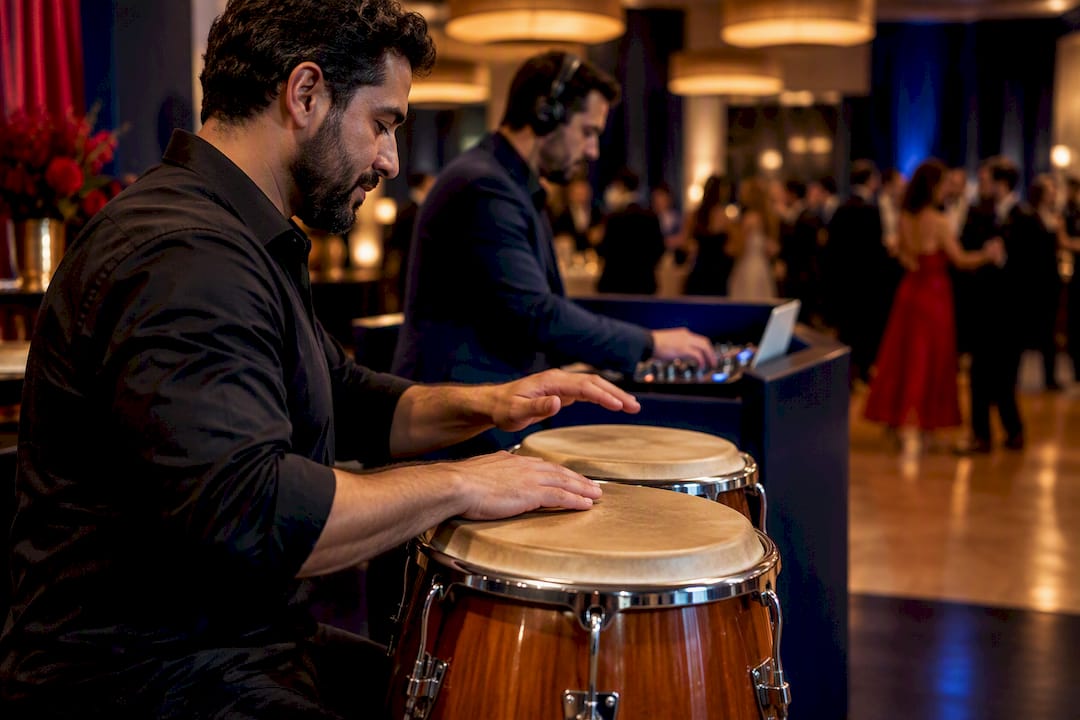
Coordinate timing between your live performers and your DJ well before the event. A five-minute live set that runs long can stall the entire reception schedule, so build a buffer into your timeline and confirm who cues whom.
What actually works when the room is full of grandparents and cousins at once
Most couples worry too much about picking the “right” songs and not enough about sequencing. A perfectly chosen bachata ballad played at the wrong moment, right after a reggaeton peak, will empty a dance floor faster than a bad song choice ever could. The transition matters more than the track list.
The other misconception is treating “Latin wedding music” as one genre. Families with Dominican, Mexican, Colombian, and Puerto Rican roots in the same room need a set that acknowledges more than one tradition, not a single-genre loop. Reading the room in real time, watching who moves toward the floor and who steps back, matters more than any pre-built playlist, no matter how carefully researched. A few hands-on rules hold up across most Latin weddings: keep a bolero or two in reserve for grandparents even if no one requests one, never stack two peak-energy songs back to back without a breath between them, let request cards guide adjustments but never let them derail your planned arc, hold reggaeton until the crowd has already committed to dancing, and always have a bilingual bridge track ready before shifting language.
— Reza
How Dj-phoenix builds your bilingual Latin reception from the ground up
Handing a DJ a Spotify link isn’t the same as having someone who reads a bilingual, multigenerational crowd in real time and adjusts the set on the fly. A professional DJ builds personalized, crowd-responsive playlists for exactly this kind of multicultural audience, pairing that curation with emcee work and sound equipment so the transitions between bolero and reggaeton actually land instead of clearing the floor.

For couples who want a fully curated bilingual Latin reception without assembling it themselves, the Gold Package at $3,500 covers full-night DJ performance, playlist curation, and emcee services built around your family’s specific mix of traditions. Smaller receptions can look at the Silver Package at $2,200 or the Bronze Package at $1,500, both scaled versions of the same curation approach. Every package includes:
- Bilingual playlist curation tailored to your families’ specific heritage mix
- Professional emcee service for two-language announcements
- High-quality sound equipment sized to your venue
If you’re still deciding what to look for in a DJ before booking anyone, this guide to choosing the right wedding DJ walks through the right questions to ask. Check package availability for your date directly on the wedding packages page.
Where to go deeper on genres and song picks
- The Knot’s Latin wedding music breakdown covers genre origins in more depth.
- EVORÉ’s bilingual wedding guidance offers sequencing advice for mixed-language crowds.
- Brides’ curated Spanish song list is a solid starting point for specific track names.
- WeDJ’s request-data chart shows which songs actually get requested most at real receptions.
For general reception layout and timing that affects how many songs you’ll need, this small wedding reception planning guide is a useful outside reference.
Sources
- The Knot — 13 Latin wedding music genres that need to be on your playlist
- EVORÉ — Spanish wedding songs (bilingual-wedding advice)
- WeDJ — Top 100 Latin wedding songs & hits (request-data chart)
- Brides — 22 Spanish songs to play at your wedding
FAQ
What are some good Latin songs for a wedding?
Strong all-purpose picks include “Vivir Mi Vida,” “Suavemente,” “Danza Kuduro,” “Despacito,” and a Romeo Santos bachata ballad. These appear repeatedly on curated editorial lists because they cross generational lines reliably.
What songs are appropriate for a Mexican wedding playlist?
Mariachi classics like “Volver, Volver” work well for entrances and family moments, while norteño and regional Mexican tracks suit dinner and mid-reception sets. Modern reggaeton and Latin pop still belong in the peak dance block regardless of specific heritage.
What music is played at Mexican weddings?
Mexican weddings typically blend mariachi and norteño traditions for ceremony and family moments with salsa, merengue, and modern Latin pop for open dancing. Many receptions also feature a live mariachi performance during cocktail hour or the processional.
What are the top Latin dance songs for a wedding peak set?
Reliable peak-set choices include “Gasolina,” “Danza Kuduro,” “Vivir Mi Vida,” “Bailando,” and current Bad Bunny tracks. Request data from real weddings shows bachata leading overall requests, with reggaeton rising fast behind it.
How many songs should a Latin wedding playlist have?
Most receptions need 50 to 100 songs, depending on how many hours the dance floor stays open. A curated set built around Dj-phoenix’s wedding packages adjusts that count live based on how the crowd actually responds.