
A well-structured wedding DJ timeline is the backbone of a reception that flows with confidence and artistry, coordinating every moment from guest arrival in the final dance. Without a detailed timeline, even the most talented DJ cannot deliver the calibre of experience your celebration deserves. Wedding DJ timeline best practices cover everything from arrival protocols and equipment checks to backup plans and overtime clauses. Couples who book their DJ 9–12 months in advance, particularly during peak season from May through October, gain the most time to build a precise, personalised timeline with their entertainer.
1. What are the essential elements of a wedding DJ timeline?
A complete wedding DJ timeline includes every musical and logistical cue from the moment doors open to the last song of the night. Missing even one element creates gaps that disrupt the evening’s momentum and leave guests uncertain about what comes next.
The core components every timeline must include are:
- Guest arrival and background music: Ambient or soft background music sets the tone before the ceremony begins. The mood here signals the formality and style of the entire event.
- Ceremony cues: Processional, signing, and recessional music each require a specific cue and a confirmed signal from the officiant or coordinator.
- Cocktail hour: Upbeat but understated music fills the room while guests mingle. This phase typically runs 60–90 minutes and bridges the ceremony to the reception.
- Formal introductions: The wedding party entrance and couple’s grand entrance are high-energy moments that demand precise timing and the right track.
- Dinner music: Background music during the meal should complement conversation without overpowering it. Announce speeches and toasts at pre-agreed intervals.
- First dance, parent dances, and cake cutting: Each of these milestones carries emotional weight. Confirm the exact song, length, and any fade or edit preferences in advance.
- Bouquet toss and special dances: These moments often shift the energy dramatically. Place them strategically to maintain crowd engagement.
- Dance floor opening: The transition from dinner to dancing is the most critical energy shift of the night. The DJ must read the room and launch the floor with a track that pulls guests in immediately.
- Late-night party set: High-energy music sustains the dance floor through the final hours. Plan this block with the DJ to reflect your guest demographic.
- Overtime and wrap-up: Overtime charges typically range from $100 to $300 per additional hour, billed in 30-minute increments. Confirm this rate in your contract before the event.
Pro Tip: Build a 10-minute buffer between each major milestone. Real receptions rarely run exactly on schedule, and a buffer prevents one delay from cascading through the entire evening.
2. How can couples collaborate effectively with their DJ to build the timeline?
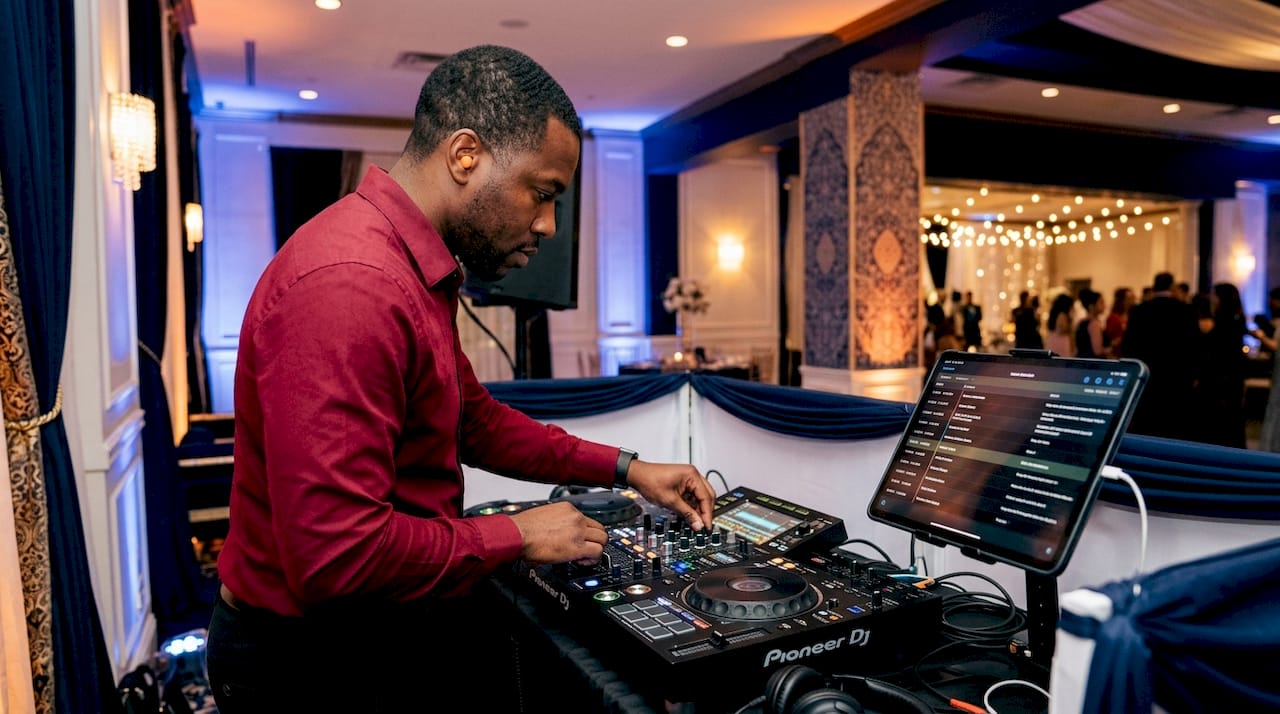
Effective collaboration with your DJ begins months before the wedding, not in the final week. The earlier you share your vision, the more precisely the DJ can shape the timeline around your priorities.
A structured DJ briefing step by step typically involves three phases. First, complete a detailed questionnaire covering song preferences, do-not-play lists, announcement scripts, and the names of key family members the DJ will introduce. Second, share a draft timeline with all vendors so everyone operates from the same schedule. Third, hold a final meeting 1–2 weeks before the event to confirm every cue and address any last-minute changes.
Key collaboration points to address with your DJ:
- Must-play and do-not-play lists: Give your DJ a clear list of both. A do-not-play list is equally important and often overlooked.
- MC responsibilities: Confirming MC duties upfront prevents confusion on the night. Many DJs double as MCs, managing announcements, toasts, and timeline flow. Clarify this role explicitly in your contract.
- Vendor timing windows: Share the caterer’s service schedule, the photographer’s shot list timing, and the venue’s noise curfew with your DJ. These constraints directly shape the timeline.
- Cultural and themed requests: If your wedding incorporates multicultural traditions, such as a Persian ceremony or an Afghan wedding programme, communicate these well in advance. Dj-phoenix, for example, specialises in multicultural wedding timelines and curates playlists that honour diverse traditions without disrupting the evening’s flow.
- Announcement scripts: Write out the exact wording for key announcements. This removes ambiguity and ensures the DJ represents your family with the correct names and pronunciations.
Pro Tip: Send your DJ a one-page timeline summary in PDF format at least two weeks before the event. Include every vendor’s name, contact number, and their role in each timeline milestone.
3. What are the best practices for DJ backup plans and equipment?
Technical failures are rare, but they are catastrophic when they happen during a first dance or grand entrance. A professional DJ’s backup plan is not optional. It is a contractual and ethical obligation.
Professional DJ contracts should include a specific backup clause covering both equipment and personnel. This means a secondary laptop loaded with an identical music library, spare controllers or mixers, and extra cables. The backup protocol must also address illness or emergency, naming a replacement DJ of equivalent calibre.
The four non-negotiable backup elements are:
- Secondary laptop with synced library: The backup laptop must mirror the primary system exactly. A different library creates gaps when switching over mid-event.
- Spare mixer and controller: Hardware failure is the most common technical issue at live events. A spare unit allows an immediate switchover without interrupting event flow.
- Locally stored music library: A library of 20,000+ tracks stored locally is the industry standard. Relying solely on streaming services like Spotify or Tidal poses significant risks due to potential internet instability at venues.
- Extra cables and adapters: XLR cables, RCA adapters, and power strips are inexpensive but critical. A single missing cable can silence the entire system.
DJ arrival timing is equally critical. Most professional wedding DJs arrive 90 minutes to 2 hours before guests to complete setup and sound checks. This window allows time to identify and resolve any technical issues before the first guest walks through the door.
Pro Tip: Ask your DJ directly: “What happens if you fall ill the morning of my wedding?” A confident, specific answer with a named replacement plan signals a professional. Vague reassurances are a red flag.
4. How to tailor the DJ timeline to different wedding styles and venues
No two weddings share the same timeline. Guest count, venue type, cultural traditions, and budget each shape how the evening unfolds. A 50-person intimate dinner reception requires a fundamentally different timeline structure than a 300-person multicultural celebration.
The table below outlines how key timeline elements shift across common wedding formats:
| Timeline element | Intimate reception (under 80 guests) | Large reception (150+ guests) | Destination wedding |
|---|---|---|---|
| Setup and arrival time | 60–90 minutes before guests | 90–120 minutes before guests | Day before or morning of |
| Cocktail hour length | 45–60 minutes | 60–90 minutes | 60–90 minutes |
| Formal introductions | Abbreviated or skipped | Full wedding party entrance | Adapted to venue layout |
| Dance floor duration | 2–3 hours | 3–4 hours | 2–3 hours (noise curfews vary) |
| Overtime likelihood | Low | Moderate to high | High (travel delays common) |
Venue noise limits and access windows directly impact DJ setup and timeline scheduling. Coordinating with venue staff before finalising the timeline prevents last-minute conflicts. Destination weddings carry additional complexity. Dj-phoenix has managed destination wedding timelines across international venues, where equipment logistics, local sound regulations, and travel schedules all require careful advance planning.
For weddings that combine a live band with a DJ, the timeline must account for band breaks. A DJ typically fills these gaps with curated sets, maintaining energy while the band rests. This hybrid format, sometimes called a fusion of live performance and expert DJing, requires precise handoff cues confirmed with both acts in advance.
Budget also shapes timeline flexibility. Couples working with tighter entertainment budgets should prioritise the dance floor hours and first dance over extended cocktail hour coverage. Allocating the DJ’s contracted hours to the highest-impact moments delivers the best guest experience per dollar spent.
5. Common red flags and timeline pitfalls to avoid
The most preventable wedding day disasters trace back to timeline planning errors made weeks or months before the event. Recognising these warning signs early protects both your investment and your experience.
The most common pitfalls couples encounter are:
- No written timeline provided to the DJ: A verbal agreement is not a timeline. Every cue, song, and announcement must exist in writing and be confirmed by both parties.
- Unclear MC role assignment: Failing to confirm who handles announcements leads to awkward silences or missed cues. Establish this in the contract, not on the day.
- No confirmed backup plan: A DJ who cannot describe their backup equipment or emergency replacement protocol is a liability. This is one of the clearest wedding DJ red flags on any checklist.
- Last-minute song or schedule changes without vendor notification: Changing the first dance song two days before the wedding without telling the DJ, photographer, and caterer creates a chain of confusion that disrupts multiple vendors simultaneously.
- Ignoring venue access and noise restrictions: Venues with hard noise curfews or restricted vendor access times will cut the evening short if these constraints are not built into the timeline from the start.
- No final confirmation call: A final planning call 1–2 weeks before the event catches errors before they become problems. Skipping this step is a risk no couple should take.
- Overlooking overtime terms: Standard overtime rates range from $100 to $300 per hour. Couples who do not confirm these terms in advance face unexpected costs when the dance floor is still full at midnight.
Key takeaways
A wedding DJ timeline built on clear communication, written cues, and verified backup plans is the single most reliable way to protect your reception’s flow and guest experience.
| Point | Details |
|---|---|
| Book early and brief thoroughly | Secure your DJ 9–12 months out and complete a detailed questionnaire covering all timeline milestones. |
| Confirm backup equipment in writing | Your DJ contract must specify a secondary laptop, spare mixer, and locally stored music library of 20,000+ tracks. |
| Assign MC duties explicitly | Clarify whether your DJ handles announcements and toasts before the event, not on the day. |
| Build in timeline buffers | Add 10-minute buffers between major milestones to absorb real-world delays without disrupting the evening. |
| Verify venue constraints early | Confirm noise curfews and vendor access windows before finalising any timeline element with your DJ. |
What I’ve learned from building wedding timelines that actually work
After years of performing at weddings ranging from intimate dinners to large multicultural celebrations, I have come to believe that most couples underestimate the timeline’s role until something goes wrong. The evening’s flow is not background music. It is the architecture of the entire experience.
The couples who arrive at their reception with the most confidence are the ones who treated the timeline as a living document, not a formality. They shared it with every vendor, updated it after each planning call, and confirmed it one final time the week before. They also asked hard questions: What is your backup plan? Who replaces you if you are ill? What happens if the venue cuts power at 11:00 PM?
One thing I have seen repeatedly is that flexibility and structure are not opposites. The best timelines I have worked with had clear milestones and built-in breathing room. They gave me the freedom to read the crowd and extend a set when the floor was electric, without losing the thread of the evening’s narrative. A rigid timeline with no buffers forces a DJ to choose between the music and the schedule. A well-crafted one lets both coexist.
My honest advice: view your DJ as a co-architect of the evening, not a vendor who shows up and plays songs. The earlier you bring them into the planning process, the more precisely they can shape the experience around what matters most to you.
— Reza
How Dj-phoenix approaches your wedding timeline
Planning a wedding reception that flows with elegance and energy requires more than a playlist. It requires a DJ who understands the architecture of the evening and brings the expertise to execute it with precision.

Dj-phoenix brings a pedigree of elite event experience to every wedding timeline, from intimate celebrations to large multicultural receptions. With a locally stored library built for live performance, full backup equipment protocols, and MC capabilities that cover every announcement and transition, Dj-phoenix is prepared for every moment the evening demands. Explore the performance gallery to see timeline flow in action, or review the wedding packages to find the right fit for your celebration. Consultations are available to build your timeline from the first song to the last.
FAQ
How far in advance should I book a wedding DJ?
Book your DJ 9–12 months before your wedding, especially if your date falls between may and october. Early booking gives you the most time to build and refine your timeline together.
What is a DJ backup plan for a wedding?
A DJ backup plan includes a secondary laptop with an identical music library, spare hardware, and a named replacement DJ for illness or emergency. These elements should be written into your contract before you sign.
Should my DJ also act as the MC?
Many professional DJs handle both music and MC duties, managing announcements, toasts, and timeline transitions. Confirm this role explicitly in your contract to avoid confusion on the day.
What are the biggest red flags when planning a wedding DJ timeline?
The clearest red flags are a DJ with no written backup plan, no confirmed overtime policy, and no process for a final planning call. A DJ who cannot describe their emergency protocol in specific terms is not prepared for your event.
How does venue choice affect the DJ timeline?
Venue noise limits and vendor access windows directly shape when your DJ can set up and how long the dance floor can run. Confirm these constraints with venue staff before finalising any timeline element.