The best birthday party playlist adults enjoy is a phased, cross-generational build that runs from arrival to peak to wind-down, sized to your party’s length. For a standard three-hour celebration, that means roughly 45 to 50 songs sequenced with intent, not shuffled. Grab one of the ready-to-play lists below or follow the energy-arc rules and build your own.
TL;DR:
- Play roughly 45 to 50 songs across four phased blocks to maintain energy and flow for a three-hour adult birthday party.
- Structure the playlist with arrival, build, peak, and wind-down phases, each with distinct tempos, moods, and decade-specific selections.
- Prioritize ordering songs to build momentum, saving guaranteed floor-fillers for moments when energy dips rather than relying on shuffle.
- Use a curated playlist of approximately 30 to 50 songs depending on event length, and include a buffer of 20 to 30 percent for requests and unintended delays.
- Hiring a professional DJ ensures smooth transitions, proper sound quality, and live room reading, preventing common playlist pitfalls during the celebration.
Table of Contents
- Curated birthday party playlists for adults by mood and decade
- How to structure the energy arc across the night
- Practical rules for building a playlist that actually works
- Three ready-to-play playlists you can copy tonight
- Reza’s DJ notes on reading the room and multicultural crowds
- A DJ’s honest take on why the phased approach beats the perfect song list
- Let Dj-phoenix handle the playlist so you can enjoy the party
- Where these playlist recommendations come from
- Sources
Curated birthday party playlists for adults by mood and decade
A great adult birthday music lineup isn’t one long list. It’s several shorter blocks, each doing a specific job. Professionals in the event world organise party playlists in phases: arrival, build, peak, and wind-down, and each phase calls for a different mood, tempo, and even decade. Here’s how Dj-phoenix breaks down the categories that consistently work across mixed-age adult crowds.
Arrival and mingling (low energy, conversational). Guests are still finding drinks and saying hello, so the room needs warmth, not volume. Think Stevie Wonder’s “Sir Duke,” Van Morrison’s “Moondance,” John Legend’s “All of Me,” Norah Jones’ “Don’t Know Why,” and Bruno Mars’ “Just the Way You Are.” This block rewards artists with warm vocals and mid-tempo grooves that don’t demand attention.
Build phase (energy climbing, first singalongs). This is where you start pulling people off the couch without forcing anyone onto the floor yet. Fleetwood Mac’s “Dreams,” Whitney Houston’s “I Wanna Dance with Somebody,” ABBA’s “Dancing Queen,” Michael Jackson’s “Don’t Stop ‘Til You Get Enough,” and Dua Lipa’s “Levitating” all sit comfortably here. It works because it’s familiar enough to sing along to but not so intense that it peaks too early.
Peak dance floor (maximum energy, full crowd). This block carries the party. Reliable staples include Earth, Wind & Fire’s “September,” Queen’s “Don’t Stop Me Now,” Mark Ronson and Bruno Mars’ “Uptown Funk,” Beyoncé’s “Crazy in Love,” and current dance-pop hits from the 2020s chart cycle. These tracks appear across nearly every major editorial party list for a reason: they’re built to unify a room that otherwise has nothing in common musically.
Decade-specific blocks (80s, 90s, 00s nostalgia runs). Curators at outlets like SiriusXM segment party songs by decade so hosts can drop in an era-specific run when the room calls for it. An 80s stretch might include Prince’s “1999,” Cyndi Lauper’s “Girls Just Want to Have Fun,” and Michael Jackson’s “Billie Jean.” A 90s run leans on TLC, Backstreet Boys, and Notorious B.I.G. A 00s block works well with Beyoncé, Usher, and OutKast.
Wind-down and closers (nostalgic, slower, memorable). As the night closes, drop tempo without killing the mood. Ed Sheeran’s “Perfect,” Etta James’ “At Last,” and a final singalong anthem like Journey’s “Don’t Stop Believin’” send guests off on a high note rather than an abrupt stop.
If you’re planning around a milestone like a 30th, 40th, or 50th birthday, weight the peak block toward the birthday person’s high school and college years. It’s the single easiest way to make a 40th birthday playlist feel personal instead of generic.
How to structure the energy arc across the night
Ordering matters more than song selection. A curated sequence beats unrestricted shuffle because shuffle has no concept of momentum. It can follow a peak anthem with a slow ballad and deflate the whole room in one skip.
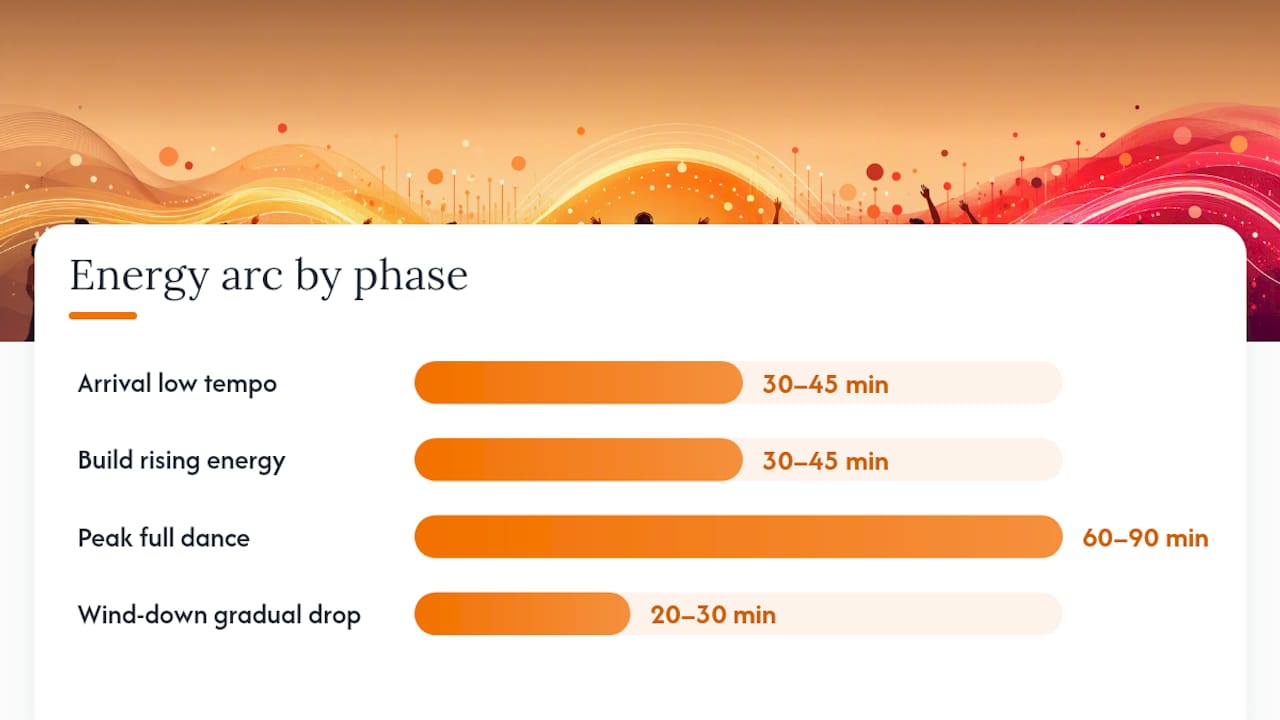
Structure the night in four stages:
- Arrival (first 30 to 45 minutes): Low tempo, conversational volume, nothing that demands dancing.
- Build (next 30 to 45 minutes): Tempo climbs, familiar hooks appear, energy rises without forcing the floor.
- Peak (60 to 90 minutes, the bulk of the party): Full dance energy, cross-generational hits, minimal breaks in momentum.
- Wind-down (final 20 to 30 minutes): Tempo drops gradually, nostalgic and singalong tracks bring the night to a natural close.
Watch the room rather than the clock. If guests are still packed on the floor at the 90-minute mark of the peak phase, stay there. If energy dips early, don’t panic. Drop in one proven floor-filler rather than three in a row.
Accept requests during the build and peak phases when they fit the arc. Steer politely around requests that would derail momentum, like a slow song request in the middle of peak. A simple line like “great choice, saving that for the wind-down” keeps guests happy without breaking the flow.
Pro Tip: Keep a mental “energy ledger.” Every high-tempo track is a deposit, every slow or unfamiliar one is a withdrawal. If withdrawals stack up, your next three songs need to be guaranteed floor-fillers.
Practical rules for building a playlist that actually works
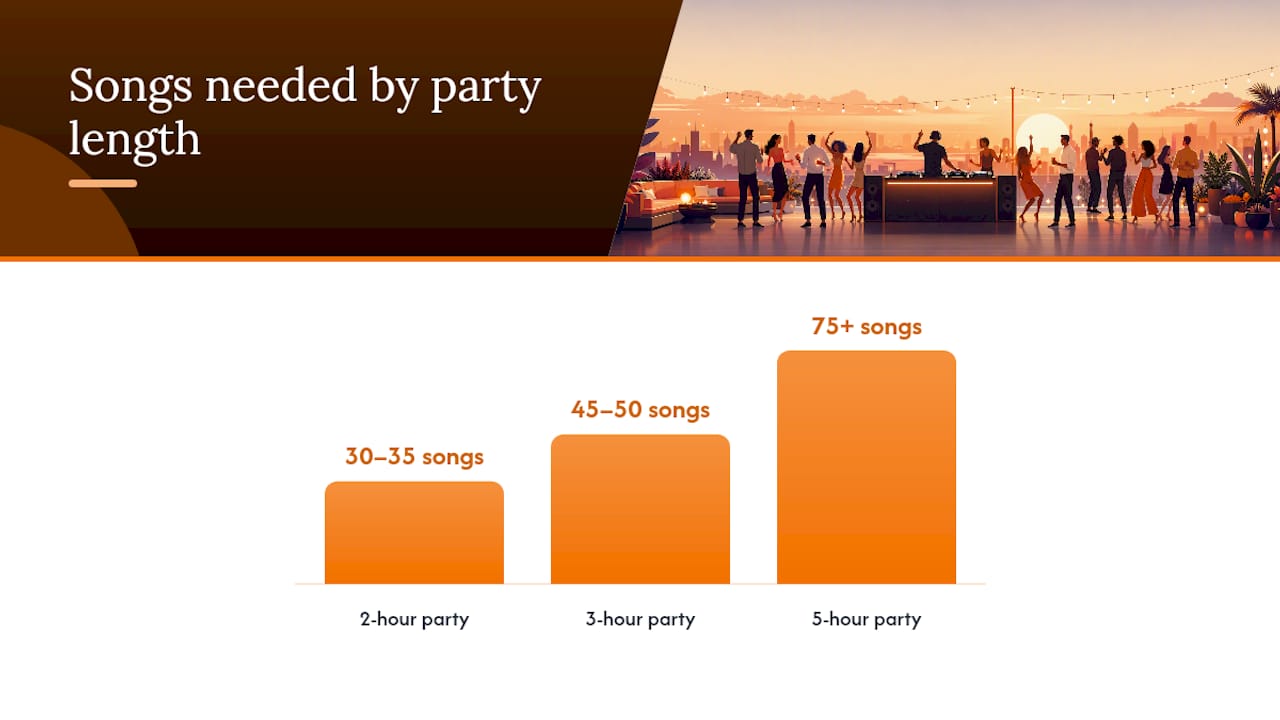
Song count depends entirely on party length, and most hosts underestimate how much music they’ll burn through. A two-hour gathering needs roughly 30 to 35 songs. A three-hour party lands around 45 to 50 songs. A five-hour celebration needs 75 or more.
Statistic to remember: professional DJs typically build in a buffer of roughly 20 to 30 percent extra runtime beyond the planned party length, since requests, encores, and mood shifts almost always stretch the night longer than expected.
A few operational rules that separate a smooth night from a frustrating one:
- Turn crossfade on at a short setting (one to three seconds) so tracks blend rather than cut off abruptly.
- Avoid full shuffle mode. Use a curated queue or a “smart shuffle within blocks” approach so phase order stays intact.
- Download the playlist offline before the party. Venue Wi-Fi and cellular data both fail at the worst moment.
- Bring a second device loaded with the same playlist as backup, and check that your speaker’s battery is charged or plugged in.
- Weight the peak block toward the birthday person’s formative years, roughly ages 15 to 25, since that’s when musical nostalgia hits hardest.
Anyone hosting at home should also think through the broader event flow, not just the playlist. A private party entertainment checklist covers the logistics that make or break the night alongside the music itself.
Three ready-to-play playlists you can copy tonight
Each of these runs close to three hours and follows the phased structure above. Copy the artist and title into Spotify, Apple Music, or your streaming service of choice, then reorder by phase.
The mixed-decade crowd-pleaser (best for a 40th or 50th birthday, 18 tracks, roughly 65 minutes of peak content): Stevie Wonder, Fleetwood Mac, Earth Wind & Fire, Queen, Whitney Houston, Prince, Michael Jackson, TLC, Backstreet Boys, Beyoncé, OutKast, Mark Ronson & Bruno Mars, Dua Lipa, Journey, ABBA, Ed Sheeran, Etta James, Cyndi Lauper. Best used across the full arc since it covers every decade block in one list.
The 30s nostalgia set (best for a 30th birthday peak hour, 16 tracks): Backstreet Boys, Britney Spears, Usher, OutKast, Beyoncé, Rihanna, Kanye West, Amy Winehouse, Justin Timberlake, Gwen Stefani, Coldplay, Kelly Clarkson, Christina Aguilera, Nelly, Black Eyed Peas, Alicia Keys. Best used during build and peak for guests who came of age in the 2000s.
The upbeat modern adult set (best for peak phase with a younger-skewing crowd, 17 tracks): Dua Lipa, Bruno Mars, Beyoncé, Doja Cat, Harry Styles, The Weeknd, Lizzo, Bad Bunny, Miley Cyrus, Chappell Roan, SZA, Post Malone, Olivia Rodrigo, Calvin Harris, Ariana Grande, Kendrick Lamar, Charli XCX. Best used entirely within the peak phase, front to back.
To swap for an older crowd, trade two or three modern tracks for disco-era staples like Donna Summer or Gloria Gaynor. To skew younger, add current chart hits from the last twelve months and trim one or two 90s tracks.
Reza’s DJ notes on reading the room and multicultural crowds
Reading a room is a skill, not a guess. Watch three signals: how many guests are actually dancing, how loud conversation gets relative to the music, and how often requests start coming in. When more than half the floor stops moving or chatter starts overpowering the speakers, that’s your cue to shift, not push harder.
Multicultural celebrations demand a wider net than most playlists account for. When I’m working an event for a mixed Persian, South Asian, or Western crowd, the peak block can’t lean on one culture’s hits alone. I’ve built sets for clients like Mercedes-Benz and FW Sports where three musical traditions had to share one dance floor, and the only way that works is smooth, deliberate transitions between styles, never an abrupt genre swap.
That’s also why professional sets carry a 20 to 30 percent buffer of extra tracks. Requests come in, moods shift, and a DJ without spare material either repeats songs or kills momentum entirely.
Pro Tip: When blending genres for a multicultural crowd, transition through instrumental or percussion-heavy intros rather than jumping straight from one vocal-heavy hit to another. It gives the room a moment to reset.
A DJ’s honest take on why the phased approach beats the perfect song list
Hosts spend hours picking the “right” songs and almost no time thinking about order. That’s backwards. A mediocre song list played in the right sequence will outperform a brilliant one played on shuffle every time, because energy is built, not stumbled into.
The one tip I’d give any host: don’t front-load your best three songs. Save at least one guaranteed floor-filler for a moment when energy visibly dips. That single move rescues more parties than any amount of pre-planning.
— Reza
Let Dj-phoenix handle the playlist so you can enjoy the party
Building a phased, cross-generational adult birthday playlist takes real planning, and running it live while also hosting your own party is a different job entirely. Dj-phoenix removes that trade-off. Booking a professional DJ gets you playlist curation built around your guest mix, a proper sound system instead of a bluetooth speaker fighting for volume, and emcee support to keep transitions smooth between phases.
That’s exactly what prevents the pitfalls covered above: no dead air while switching tracks, no shuffle mode killing a dance floor mid-peak, and no scrambling for a backup device when the Wi-Fi drops. Dj-phoenix has run multicultural celebrations for clients ranging from private milestone birthdays to brands like Mercedes-Benz and FW Sports, reading rooms live and adjusting in real time rather than relying on a fixed list. For the décor and theme side of the night, adult party decor ideas pair well with a properly paced soundtrack.
Browse the DJ performance gallery to see past events in action, then reach out to check availability for your date.
Where these playlist recommendations come from
- Best birthday party playlist in 2026 (V360 Silent Disco) — song-count and phasing guidance.
- The ultimate adult birthday song playlist (EatHealthy365) — phase structure reference.
- 40 best party songs (Time Out) — cross-generational floor-filler selections.
- 123 of the best party songs (SiriusXM) — decade-segmented song blocks.
- 40th Birthday Party Hits (Spotify) — milestone playlist template example.
Sources
- Best birthday party playlist in 2026 | V360 Silent Disco
- A fun birthday song playlist for adult celebrations — EatHealthy365
- 40 best party songs | Time Out