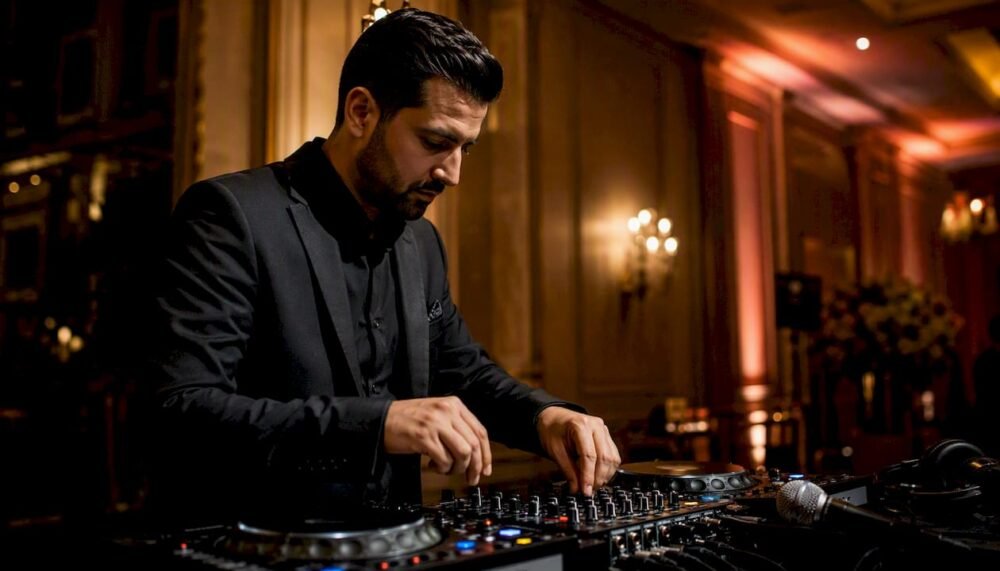
An awards gala DJ is a production-grade entertainer who programs and executes the complete musical and mic-driven flow of a formal ceremony, keeping every segment on time, on tone, and on brand. The role goes far beyond selecting tracks. A gala DJ functions as a show-floor audio operator, working from a scripted rundown alongside the stage manager, AV team, and MC to deliver cues with broadcast-level precision.
Core responsibilities at a glance:
- Music programming across distinct event segments: arrival, cocktail hour, dinner, award blocks, and post-ceremony celebration
- Mic and emcee support, including wireless mic handoffs, gain management, and basic MC duties when a separate host is not engaged
- Scripted transition beds, pre-scored audio underscoring that fills the space between presenters without dead air
- Winner walk-up and walk-off cues, timed to the second and triggered live from the rundown
- AV coordination, including pre-show patch checks, PA calibration, and handoffs to the house system
- Timekeeping, flagging overruns to the stage manager and adjusting cue durations in real time
Key takeaways
An awards gala DJ is a production partner first and a performer second: the role demands rundown fluency, mic management, and broadcast-level cue discipline alongside musical artistry.
| Point | Details |
|---|---|
| Gala DJ role | Programs and executes music, mic cues, and transition beds from a scripted rundown, not just a playlist. |
| Critical hiring criteria | Request a cue sheet, corporate references, proof of insurance, and a written AV coordination plan before signing. |
| Equipment non-negotiables | Dual playback systems, wireless mics, and a confirmed patch plan with the venue AV team are baseline requirements. |
| Red flags to avoid | No backup equipment, vague mic responsibilities, or resistance to tech rehearsal signals a production mismatch. |
| Dj-phoenix for galas | Offers full rundown coordination, multicultural programming, AV integration, and liability insurance for Canadian corporate galas. |
Table of Contents
- What services does an awards gala DJ typically provide?
- How does a gala DJ differ from a wedding or club DJ?
- How does the DJ fit into your event timeline and rundown?
- What equipment does a gala DJ need on site?
- What should you expect to pay for a gala DJ in Canada?
- How do you vet and hire the right gala DJ?
- What a professional gala execution actually looks like
- What production discipline actually means at a gala
- Dj-phoenix brings gala-calibre production to your awards night
- Sources
What services does an awards gala DJ typically provide?
The service scope of a gala DJ is considerably wider than most planners anticipate when they first begin sourcing entertainment. Corporate galas require ambient music for networking and energising sets for awards or after-parties, and a skilled DJ must deliver both within the same evening, often within minutes of each other.
Core service deliverables include:
- Ambient background music calibrated for arrival and dinner conversation
- Transition underscoring between each award category, bridging presenter exits and entrances
- Branded walk-up music for individual winners or team recipients
- A celebration or dance set following the formal programme, often the most energy-intensive portion of the night
Beyond the core, planners should expect a professional gala DJ to offer emcee and mic management. This ranges from basic wireless mic routing and handoffs to full MC duties when the budget does not include a separate host. The distinction matters: mic management is a technical function, while full MC service requires scripting, crowd-reading, and on-stage presence.
DJs offer flexibility and adaptability to shifting energy needs that a single live act often cannot match, which is precisely why they are the preferred choice for events with variable pacing. A hybrid approach, pairing live music for arrival and dinner with a DJ for transitions and the dance set, is increasingly common at prestige galas and preserves ceremony polish while enabling a high-energy celebration later.
Common add-ons to consider:
- Uplighting and DMX-controlled stage wash for branded colour schemes
- Additional wireless handheld or lapel microphones for panel-style award presentations
- Stage monitors for presenters who need audio confidence
- Photo booths integrated into the post-ceremony celebration
- Live-mix elements or guest-performer integration
Uplighting, for example, is particularly effective when a corporate sponsor’s brand colours need to carry through the room. Extra wireless mics become necessary the moment you have more than two presenters sharing a stage simultaneously.
Choosing entertainment that aligns with organisational goals is what separates a night that feels genuinely inspiring from one that simply checks a box. The DJ’s service scope should be built around that objective from the first planning conversation.
How does a gala DJ differ from a wedding or club DJ?
The operational demands of an awards gala are distinct enough that hiring a wedding or club DJ without gala experience carries real production risk. The differences are structural, not stylistic.
| Axis | Gala DJ | Wedding DJ | Club DJ |
|---|---|---|---|
| Primary goal | Show coordination and cue execution | Emotional arc and dance floor | Sustained dance energy |
| Timing discipline | Broadcast-level, cue-by-cue | Flexible, guest-led | Fluid, no fixed timeline |
| Mic duties | Wireless mic management, emcee support | Announcements, toasts | Minimal or none |
| Music approach | Scripted beds, walk-up cues, genre shifts | Crowd-reactive sets | Genre-consistent mixing |
A wedding DJ’s strength lies in reading the room and building a dance floor organically. A club DJ sustains a single energy arc across hours. A gala DJ, by contrast, must execute a scripted cue sheet where a walk-up track for an award winner is timed precisely to match the moment a name is announced and the recipient arrives at the podium. That is a fundamentally different skill set.
Consider a typical gala transition: the DJ fades out dinner music, brings up a 30-second branded sting as the host returns to the stage, then drops to near-silence for the presenter’s introduction, all while monitoring the wireless mic level for the next speaker. A wedding reception set, by comparison, allows the DJ to extend a song, read the floor, and adjust spontaneously. The gala format allows almost none of that latitude.
For planners weighing types of corporate event entertainment, this distinction is the single most important factor in the hiring decision.
How does the DJ fit into your event timeline and rundown?
A disciplined rundown and scored musical beds are what make an awards night land rather than drag, and the DJ is the person responsible for executing both in real time. Here is how a typical gala timeline maps to DJ responsibilities:
- Doors open / arrival (60–90 min before show): Ambient playlist at low-to-medium volume; the DJ monitors room fill and adjusts energy upward as capacity increases.
- Dinner service (45–75 min): Curated dinner set, with genre and tempo calibrated to support conversation rather than dancing; volume is managed in coordination with the AV operator.
- Welcome and opening remarks: DJ fades dinner music on stage manager cue; brings up house music briefly between speakers to reset the room.
- Award blocks (repeated per category): Presenter walk-on music, scripted transition bed, winner walk-up cue, applause fade, walk-off music, reset to ambient.
- Keynote or special address: DJ holds silence or plays a very low ambient bed; manages wireless mic for the speaker.
- Post-ceremony celebration / dance set: Full DJ performance, high-energy programming, crowd-reactive mixing.
The rundown the DJ works from is not a simple playlist. It is a document that names every cue, its duration, its owner (DJ, stage manager, or AV operator), and its trigger condition. Professional event producers rehearse this document repeatedly before show night, and the DJ participates in those tech rehearsals to confirm patch points, mic levels, and cue timing.
Pro Tip: Pre-score your transition beds as standalone audio files with a defined fade-out tail rather than relying on live fades. This gives the DJ a clean, predictable exit point for every cue and eliminates the risk of a live-fade overrun during a tense award moment. It is one of the simplest ways to reduce dead air and protect the show’s pacing.
Coordination with the venue’s AV provider should be confirmed at least two weeks before the event. The DJ needs to know the patch location, the signal chain from their mixer to the house system, and whether there is a sound lock-out window during dinner service.
What equipment does a gala DJ need on site?
A professional awards night requires a DJ, MC, PA system with wireless microphones, stage lighting, and optional guest-engagement add-ons. The technical checklist below covers what planners should confirm before contracting.
Essential gear the DJ should bring or coordinate:
- Main PA system (line-array or point-source, scaled to room capacity and ceiling height)
- Mixer with sufficient channels for music playback, wireless mics, and monitor sends
- Playback redundancy: two laptops or a laptop plus a standalone media player running identical cue sheets
- DI boxes for clean signal conversion between playback devices and the house patch
- Wireless handheld and lapel microphones (minimum two channels; more for panel formats)
- Monitor wedges for presenters and the DJ position
- DMX lighting controller if the DJ is also managing uplighting or stage wash
Questions to ask the venue and AV provider before show day:
- What is the stage size and DJ footprint allocation?
- Where are the patch points and what connectors does the house system accept?
- Is there a sound lock-out window during dinner service?
- What are the load-in and load-out windows, and is there dedicated parking for equipment vehicles?
- Who is the on-site AV contact and what is their communication protocol during the show?
Redundancy is non-negotiable at this calibre of event. A DJ who arrives with a single laptop and no backup playback device is a liability. The professional standard is duplicate playback systems running simultaneously, with an instant-switch capability that the operator can execute in under five seconds.
What should you expect to pay for a gala DJ in Canada?
Gala DJ pricing in Canada varies by market, scope, and production complexity. Rather than quoting figures that shift with demand and geography, planners should understand how packages are structured so they can compare quotes on equal terms.
Typical package shapes:
- Basic performance block: DJ performance only, covering arrival through post-ceremony dance set, with the DJ’s own PA and standard wireless mics. Suited to smaller galas with an in-house AV team handling the room system.
- Full-production coordination package: Includes rundown consultation, tech rehearsal attendance, cue sheet preparation, AV coordination, emcee support, and the full performance. This is the appropriate scope for prestige corporate galas.
- Hybrid live and DJ package: Live music for arrival and dinner, DJ for transitions and the dance set. Higher cost, but delivers a layered experience that distinguishes the event.
Common pricing components to expect in any quote:
- Deposit (typically non-refundable, confirming the date)
- Performance hours and a defined overtime rate per hour beyond the contracted block
- Travel and accommodation fees for events outside the DJ’s home market
- Equipment fees if the DJ is supplying PA, lighting, or additional wireless mics
- Setup and strike time, which should be billed separately from performance hours
- Hospitality rider requirements (meals, parking, green room access)
Contract items to review carefully:
- Scope of services: confirm exactly which cues, mics, and coordination tasks are included
- Cancellation and force majeure clauses
- Overtime calculation method (per 30 minutes vs. per hour)
- Sound and noise curfew compliance obligations
Compare quotes by deliverable, not by headline hourly rate. A lower rate that excludes rundown consultation, tech rehearsal, and cue sheet preparation will cost more in production risk than the savings suggest.
How do you vet and hire the right gala DJ?
Hiring a gala DJ requires a more rigorous vetting process than hiring for a social event. The questions below are the ones that separate a production-ready professional from a capable but mismatched candidate.
- Ask for gala-specific experience. How many awards ceremonies have they performed? Can they name the format (seated gala, standing reception, hybrid) and the approximate guest count?
- Request a sample rundown or cue sheet. A cue sheet demonstrates that the DJ understands timed show elements, not just playlists. Hiring guides recommend asking for sample rundowns and references from corporate clients as a baseline vetting step.
- Ask for corporate client references. Testimonials from brand events, association galas, or corporate award nights carry more weight than social event reviews.
- Confirm insurance and liability coverage. A professional DJ at this calibre carries general liability insurance. Request a certificate of insurance naming your organisation as an additional insured if your venue requires it.
- Review their performance gallery and sample mixes. Event listings and performance galleries provide quick social proof; a DJ’s own gallery should show gala or corporate setups, not only nightclub or wedding photos.
- Clarify mic and emcee responsibilities in writing. Who manages the wireless mics during the award segments? Who is the point of contact for the AV operator? These must be defined in the contract.
- Confirm their AV coordination plan. Professional gala DJ packages include AV coordination, a rider, and proof of insurance as standard deliverables. If a candidate cannot produce these, that is a significant red flag.
Red flags to watch for:
- Vague or non-existent rundown documentation
- No backup playback equipment
- Unclear or verbal-only mic and mix responsibilities
- No written AV coordination plan or tech contact
For planners who want a deeper framework on vetting questions and contract items, the DJ hiring guide for corporate events covers contract must-haves that apply equally to gala engagements.
What a professional gala execution actually looks like
The clearest way to understand what a gala DJ delivers is to walk through a professional engagement from pre-event planning to show night.
Pre-event planning: The DJ joins a planning call with the event producer and stage manager, reviews the draft rundown, and flags any cue conflicts or timing gaps. They submit a rider detailing power requirements, stage footprint, and hospitality needs. A cue sheet is built from the rundown, naming every music moment by title, duration, trigger condition, and responsible party.
Tech rehearsal: The DJ arrives during the load-in window, patches into the house system, and runs a full sound check with the AV operator. Wireless mics are tested at every presenter position. Walk-up cues are played at show volume and confirmed with the stage manager. The rundown is walked through cue by cue, with timing adjustments noted.
Show night: The DJ executes from the cue sheet, communicating with the stage manager via intercom or radio. Every walk-up cue is triggered live; every transition bed runs to its pre-scored tail. The DJ monitors wireless mic levels throughout the award blocks and manages the room’s energy through the dinner-to-ceremony-to-celebration arc.
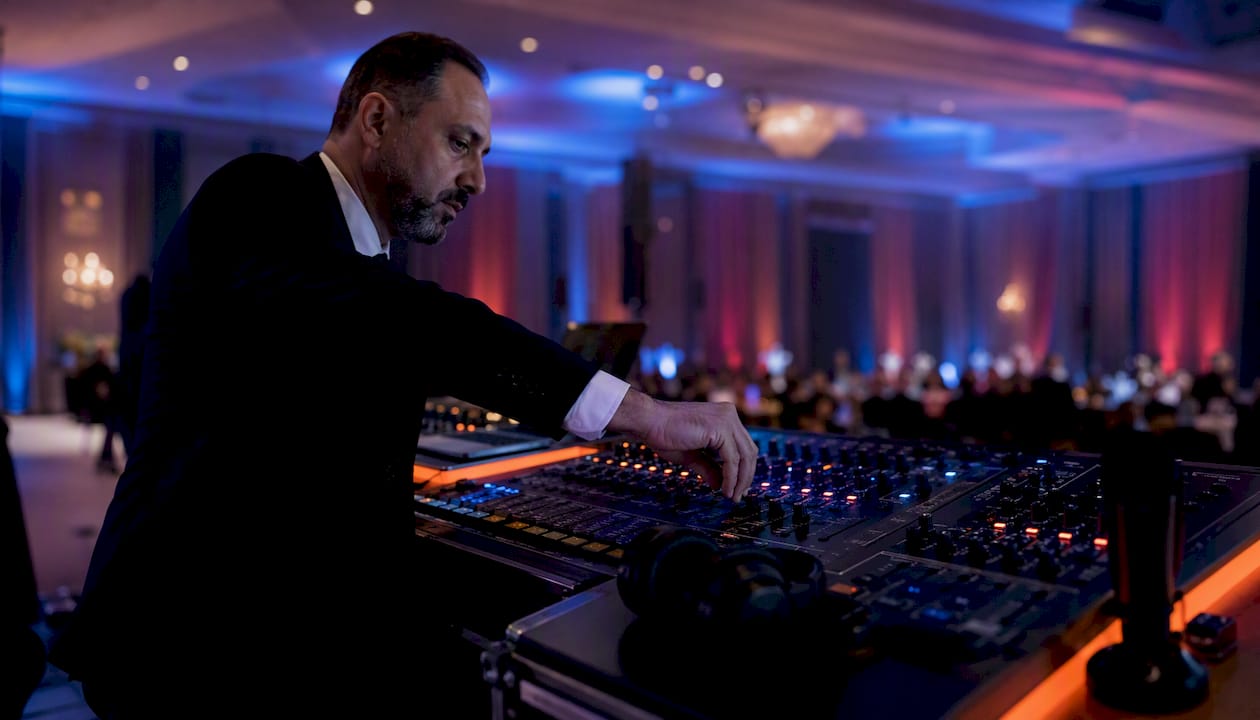
Post-event deliverables: A professional DJ provides the lined rundown with actual timings noted, audio recordings of the performance if requested, and a debrief note for the production team. These materials are the mark of a DJ who treats the engagement as a production partnership, not a performance booking.
Rehearsing the rundown multiple times before show night is standard practice at this level, and a DJ who resists rehearsal calls is signalling a mismatch with the production’s standards.
What production discipline actually means at a gala
There is a version of this conversation that focuses entirely on music taste and playlist curation, and it misses the point almost completely. The music at a gala is not the product. The product is the experience of the room at every moment of the night, and music is the mechanism that shapes it.
What separates a gala DJ of genuine calibre from a capable generalist is production discipline: the willingness to subordinate personal artistry to the show’s architecture, to execute a 12-second walk-up cue with the same precision every time, and to hold a low ambient bed through a 20-minute speech without a single audible level shift. That discipline is not glamorous, but it is what makes a room feel effortless to the people sitting in it.
The multicultural dimension of Canadian corporate events adds another layer of complexity that planners often underestimate. A gala honouring recipients from diverse backgrounds may require music programming that moves fluently across cultural registers, from Persian classical underscoring to contemporary R&B walk-up tracks, without any moment feeling incongruous. That requires not just a broad library but genuine cultural fluency in how music functions within different communities.
Dj-phoenix brings gala-calibre production to your awards night
Dj-phoenix brings the production discipline and multicultural programming depth that prestige awards galas in Canada demand. With a track record that includes corporate clients such as Mercedes-Benz and FW Sports, the team delivers full rundown coordination, emcee support, AV integration, and culturally fluent playlists, all backed by professional liability insurance and a written AV coordination plan.
Every gala engagement includes a pre-event planning consultation, a detailed cue sheet built from your rundown, tech rehearsal attendance, and a performance that moves from elegant ambient arrival music through to a high-energy celebration set. You can review past corporate and gala work in the DJ performance gallery before making any commitment. To discuss your event’s scope and request a quote, visit the corporate events page and connect with the team directly.
Sources
- Awards Ceremony Production: A Night That Lands
- Ultimate Guide to Hiring a DJ for Your Event – AGNT • BLOG
- Eventbrite