The clearest signs of a quality private DJ are a written contract with cancellation and overtime terms, a current Certificate of Insurance, a documented backup DJ plan, professional-grade PA equipment, and consistent recent reviews across Google and The Knot. You can verify all five in a single consultation call before paying any deposit.
Quick verification checklist:
- Ask for a sample contract and confirm it names cancellation terms, overtime rates, and deposit conditions
- Request the Certificate of Insurance (COI) and confirm the coverage limit meets your venue’s requirement
- Ask: “Who is your backup DJ, and what is their experience level?”
- Request a short video from a recent event showing MC work and crowd response
- Search the DJ’s name on Google and cross-reference with wedding directories for recency and specificity of reviews
Dj-phoenix is one Canada-based provider that meets all five criteria, serving weddings, corporate gatherings, and private parties across Toronto, Montreal, and Ottawa.
Table of Contents
- Why does event-specific experience matter so much?
- Does the DJ’s equipment match your venue and guest count?
- What performance skills separate good DJs from great ones?
- How do you evaluate reviews, references, and portfolio material?
- What should a quality DJ package include, and what are the red flags?
- What should you ask at the consultation?
- Key takeaways
- What the checklist reveals about the hiring process
- Dj-phoenix already meets the standard
- Useful sources
Why does event-specific experience matter so much?
A nightclub DJ and a wedding DJ share the same hardware but perform entirely different jobs. Private-event DJs manage three responsibilities simultaneously: curating music for a mixed-age crowd, running a live timeline with announcements, and managing the room’s emotional arc across ceremony, cocktail hour, and reception. A club DJ optimises for one sustained energy peak. Those skills rarely transfer without deliberate practice in private-event contexts.
Industry guides recommend that a DJ have performed 50–100 weddings before positioning themselves primarily as a wedding specialist. That threshold reflects the number of events needed to handle the unpredictable: a late caterer, a nervous groom who forgets his cue, a grandmother who requests a song mid-first-dance. For corporate events, ask for named clients and request footage of a structured programme introduction — the phrasing and posture a DJ uses on-mic at a branded event reveals whether they understand that context.
| Event type | Minimum experience signal | Key verification step |
|---|---|---|
| Wedding | 50–100 weddings performed | Request a recent ceremony-to-reception video |
| Corporate | Named brand clients, structured programme | Ask for on-mic footage of an introduction or award segment |
| Private party | Diverse playlist range, crowd-reading examples | Request a mix or playlist sample from a similar guest demographic |
Pro Tip: During the consultation, ask the DJ to describe a moment when the timeline ran 20 minutes late. Their answer reveals whether they solve problems quietly or escalate them to the host.
Does the DJ’s equipment match your venue and guest count?
Professional-grade gear is not a luxury; it is the difference between a room that sounds polished and one that sounds strained. A quality private DJ arrives with a full-range PA system sized to the room, powered floor monitors, a primary and backup controller, a wireless handheld microphone, a wireless lavalier, DI boxes for live instrument inputs, and a redundant laptop loaded with the same library.
For outdoor or large-venue events, PA sizing and power distribution planning become critical considerations. Ask these questions directly:
- What is the wattage and coverage area of your main speakers?
- Do you carry a backup controller and a second laptop?
- How much power draw does your rig require, and do you bring your own power distribution?
- What is your soundcheck window, and do you coordinate that with the venue’s AV team?
- Does your lighting package require a separate power circuit?
A DJ who mentions only a single Bluetooth speaker for a seated dinner of 80 guests is not equipped for the job. That is not a budget consideration — it is a capability gap.
What performance skills separate good DJs from great ones?
The line between a competent DJ and an exceptional one comes down to crowd reading, mixing technique, adaptability, and emotional pacing. Crowd reading means recognising when a genre shift is needed before the dance floor empties, not after. Harmonic mixing keeps transitions smooth so guests feel the energy build rather than hear a jarring cut. Emotional pacing means understanding that the hour after dinner is not the same as the final 30 minutes of the night.

On-mic presence is equally telling. Watch short event videos and listen for clarity of diction, appropriate pause timing, and whether the DJ defers gracefully to the couple or executive being honoured. Reviewing run-of-show responsibilities and emcee duties before booking clarifies exactly what you are hiring.
Pro Tip: When reviewing a DJ’s portfolio video, mute the audio for 30 seconds and watch the crowd. If guests are engaged, facing the floor, and moving, the DJ is reading the room correctly.
How do you evaluate reviews, references, and portfolio material?
Consistent, recent, and specific reviews across multiple platforms are the strongest online signal; direct reference calls are the decisive check. A DJ with 40 reviews from three years ago and nothing recent raises a legitimate question about current quality.
Check these platforms in sequence:
- Google Business Profile — look for reviews mentioning specific moments (first dance, cocktail hour energy, MC announcements)
- The Knot or WeddingWire — wedding-specific reviews often include timeline detail
- Local directories — search the DJ’s name alongside your city for any unaffiliated mentions
When you call references, ask three questions:
- Did the DJ follow the run-of-show, and how did they handle deviations?
- Were there any equipment or sound issues, and how were they resolved?
- Would you book this DJ again for a similar event?
Warning signs in reviews: repeated mentions of poor communication, failure to honour a do-not-play list, or any reference to a no-show or last-minute substitution without prior notice.
What should a quality DJ package include, and what are the red flags?
A mid-market private DJ package in Canada typically covers four to six hours of performance, a setup and strike window, ceremony audio, cocktail-hour coverage, wireless microphones, and basic uplighting. Travel within a defined radius is usually included; remote venues attract a per-kilometre surcharge. Overtime is billed in 30-minute or one-hour blocks at a stated rate.
| Package element | Included in quality packages | Red flag if absent |
|---|---|---|
| Written contract | Yes | Walk away |
| Liability insurance (COI) | Yes | Walk away |
| Backup DJ policy | Yes | High risk |
| Itemised overtime rate | Yes | Budget surprise risk |
| Equipment list with brands | Yes | Gear quality unknown |
Confirming availability, roster transparency, and what pricing includes is a baseline vetting step, not an advanced one. A price dramatically below the local market almost always means something is missing: insurance, backup gear, or the experience that justifies the rate. Ask for an itemised quote and match each line to a contract clause before signing.
What should you ask at the consultation?
A structured consultation call surfaces the signals that online research cannot. Use this checklist:
- Who will perform at my event — you personally, or someone from your roster?
- Are you available on my date, and will you confirm that in writing?
- What is your setup timeline, and when do you need venue access?
- Can you provide a full equipment list with brand names and wattage?
- What is your power draw, and do you bring your own distribution?
- Can I see your Certificate of Insurance?
- Who is your backup DJ, and what is their experience with my event type?
- Can I review a sample contract before committing?
- How do you build the playlist, and what is your policy on requests and do-not-play lists?
- How do you coordinate with my planner, caterer, and photographer on the run-of-show?
Score each answer green (clear, confident, documented), amber (vague but willing to clarify), or red (evasive, dismissive, or contradictory). Three or more red answers is a decisive signal to continue your search.
Three high-value questions that reveal posture immediately:
- “Who is your backup DJ, and what is their experience with events like mine?” — a prepared DJ names a specific person.
- “Can you walk me through how you handled a timeline that ran significantly late?” — reveals problem-solving under pressure.
- “What do you need from me to build a playlist that fits our crowd?” — reveals whether they listen or assume.
Key takeaways
A quality private DJ is identifiable before the event through five verifiable documents: a written contract, a Certificate of Insurance, a backup DJ policy, a branded equipment list, and consistent recent reviews across multiple platforms.
| Point | Details |
|---|---|
| Contract is non-negotiable | Confirm cancellation terms, overtime rate, and the named performer before signing anything. |
| Insurance protects everyone | Require a COI with at least $2 million CAD in coverage and confirm venue’s additional-insured requirement. |
| Experience must match event type | Wedding DJs should show significant wedding-specific experience; corporate DJs should name recognisable clients. |
| Reviews need recency and specificity | Cross-check Google, The Knot, and local directories; call two references directly before the deposit. |
| Dj-phoenix meets the checklist | Dj-phoenix serves Toronto, Montreal, and Ottawa with a sample contract, COI on request, backup DJ policy, and a performance gallery for verification. |
What the checklist reveals about the hiring process
The conventional wisdom in event planning is that the DJ is a vendor you confirm late, after the venue, caterer, and photographer are locked. That sequencing is a mistake. The DJ controls the room’s emotional arc from the first ceremony note to the final song of the night, and the signals of quality described above take time to verify properly. A reference call cannot happen the week before the event.
What the checklist also reveals is that the posture a DJ takes during the consultation is the most predictive signal of all. A DJ who produces a sample contract without being asked, names their backup DJ by name, and asks thoughtful questions about your guest demographic before discussing their own playlist is demonstrating the same discipline they will bring on the day. Evasion during the consultation is not a negotiating tactic; it is a preview.
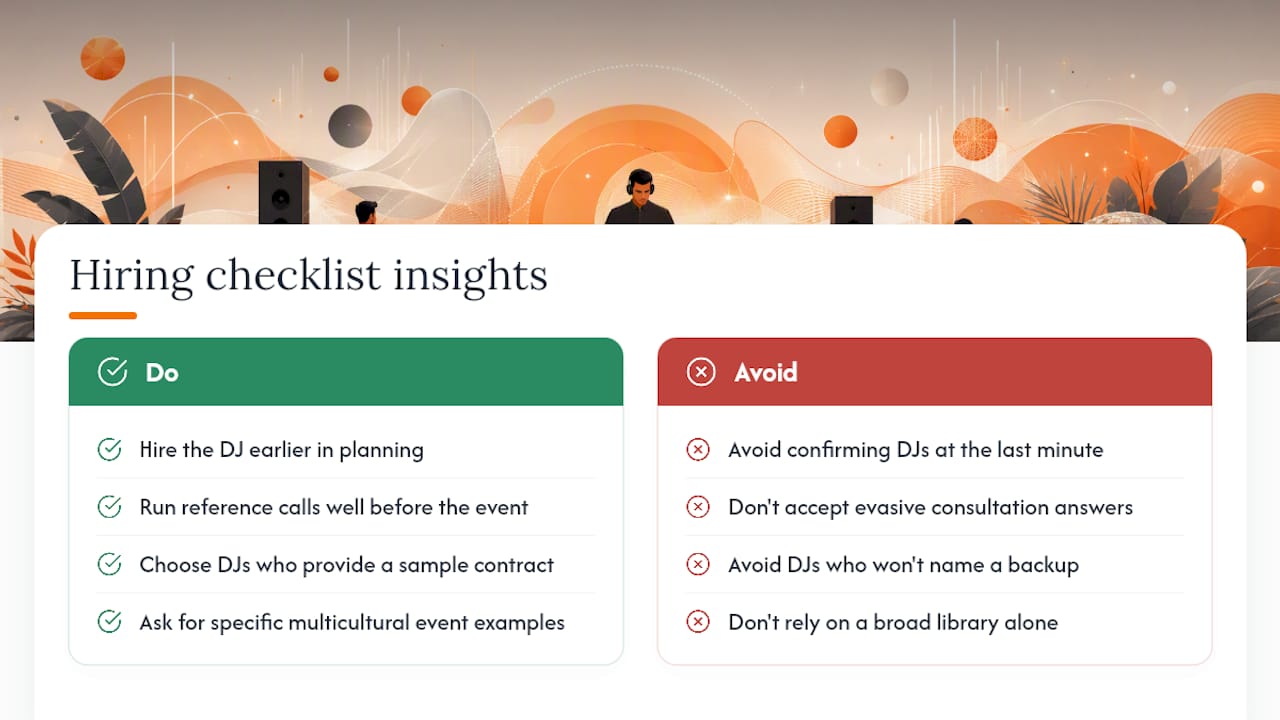
For multicultural events specifically, the vetting criteria extend further. Cultural competence in music programming — the ability to read a room that spans multiple generations, languages, and musical traditions — is a skill that requires deliberate cultivation, not just a broad library. Ask the DJ to describe how they have handled a bilingual or multicultural event, and listen for specificity.
Dj-phoenix already meets the standard
Dj-phoenix has performed for clients including Mercedes-Benz and FW Sports, bringing the same documented professionalism to weddings, corporate events, and private parties across Toronto, Montreal, and Ottawa. Every booking includes a written contract with cancellation and overtime terms, a Certificate of Insurance available on request, a named backup DJ policy, and a full equipment list with brand specifications.
The difference between Dj-phoenix and a generalist hire is the depth of preparation before the event begins: a structured consultation, a curated playlist built around your specific guest demographic, and the multicultural programming expertise to serve a room that spans languages and generations without a gap in energy.
View recent performances and judge the on-mic work and crowd response for yourself at the DJ performance gallery, or request a sample contract and checklist to begin your vetting process today.
Useful sources
- How to Choose a Wedding DJ: The Complete 2026 Guide | WeddingDJFinder
- What makes a good DJ? — Livent Group
- How to choose a DJ for an event — Martin’s Caterers
- DJ Will Gill | Hire Corporate DJ: 10 Questions You Must Ask Before Booking
- Questions to ask your DJ — The Knot
- Questions to ask your wedding DJ or band before booking — Brides
- How to choose a DJ for a private event — DJs of Charleston